
How we built a finishing and fit-out contractor website in Egypt from an empty domain and five phone reels, with real speed numbers and honest limits.
- شركة برمجيات مصرية منذ 2010
- دعم فني على واتساب
Read this case study in Arabic
In short: This is the story of a finishing company website we built for Wall Breakers, a finishing and fit-out contractor in 6th of October City, Egypt, starting from a domain that showed only “Index of /” and five low-resolution phone reels. The first version was not approved because we skipped the plan. The second one is live in Arabic and English, with dark and light themes, and this article shows what is on it, what we measured and what a contractor can copy.
Who Wall Breakers is, and what we found on day one
Wall Breakers Finishings and Fitout is a contracting company in 6th of October City, on the western edge of Greater Cairo. Its public profile says it was founded in 2011 and that it has delivered more than 500 residential units, 65 medical buildings and 25 administrative buildings. Those numbers are the company’s own claims. We did not audit them, and we repeat them here only as what the company says about itself.
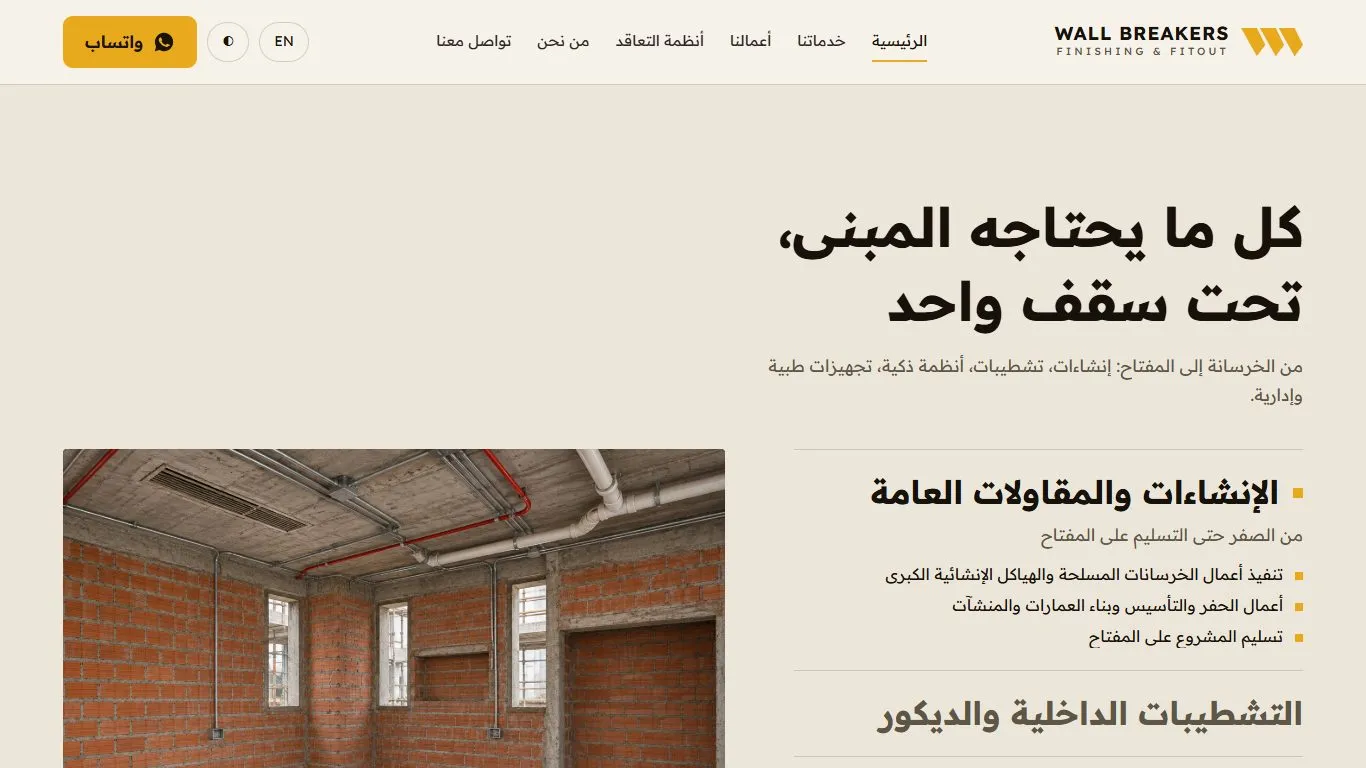
The work covers five areas: construction and general contracting, interior fit-out and finishes, smart and sound systems, medical facility fit-outs, and administrative and office fit-outs. In plain words, the company takes a space from bare concrete to a handed-over unit, and its own tagline says the same thing: “From raw space to refined living”.
When the project reached us, the domain wallbreakersegy.com opened to a bare server listing titled “Index of /”. Nothing else. No logo file, no pages, no text. The company had a Facebook page of about 500 followers, one post, and five phone-shot portrait reels showing before and after work. The reels were 478 by 850 pixels, burned-in “before” and “after” captions and a logo watermark included. There were no photographs or videos of its medical, office or smart-system work at all.
That is a normal starting point for a contractor. The work is done on site, the phone is the camera, and the proof lives in WhatsApp and Facebook. Our job was to turn that thin pile into a website that a homeowner, a clinic owner or an office manager could trust within a minute, and that Google could understand.
What the search results for finishing contractors look like
Before touching any design, we looked at how people in Egypt search for this service and who answers. We ran searches in Arabic and English by hand. We had no search volume data, so we do not quote any numbers and we chose words only by what real result pages and related questions show. The full notes are in the research file we keep with the project.
The Arabic searches that mattered were close to the way a client speaks: finishing company in 6th of October with turnkey delivery, apartment finishing prices, clinic fit-out, office finishing, and the difference between half finishing and turnkey. Three patterns appeared in the results.
- Price-per-metre pages and “best companies” lists dominate apartment searches. Many are written by the companies themselves. They compete on a number, usually a price per square metre.
- Clinic and medical searches are about licensing first. News sites and legal sites explain what the Ministry of Health asks for, and companies add a line saying they follow the ministry’s standards. One legal site notes that a 2023 ministry decision on private health facilities was cancelled and replaced by a 2024 decision. That is the reason we put no room-size or licensing rule on the Wall Breakers site. Rules change, and a contractor’s website should not be the place where they go stale.
- Office fit-out results are mostly company pages and directories that list partitions, ceilings, electrical work and networking.
Contract type is where we saw a gap. Egyptian pages explain “cost plus a supervision percentage”, “lump sum” and “bill of quantities” in general terms, and they often mention percentages. Very few contractors explain, on their own site, which of those they offer and what the client gets under each. Wall Breakers already works in three ways, so that became a page instead of a paragraph.
So the words we decided to carry across the site were: finishing company, turnkey finishing, fit-out contractor, clinic and medical fit-out, office finishing, 6th of October, and cost-plus, fixed cost and per-item supervision. Arabic first, since Arabic is the main audience, with a complete English version, not a stub.
The first version, and what we got wrong
We built a first version quickly. It had a hero video behind a brick wall that “broke” on load, expanding panels for each sector, and the five reels in a row. It worked technically. It was not approved.
The reason was our process, not a bug. We started building before we loaded the right design skills and before we wrote and showed a plan. We had a quick look at what we had built before for other clients, and we jumped into fonts and code. A plan would have caught two problems early: a low-resolution portrait reel does not belong as a full-bleed hero, and a pile of icon cards is the same page every contractor already has.
From that point we use one rule for every site: load the skills, write a short plan, show it, then build. It costs a few minutes at the start and saves a full round later.
The plan we wrote the second time
The plan fitted on one page. It named the idea, the real material, the generated material, the structure and the checks.
- Idea: one room, followed from bare concrete to handover, as a short film the visitor can scrub. That is the story the company tells in its own tagline, and it is the thing a client wants to see before choosing a contractor.
- Real material: the five client reels and stills taken from them, used at the size they can support, in portrait frames, with the burned-in captions cropped out.
- Generated material: illustrative renders for the hero stages and for sectors the client has no footage of. Each one carries a visible “Illustrative render” label, because they are AI-made and the client never built that exact room.
- Structure: six pages in Arabic at the root and the same six in English under /en/, so twelve addresses, linked to each other with language tags.
- Rules for every site we deliver: Arabic and English, dark and light, real scroll tests on phones, and nothing invented.
What we built: one room, four stages
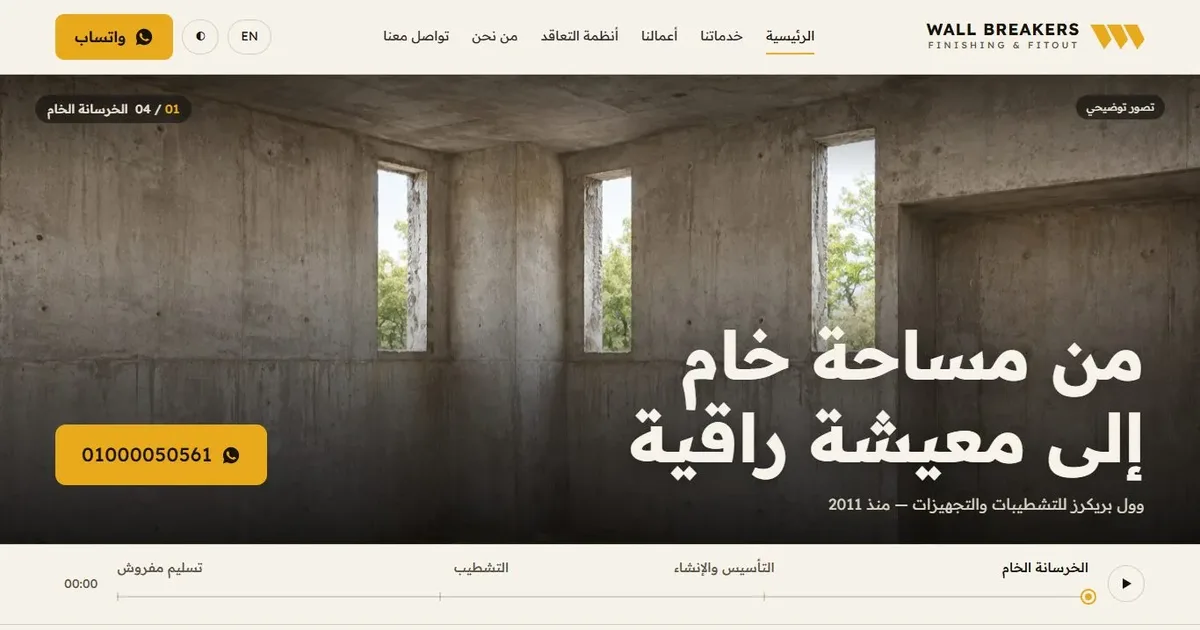
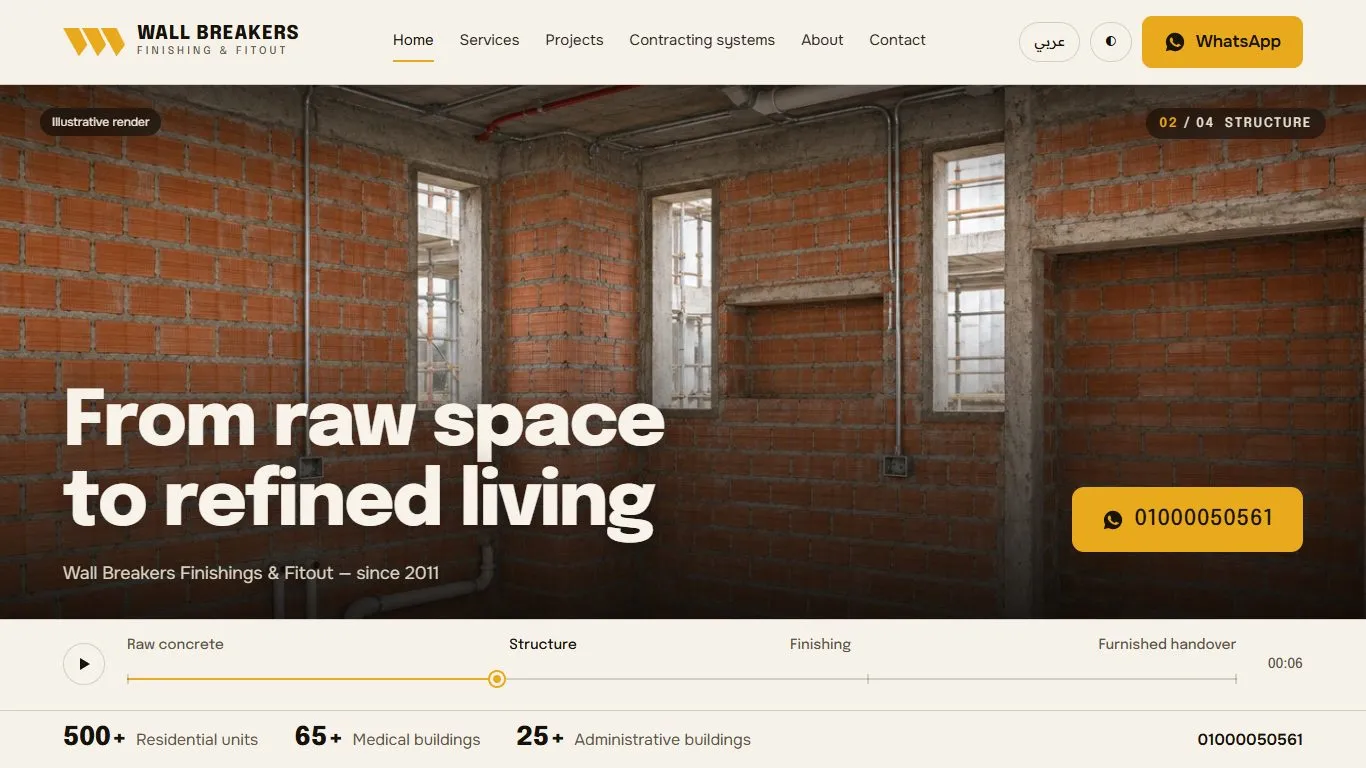
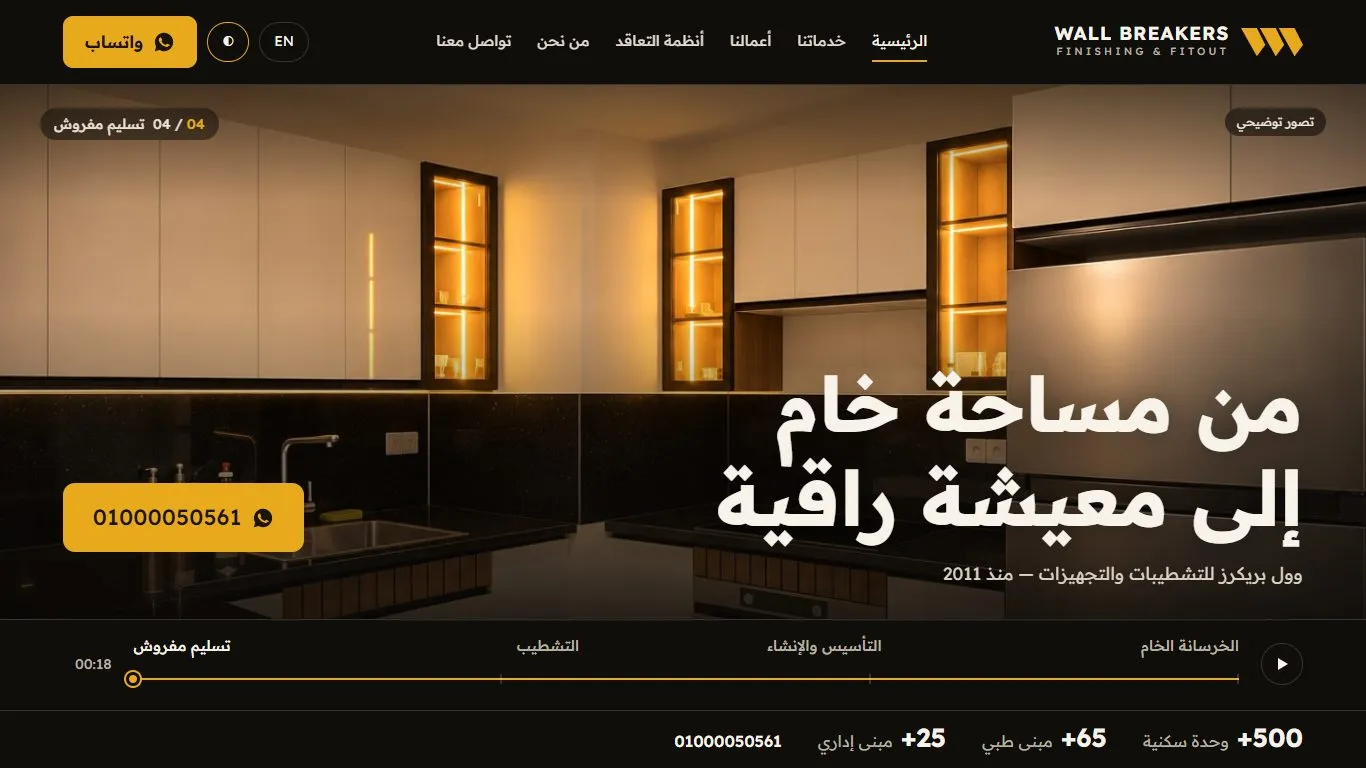
The home page opens on a single empty room. The headline reads “From raw space to refined living”. Under it sits a thin timeline with four stops: raw concrete, structure, finishing and furnished handover. A play button runs the whole sequence in about eighteen seconds. A visitor can also drag the timeline or tap a stop to jump. While it moves, a new image wipes across the previous one, so the room is rebuilt in front of you: concrete walls, then brick and pipework, then fitted cabinets, then the finished kitchen with lighting.
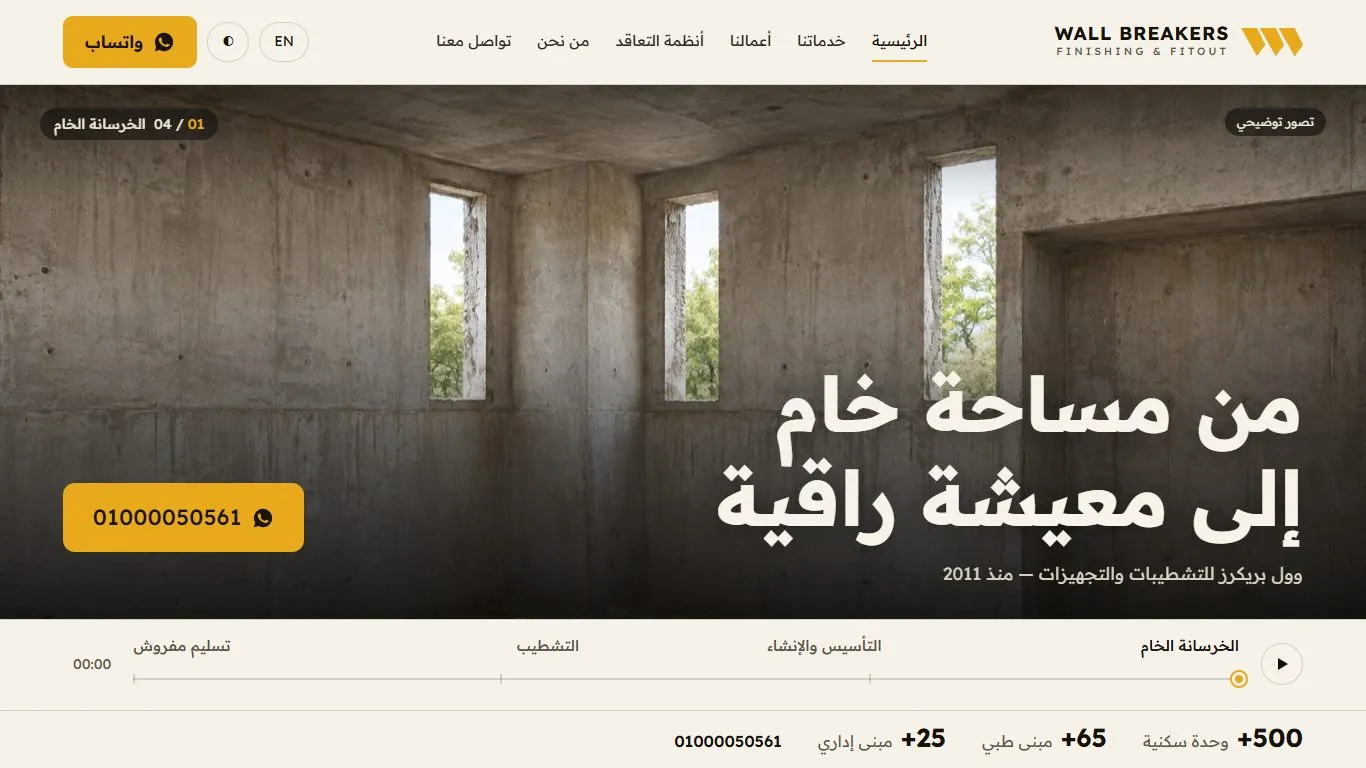
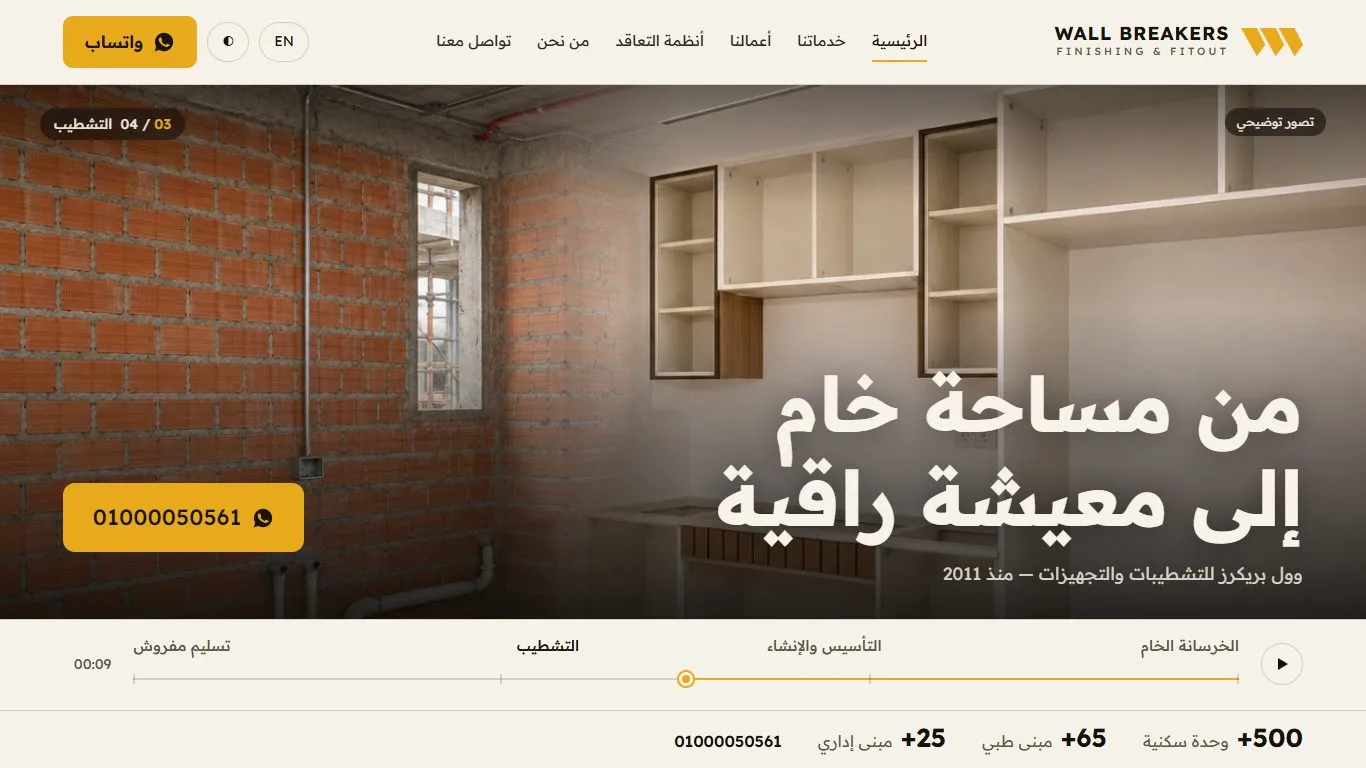
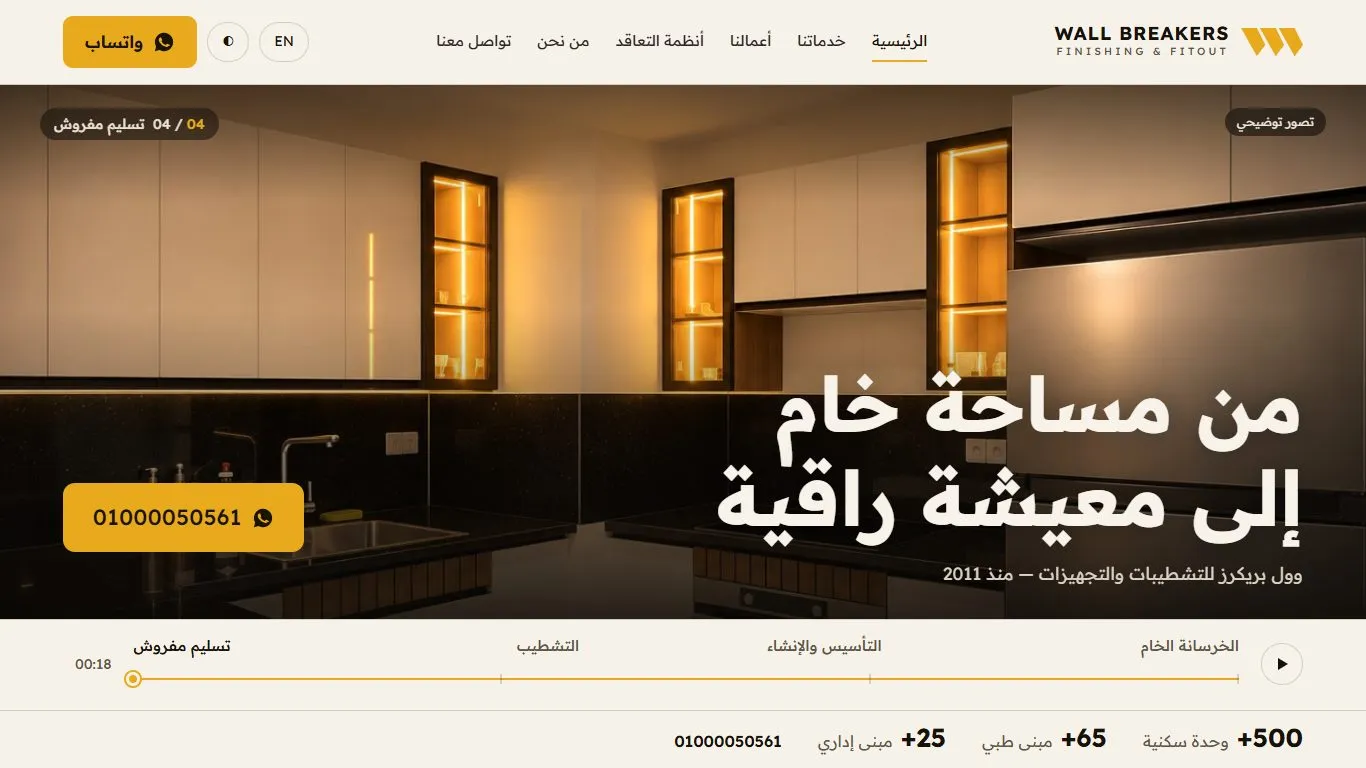
The four stage images come from a single master image of the room, so the camera and the walls stay put while the finish changes. They were generated, which is why the badge in the corner says “Illustrative render”. Under the hero, the three headline figures (500+ residential units, 65+ medical buildings, 25+ administrative buildings) appear next to the phone number. We show them because the company states them, and the page text attributes them to the company.
Two practical details matter for a contractor. First, if a visitor has reduced motion turned on in their device, the hero does not play. It shows the finished room and leaves the timeline for the visitor to use. Second, the WhatsApp button and the phone number stay one tap away on every screen, because that is where Egyptian clients actually contact a contractor.
Real work and generated images: how we kept them apart
This was the part we cared about most. A contractor’s website sells trust, so a generated image passed off as a finished project would damage exactly what the site is for. We set three rules.
- Anything generated carries the words “Illustrative render” on the image itself, in Arabic and in English.
- Real work appears only in the form the client gave us: the reels and stills cut from them. We did not upscale them to pretend they are sharper than they are.
- No project names, client names, prices or reviews appear anywhere, because the company did not give us any.
The sectors with no client footage (medical, administrative, smart systems, construction) use the labelled renders. The services page lists what the company says it does in each area, for example operation theatre fit-out, X-ray rooms, medical gases, nurse-call, glass partitions, CCTV and structured cabling, and then asks the visitor to message the company for specifics. It does not claim any particular finished clinic.
The stage tracker and the client’s own reels
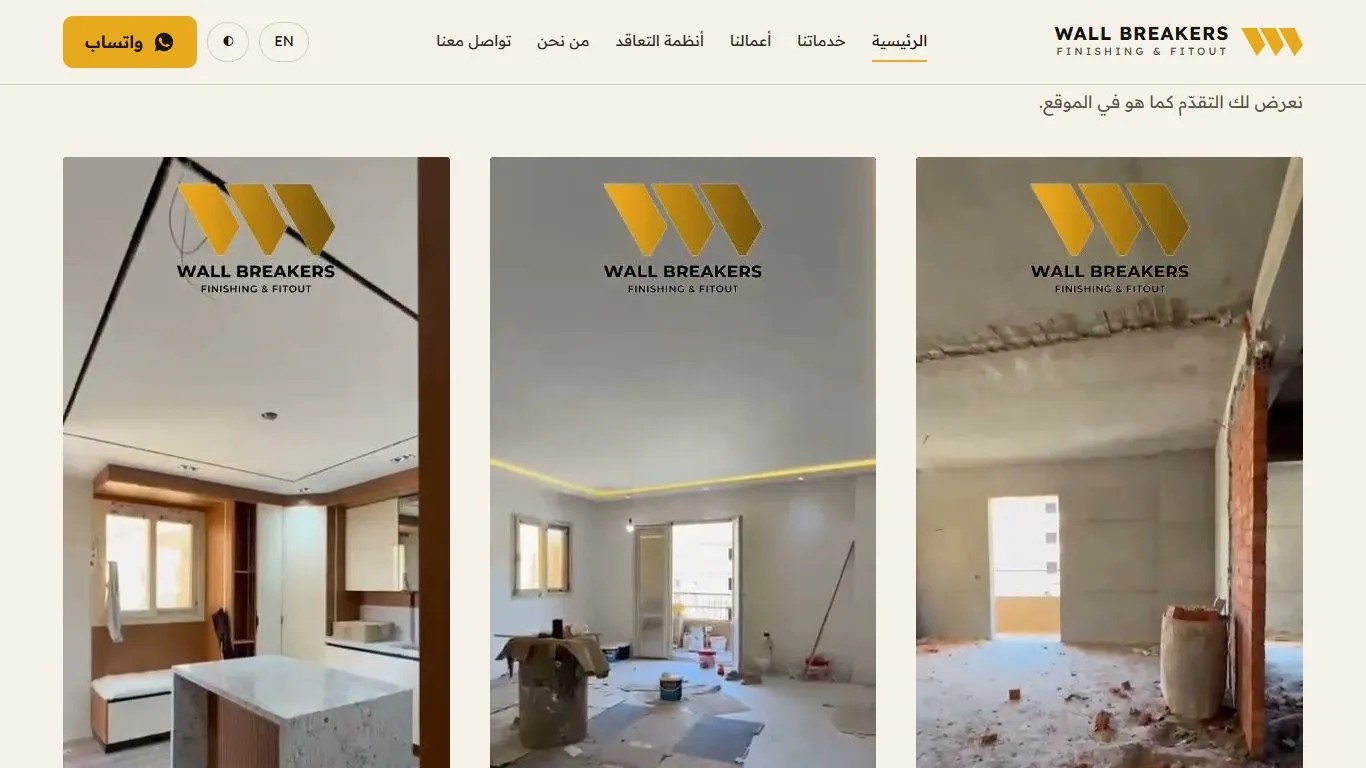
The five reels are the only proof the company had, so we gave them their own place. The first is a stage tracker: three portrait stills taken from one apartment video, labelled Stage 01 (0% finishing at handover), Stage 02 (70% complete) and Handover (100% complete). The percentages come from the client’s reel, not from us. The point of the row is to show progress the way it looks on site: dust, paint tins and a half-lit ceiling, then the finished room.
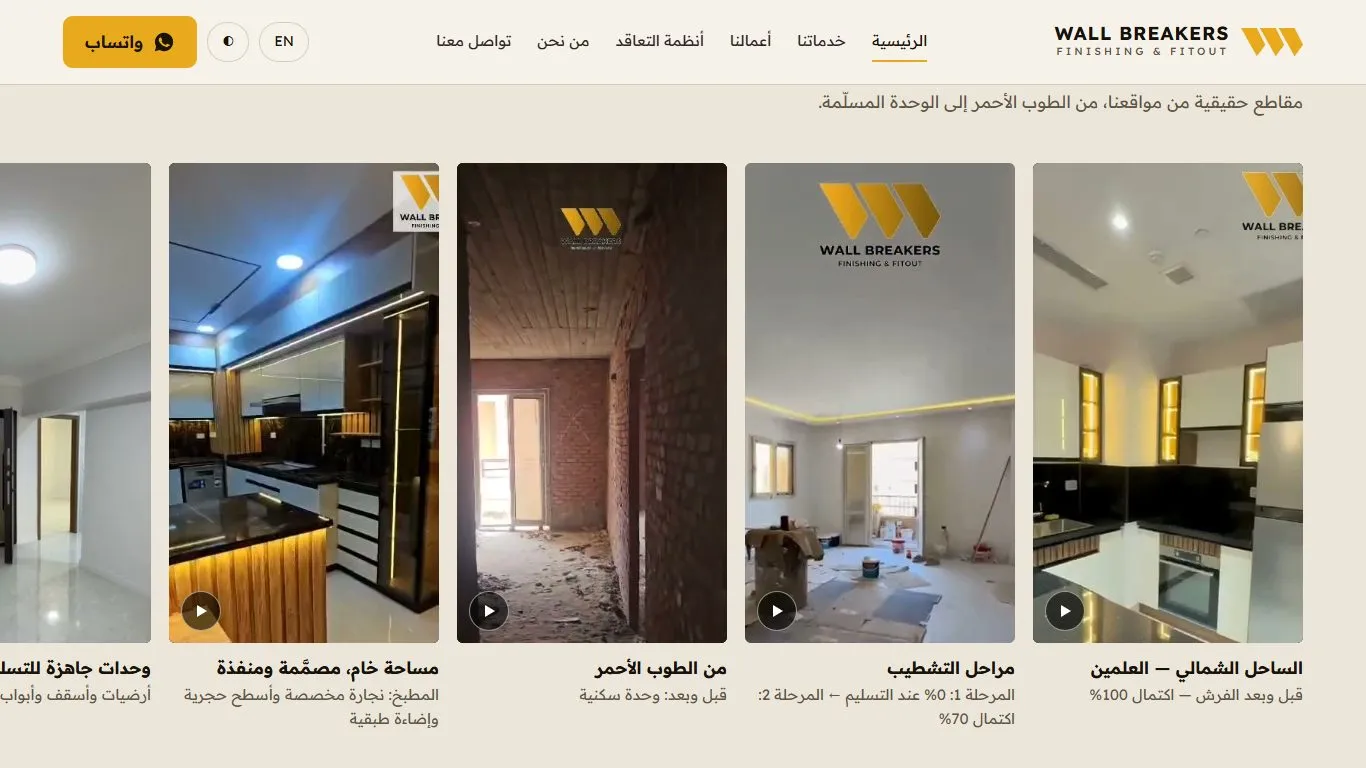
Below it is a horizontal row of the five reels: a North Coast furnishing before and after, the finishing stages, a red-brick unit before and after, a raw space turned into a kitchen with custom joinery and stone surfaces, and handover-ready units with floors, ceilings and doors. Each reel plays on tap. The video file is requested only when someone taps it, so the page does not carry five videos for visitors who never press play. We checked this in our measurements: no video file was requested on a normal first load.
Explaining the three contracting systems
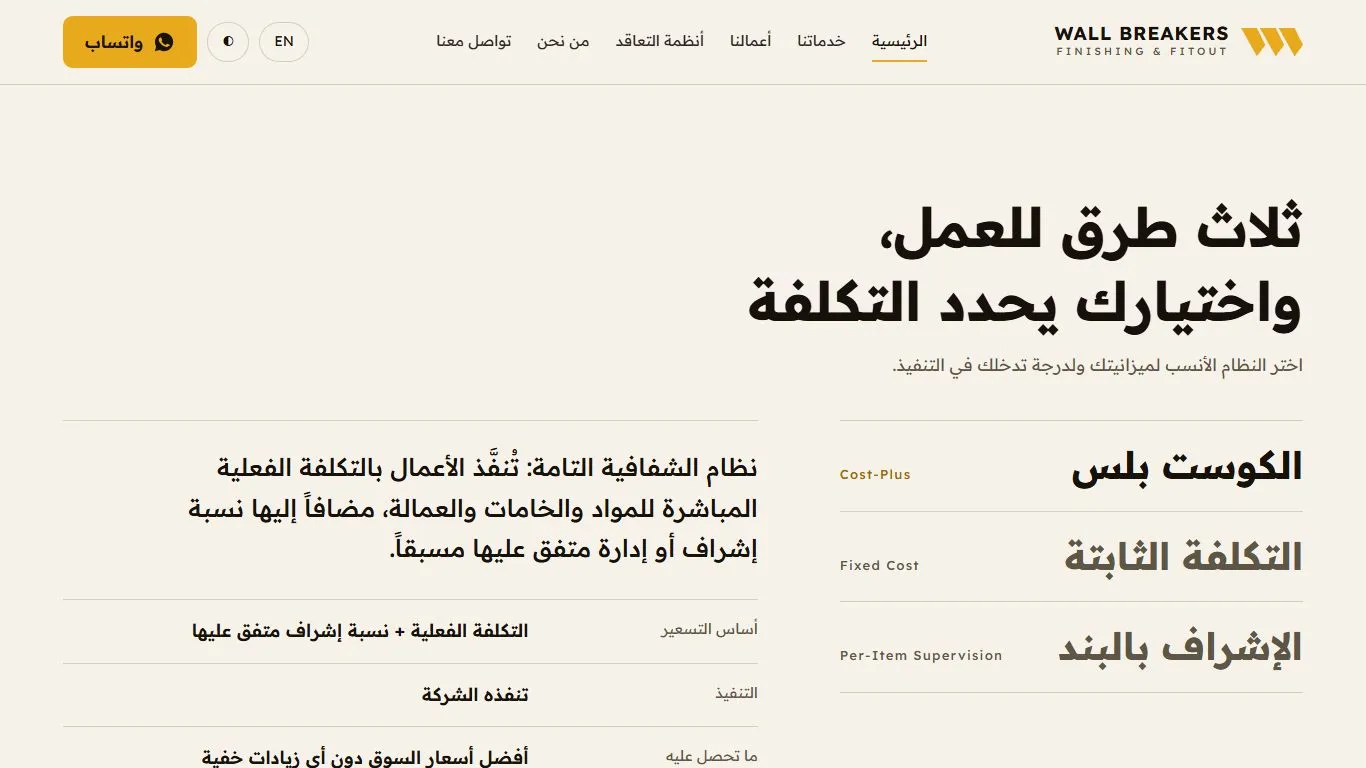
Clients compare contractors on price, but price depends on how the contract is written. Wall Breakers works in three ways, and its own text describes them like this.
| System | How cost is set (client’s description) | Who executes |
|---|---|---|
| Cost-Plus | Actual direct cost of materials, supplies and labour, plus an agreed supervision or management percentage | The company |
| Fixed Cost | A fixed bill of quantities and total cost, agreed from the drawings and final finishing specifications | The company |
| Per-Item Supervision | The client manages and executes the works, with the company supervising each item | The client |
We put these in a tabbed block with the system name large and the three lines underneath. We published no prices and no percentage, because the company did not give us one and any number we guessed would become a promise. General guides we read describe the trade-off in similar terms: with a lump sum, the contractor carries price risk and the owner needs complete drawings; with cost-plus, the owner sees real invoices and carries price movement. A contractor who explains this on a page answers the question clients ask first.
Dark and light themes that cover every surface
Every site we deliver has a dark and a light theme, remembered between visits. On this one we made a mistake worth admitting. In the first pass the header and the hero stayed dark while the rest of the page turned light, so the toggle looked broken. The fix was a stylesheet loaded last that sets every surface from the same theme values, so the header, hero, menu, tracker, forms and footer all change together.
On a phone
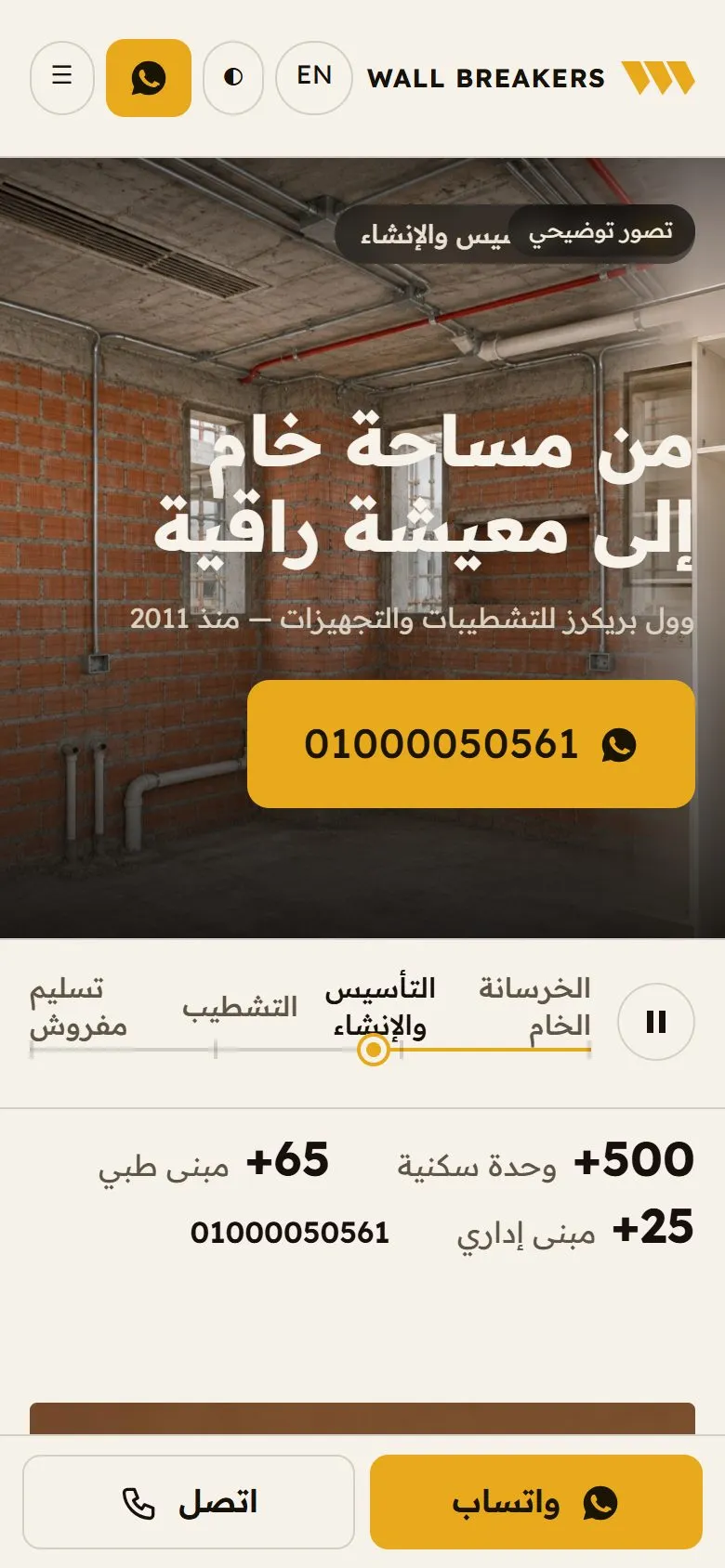
Most visitors from a WhatsApp or Facebook link arrive on a phone, so we tested real scrolling at several phone widths and not only a resized desktop window. On a 390 pixel screen the hero stacks, the call and WhatsApp buttons sit in a bar at the bottom, and the stage tracker becomes three narrow columns. We found no sideways scroll at the width we measured.
How we checked it before it went live
Before we called the second version finished, we went through it as a visitor would. We opened all twelve pages and their images, scripts and videos on the live domain and confirmed each one answered normally. We added a proper error page for addresses that do not exist, so a mistyped link does not end on a blank server message. We looked at both languages in both themes, at desktop and phone widths, with real scrolling, and we watched the browser console for errors. There were none, and there was no sideways scroll. None of this is exciting to read. It is the part clients never see, and it is what separates a site that looks right in a screenshot from one that works when a stranger opens it from WhatsApp.
What we measured
On 14 November 2026 we loaded the Arabic home page five times in a headless Chromium browser set to a 390 by 844 phone screen at double pixel density. We recorded three of these runs in full. There was no network or CPU throttling, we used a single computer and one connection, and we did not run Lighthouse. The values are lab numbers from our own machine, not field data from real visitors, and a real phone on mobile data will be slower.
| Measure | Result |
|---|---|
| Time to first byte | 473 ms, 765 ms and 912 ms in three runs |
| Largest Contentful Paint | 1.5 s, 2.4 s and 3.2 s in the same runs (the element was the hero image) |
| Cumulative Layout Shift | 0.002 in four of five runs, and 0.31 in one run |
| Requests on first load | 16 |
| Transferred on first load | about 1.59 MB (images about 1.05 MB, linked resources such as fonts about 0.33 MB, CSS about 55 KB, script about 2 KB) |
| Console errors | 0 in every run |
| Horizontal overflow at 390 px | none |
Reading these honestly: the page is light for a site built around imagery, and the hero image is what the browser reports as the largest element. The 0.31 layout shift in one run is a problem. In the small shifts of the other runs the elements that moved were pieces of text changing width, which fits a web font replacing its fallback. We have not isolated the cause of the large one, and the result varies from run to run. A real fix is to give the fallback font matching metrics so text does not move when the real font arrives. That is on our list for this site, and we would rather show it than hide it.
What is live now
These are the facts we can verify today, from the public site:
- The site is live on the company’s own domain, wallbreakersegy.com, in Arabic at the root and in English under /en/.
- There are six pages per language: home, services, projects, contracting systems, about and contact, so twelve addresses.
- A sitemap and a robots file respond with a normal status, and the sitemap pairs each Arabic page with its English twin.
- The enquiry form builds a ready WhatsApp message, so the lead arrives where the company already works.
- The contact details shown are the ones the company gave us, with two phone numbers and an email.
We are not reporting rankings, traffic or enquiries. The site is days old, and we will not invent results for it.
What is still missing
A finishing website is only as strong as the proof it can show, and here the proof is thin. We still need a high-resolution version of the logo, and real photographs or video of the medical, office and smart-system work, so the illustrative renders can be replaced one by one. Project names, with the client’s permission, would help more than any design change. The portfolio and promo video work is a separate step that follows once the company has reviewed the site.
Lessons for finishing and fit-out contractors
- Show the process, not the finished room only. Clients cannot judge a ceiling from a photo. They can judge whether you will walk them from raw concrete to keys.
- Write the contract options on the site. “Cost plus”, “fixed cost” and “supervision only” are search terms and also the first questions a client asks.
- Do not put a low-resolution portrait video full width. Frame it as what it is. A small honest frame beats a big blurry one.
- Label anything generated. One visible badge costs nothing and protects the claims you can prove.
- Treat licensing rules as moving. For clinics, link to the authority or ask the client to check, instead of quoting a rule that may change.
- Make contact one tap. WhatsApp and call buttons on every screen.
- Measure more than once. One run told us the layout was stable. Two more runs showed it was not always.
FAQ
How long does a finishing company website take?
It depends on how much real material the company has. For Wall Breakers, the slow part was not code. It was working out how to present five low-resolution reels honestly. Ask for a plan and a page list before work starts, and for the real photos you already have.
Can a finishing company website use AI-generated images?
It can, if they are labelled and never presented as completed projects. We used them for the hero stages and for sectors where the client had no footage, each marked “Illustrative render”. Real work stays real and is shown at the quality the client supplied.
What should a turnkey finishing website show?
The path from raw space to handover, the services you actually perform, how you price the work, how to contact you in one tap, and real before and after proof. Prices are optional, but how a price is set should be clear.
Should a contractor publish prices?
Many Egyptian pages compete on a price per metre. Wall Breakers has not given us prices, so the site explains its three pricing systems and invites a message instead. Publish a number only if you are ready to honour it, and say what it includes.
What is the difference between cost-plus, fixed cost and per-item supervision?
Under the company’s description, cost-plus means actual cost plus an agreed supervision percentage, fixed cost means a total agreed from drawings and specifications, and per-item supervision means the client executes while the company supervises. Each moves the price risk differently, so read the contract wording before signing.
Do medical fit-out pages need licensing details?
Clinic searches are driven by licensing, but the rules change, and one legal source notes a 2023 decision was replaced in 2024. We listed what the company says it does for medical work and kept rule details off the site. Check the current ministry rules before designing a clinic.
Why does the site have both Arabic and English?
Arabic is the main audience, but English serves developers, expatriates and international suppliers. Both are complete pages, and each Arabic page is linked to its English twin.
Is a dark theme useful for a contractor site?
For a contractor it is a courtesy, since many clients read on phones at night. The condition is that every surface follows the toggle. A half-dark page looks like a bug.
Talk to us about your own contractor website
If you run a finishing, fit-out or contracting company and want a website built from the real material you have, message us on WhatsApp. You can see our web development service, our contracting company website page, and our portfolio. The Wall Breakers site is at wallbreakersegy.com.
خدمات مرتبطة
- تصميم مواقع الشركات في مصر
- إنشاء متجر إلكتروني
- برمجة مواقع وأنظمة خاصة
- ايميل رسمي للشركات
- أتمتة واتساب للشركات
- نظام شركات السياحة