
How we built a fire protection company website for linkffs in Cairo: real photos, a proof wall, a bilingual dashboard with PDF proposals, and our mistakes.
- شركة برمجيات مصرية منذ 2010
- دعم فني على واتساب
Read this case study in Arabic
In short: Link for Fire System (linkffs) is a Cairo fire-fighting contractor that came to us with a PDF of certificates, a handful of phone photos and a Facebook page. This is the story of its fire protection company website: three concepts, one honest “no” from our own owner, a switch from 3D to real photographs, and an admin dashboard that lets the client add products, brands, projects and priced proposals without calling us. We tell the parts that went wrong too.
Who the client is, and what he brought
Link for Fire System, written لينك لأنظمة الحريق in Arabic and “linkffs” in its domain, designs, supplies, installs and maintains fire-fighting and fire alarm systems from an office in Cairo. Its own site states that it is a contractor registered with the Civil Protection authority, working since 2021. The material we received was a pile of paper rather than a brand: one PDF of eleven pages holding certificates, a commercial register, a tax card, an e-invoicing certificate, a trade-body membership card and three reference letters, plus a WhatsApp folder with four usable photos of one fire pump skid and several tiny thumbnails.
The client also had a Facebook page with about a thousand followers. We read it logged out, from a throwaway browser, and kept what was public: the logo colours (a blue gear and orange lettering on charcoal), the address, the phone number, the line about “design, installation, supply and maintenance of all fire-fighting systems” and a few dozen photographs of real work.
Two things in that PDF shaped the project from the first day. The commercial register and the tax card carry the owner’s personal identity and tax numbers, so we decided at once that no scan of them would go on the site. And one reference letter from the Civil Protection directorate in Qena lists twenty-five delivered projects. That list was the strongest proof the company had, and it was addressed “to whom it may concern”, which is what made it publishable.
What the brief really asked for
The brief had four parts. A public site in Arabic and English. An admin dashboard, also bilingual, where the client could add blog posts and products. A WhatsApp button on every product (“ask about the price” with a prefilled message). And a proposals section: type a customer name, pick products from the catalogue, let the price fill in but stay editable per proposal, save, and download a PDF carrying the logo, the address and the phone number.
That last part is what makes this case different from the other sites we describe on this blog. Most of them are a design problem. This one was a design problem and a small piece of business software at the same time, and the software had to survive the client’s own hands.
What we learned about the field before designing
We searched in English and in Arabic for what a buyer of fire protection services meets. The English results are dominated by agencies that sell marketing to fire protection firms, and they agree on a short list: a page per service instead of one page with fifteen bullets, a phone number or call-to-action visible without scrolling, credentials near the top, a mobile layout because property managers search from their phones, and local pages. The Arabic results for a fire-fighting company in Egypt are a mix of directory listings and company sites that list alarm, sprinkler and extinguisher work in long plain pages, usually with a phone number and a line about Civil Protection requirements.
We cannot say how many people search for any of these phrases. The tools we had give no search volumes, and we will not invent them. What we can say is what the pages look like, and the gap was clear: almost nobody shows the one thing that decides the purchase, which is what the system does in the first minutes of a fire. Everyone lists equipment. Nobody tells the sequence.
Attempt one: a concept we invented, and the owner said no
Our first prototype was a static page built around a riser diagram, with the sections arranged like pipework. It looked tidy and we were pleased with it. The owner of PRMAGLY rejected it with one sentence: he had told us to follow the rules in our own web design notes, and we had not.
He was right, and the reason is worth passing on to anyone hiring a studio. Our notes say that when the concept for a field is open, you ask, and that contractors should start from proof: past projects, certificates, a wall of evidence. We had skipped the question and invented a concept outside the catalogue we ourselves had researched. We had also picked fonts outside the shortlist, and we had tested the layout at only two screen widths, where our rule is five. We voided that prototype in our own records and started again.
Attempt two and three: proof first, then the first ninety seconds
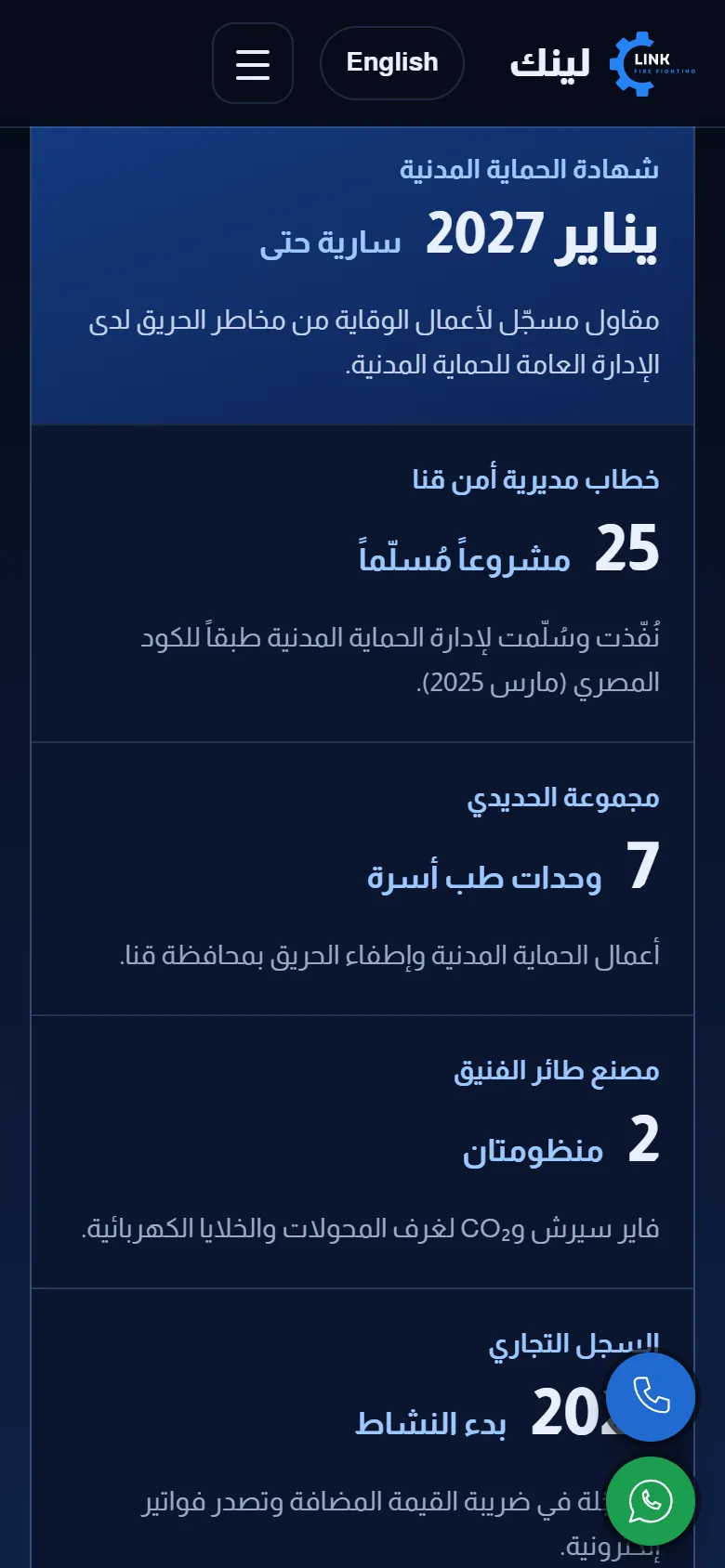
The second version put a proof wall first: the Civil Protection certificate and its validity date, the twenty-five Qena projects, the seven family-medicine units for one group, the two systems at a steel mill, and the year the company began. The owner picked that structure from the catalogue and then added a request: he wanted it in 3D.
We built a small 3D pump skid and the owner still rejected it as too modest. The third version, which went much further, was a cinematic scroll called “the first ninety seconds”. A night scene of a building, scroll-driven, with a clock in the corner running from 00:00 to 01:30. A fault starts the fire, a detector raises the alarm, the heat opens only the sprinkler above the flames, pressure drops, the diesel pump starts by itself, and the pressure recovers. A gas system handles the server room. We wrote that sequence as a chain of causes, because that is what a fire protection system is: one thing triggers the next.
The owner liked the idea and sent two notes. The fire should look real, or show how it started and how the system controls it realistically. And the Arabic font was wrong. We rendered a specimen of sixteen Arabic typefaces side by side, picked Almarai, and replaced the previous pair. For the fire we wrote noise-shader flames, embers and a smoke layer, and the story became eight stages instead of seven.
The client’s message that changed the page
While we were polishing the 3D scene, the client sent us a list of agencies and brands he works with. Twelve at first, then nine more fire-fighting names and nineteen fire alarm names, with the request to search for their logos and show them as running partners on the site.
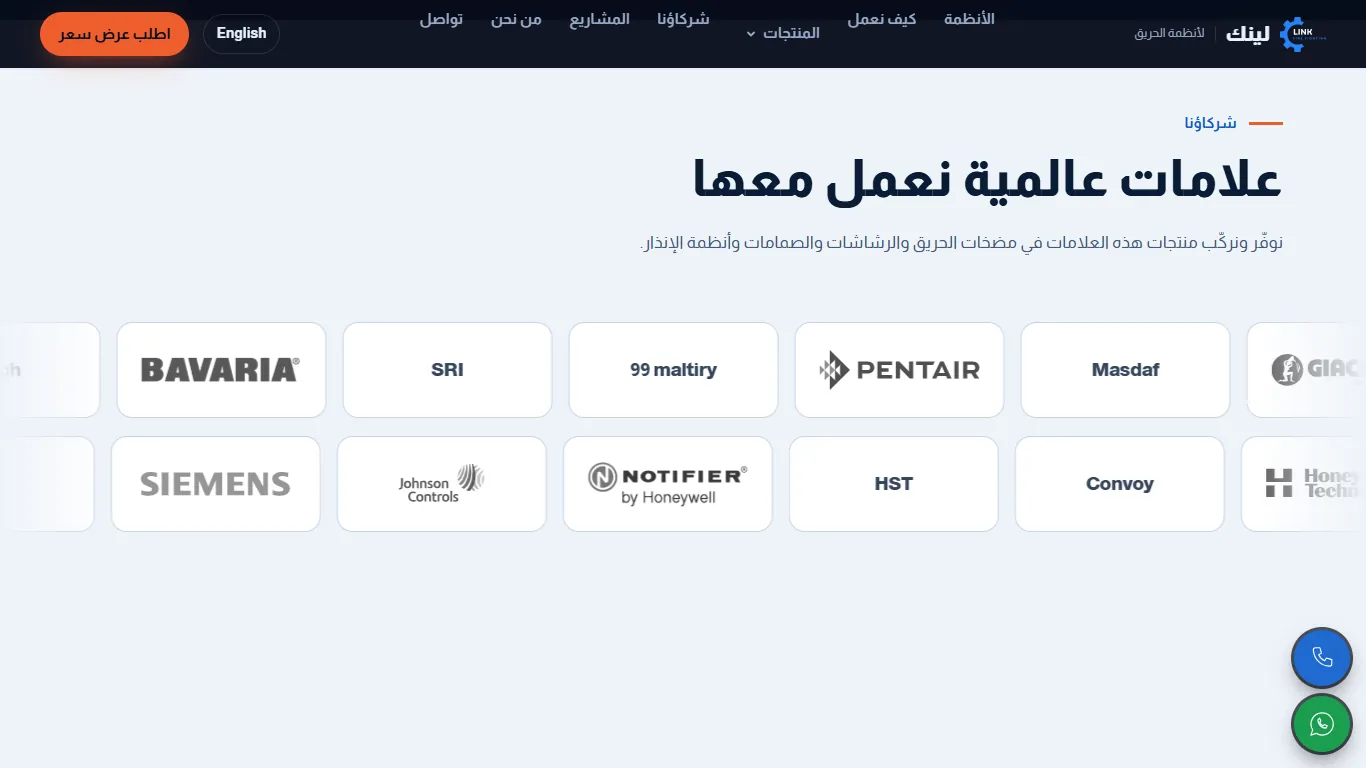
We found real logos for twenty-one of them on official sites and open sources. For the rest we made plain text tiles with the name, because inventing a logo is worse than showing none. We also told the owner what we still tell every client in this situation: showing a trademark is not the same as being an authorised agent, and the client should keep his authorisation letters ready before the site says “authorised”. The brand pages on the site are deliberately plain for now: a name and a WhatsApp button until the client supplies descriptions and product lists. That list of partners now stands at thirty-nine brands, each with its own page in both languages.
Attempt four: real photographs replace the 3D
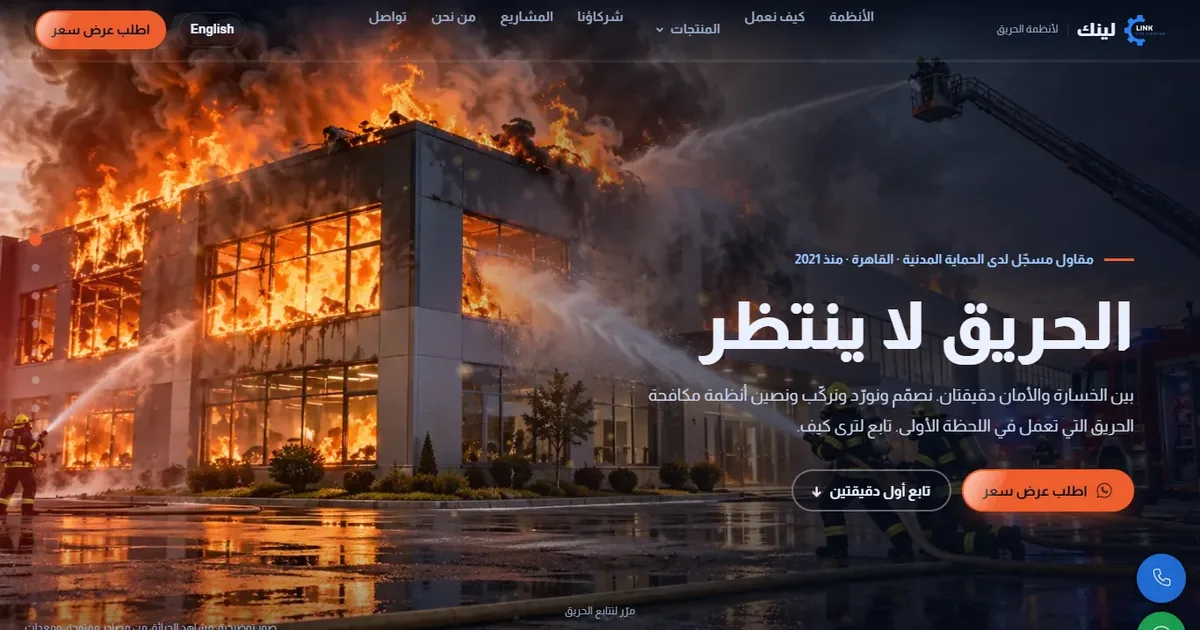
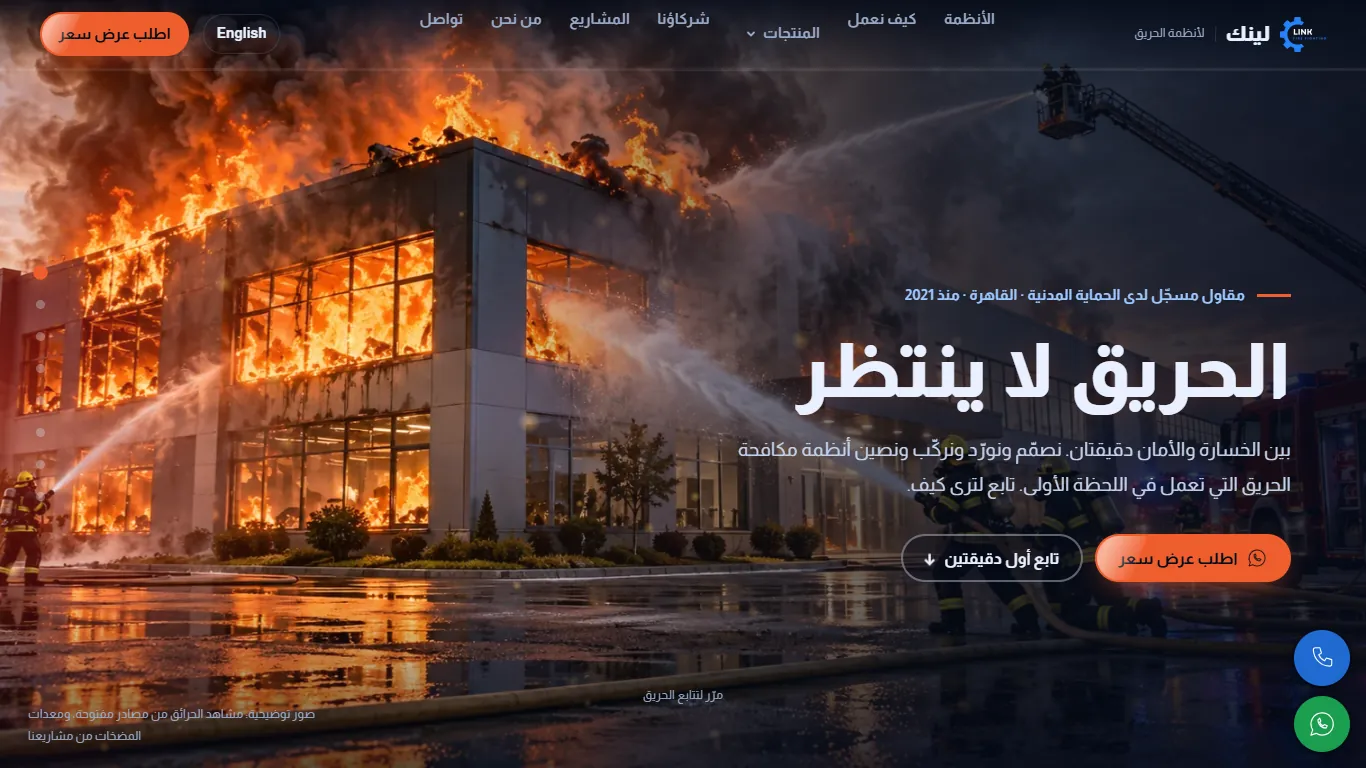
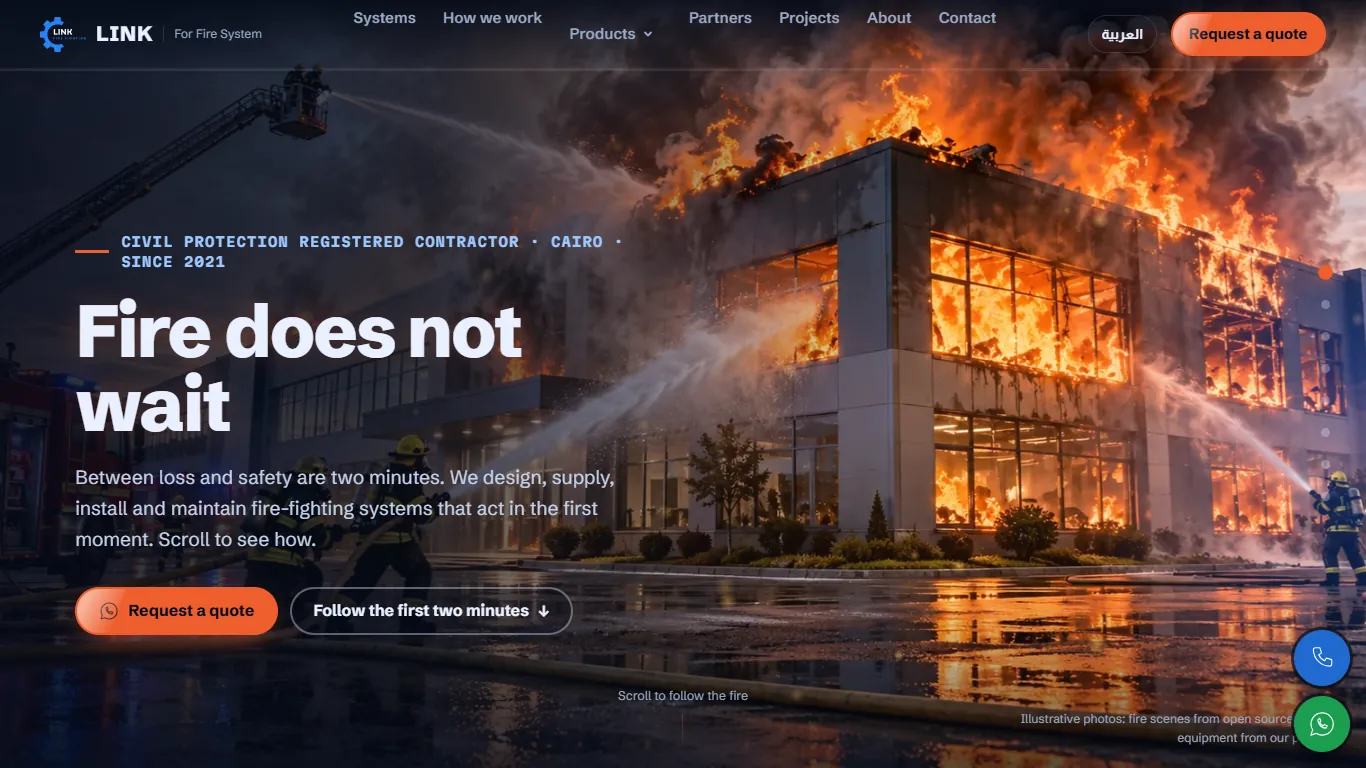
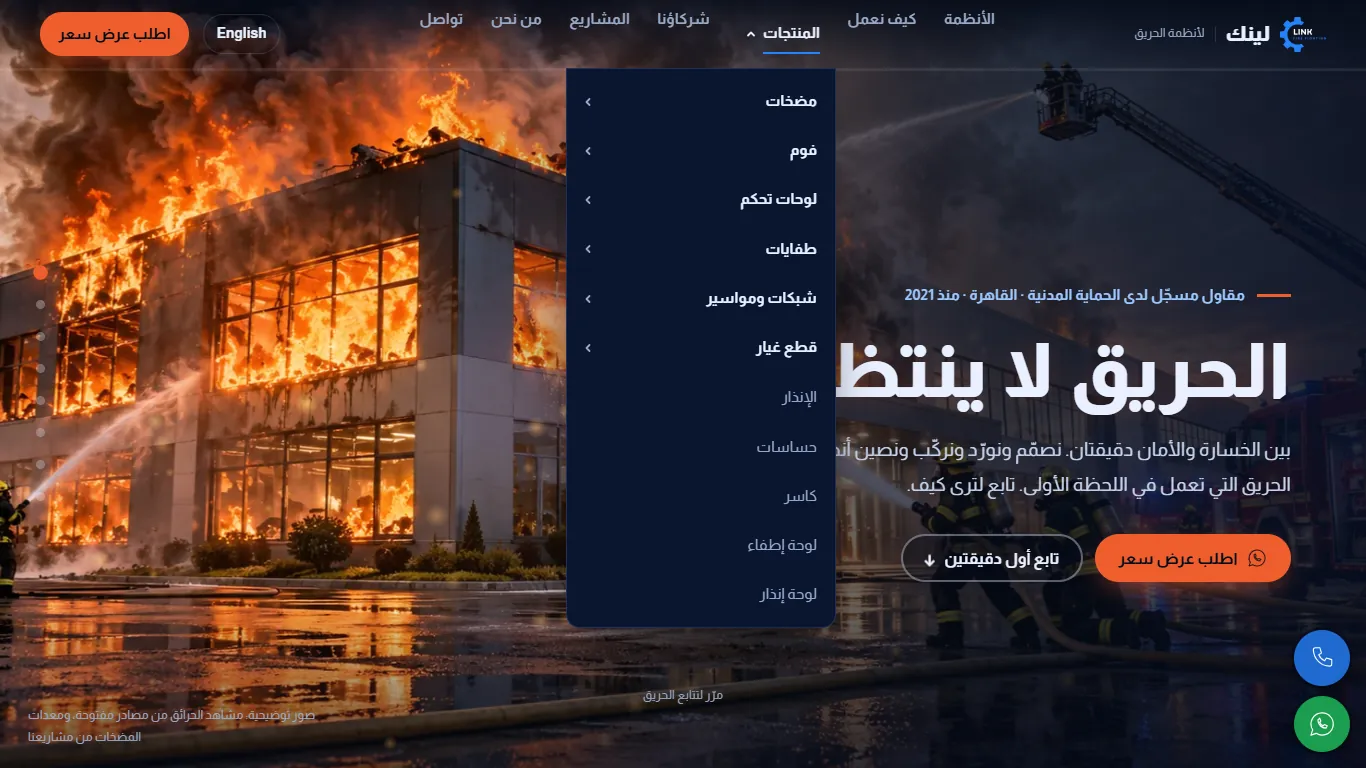
The next message from the owner was short: change this to real images, a real building, real fire, real pumps. He sent his own picture of a burning building with firefighters. We removed the 3D scene from the build and kept it only as a backup file.
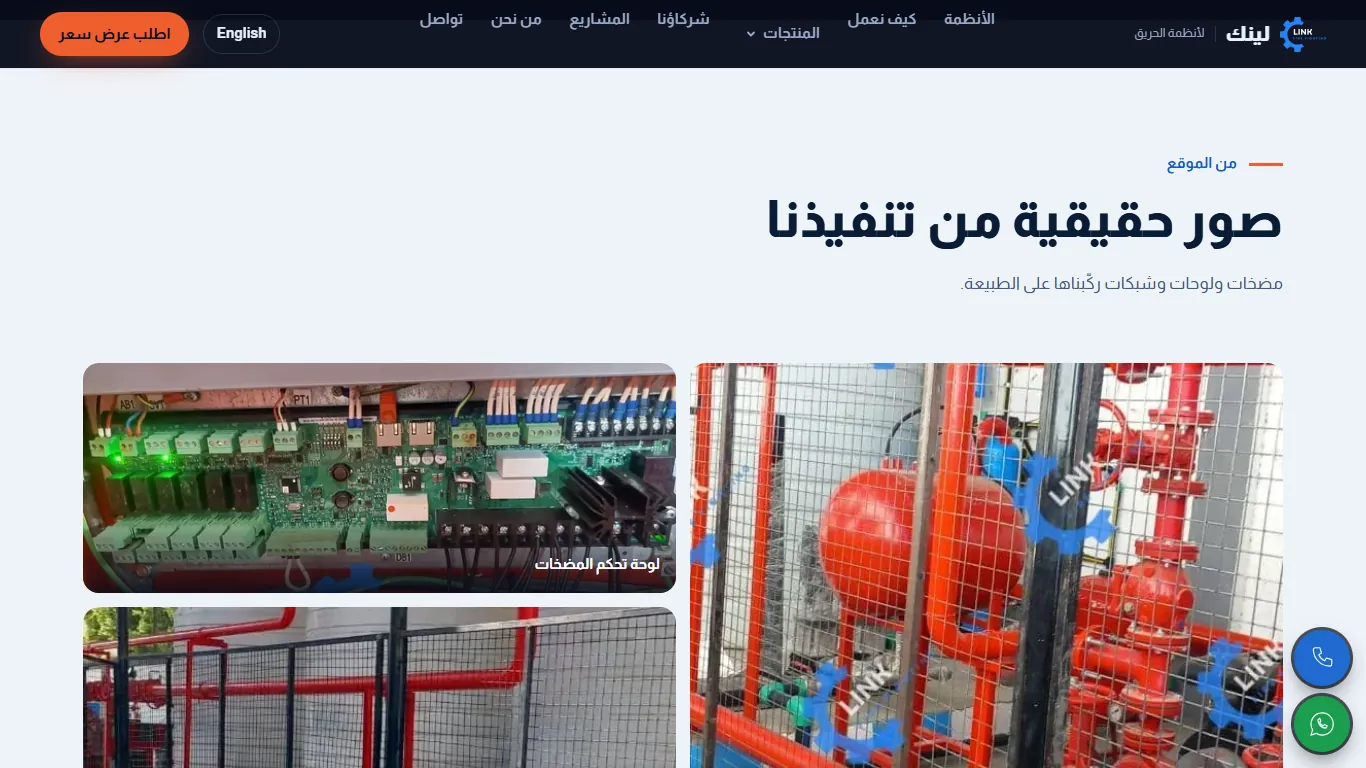
The new story is a set of photo layers that cross-fade as you scroll: the hero image the owner supplied, public-domain and open-licence photographs for the fire and the firefighters, and the client’s own photographs of pumps, risers, tanks and panels for the system itself. The home page labels the stock and generated pictures as illustrative. The client’s own photographs carry the proof.
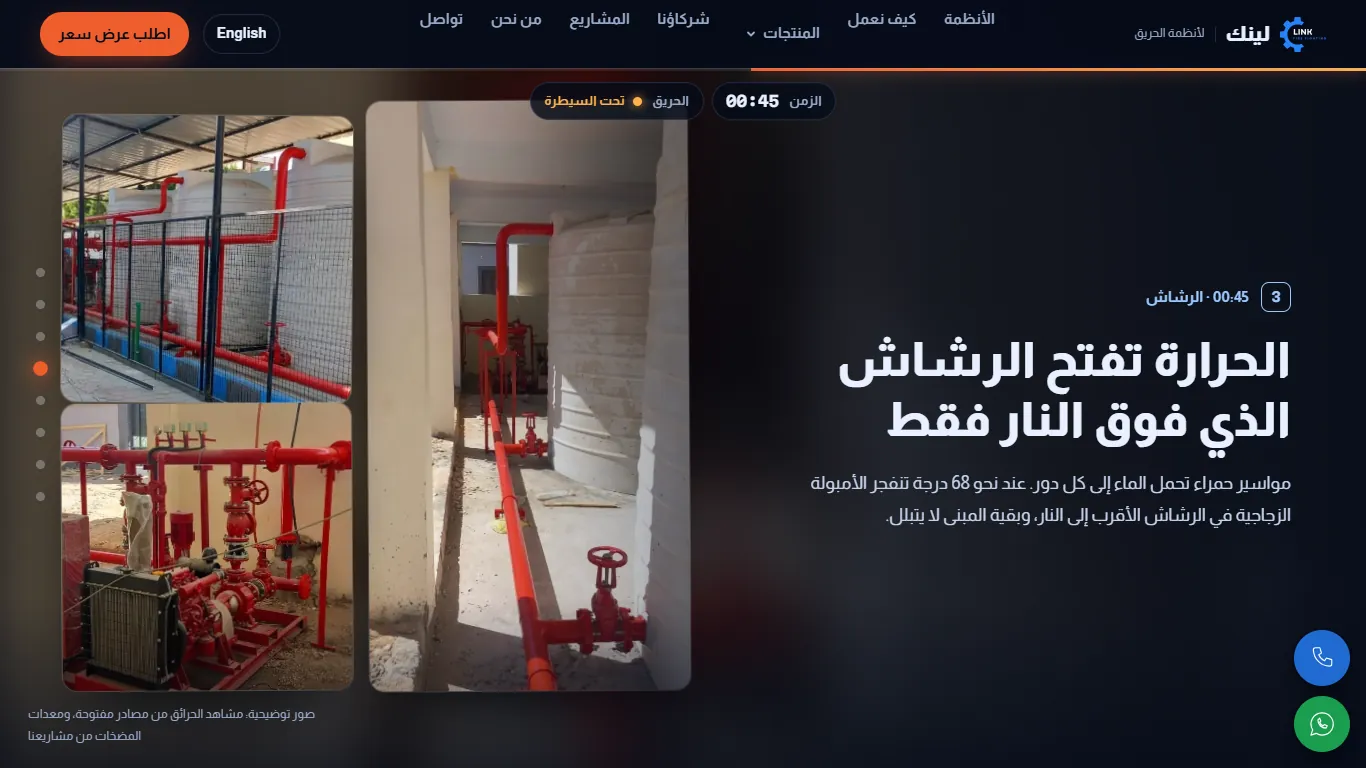
As you scroll, each stage explains one step of what the system does, in plain words. This is the sprinkler stage: pipes carry water to every floor, and at about 68 degrees the glass bulb of the sprinkler nearest the fire bursts while the rest of the building stays dry. The photographs on this stage are the client’s own installation work.
Proof, projects and partners
Under the story sits the proof wall. It states the Civil Protection certificate validity (January 2027, as printed on the client’s certificate), the twenty-five projects in the Qena letter, seven family-medicine units for one group, two systems at a steel mill, and the date the commercial activity began. Every figure comes from a document the client gave us. We show the numbers and describe the documents; we do not publish the scans.
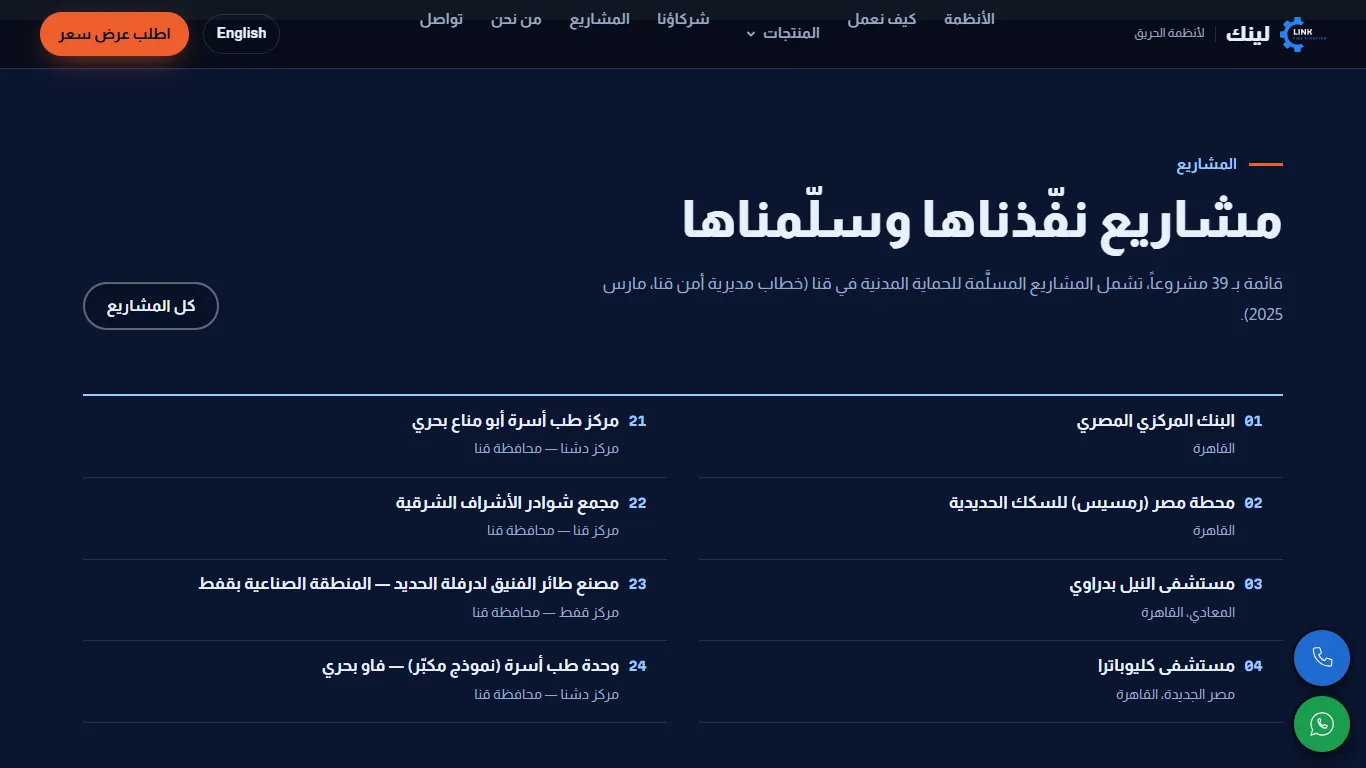
The project list started with the twenty-five Qena entries. Later the client sent a Word file with a table of seventeen rows (year, scope, place, owner) and a set of equipment photos. We imported sixteen into the project list and kept two sensitive facilities hidden, pending a decision by the owner and the client, because we did not want to publish them without being sure. We also did not use government emblems or ministry seals from that document. The live list now states “39 projects”.
The part nobody sees: the dashboard
The site is the shop window. The dashboard is where the client works. We built the application in Laravel, with the public pages in Arabic at the root and in English under /en, and the admin area at /admin with an Arabic and English switch. What the client can do there is the real answer to “why not just a template”.
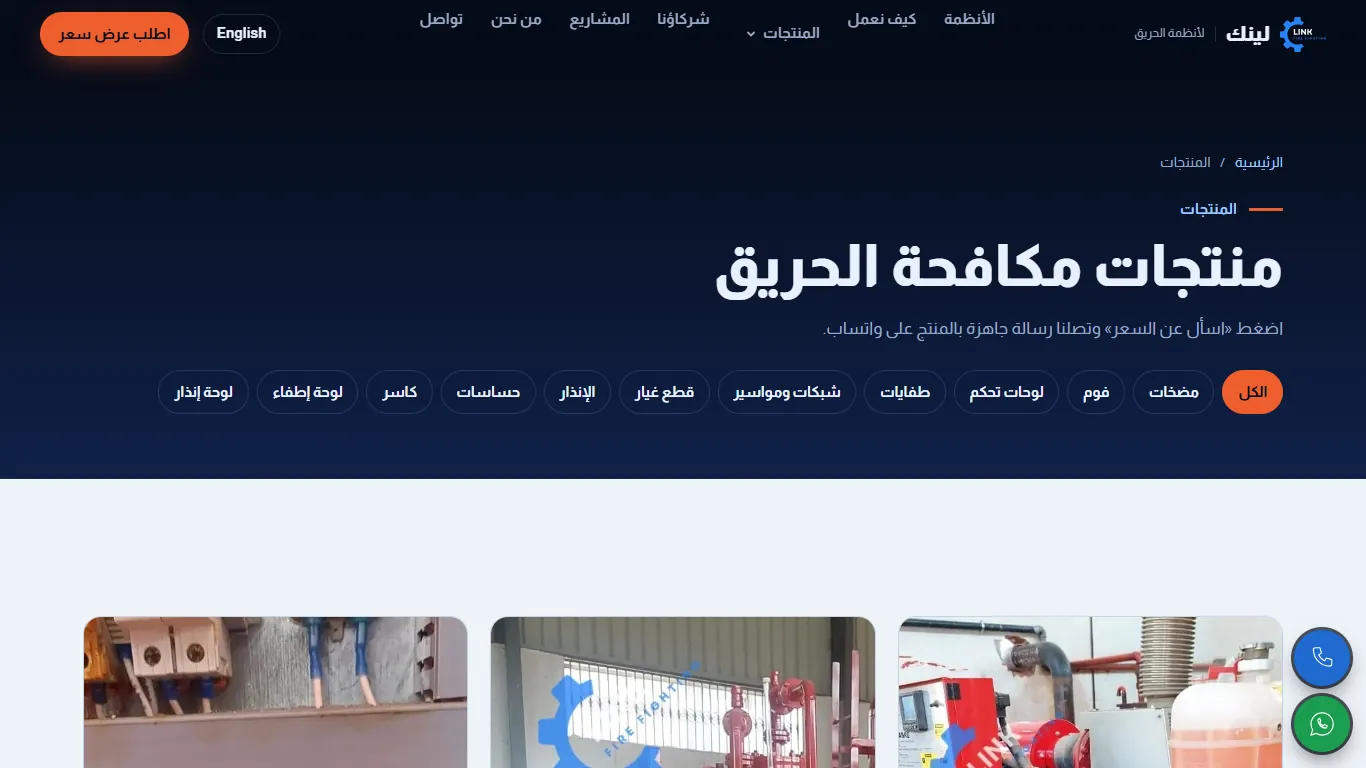
- Products. Each product has a picture, a category, an optional brand and a button that opens WhatsApp with the product name and link already in the message.
- Brands, projects and gallery. Add a partner and it appears in the home strip and gets its own page. Add a project and it appears on the home list. Upload a photograph with a caption and it joins the gallery, in a layout that handles any number of photos.
- Blog. Posts in both languages.
- Categories. The client defined five of his own (alarms, sensors, break glass, extinguishing control panel, alarm control panel). A category can be hidden, reordered, and cannot be deleted while it still holds products. That last rule exists because a delete button without a guard is how a catalogue disappears.
- Proposals. Customer name, products chosen from the catalogue, the price filled in but editable on that proposal, then a PDF with the company logo, address and phone. The amount is also written in words in Arabic and English, with the grammar of Arabic numbers handled, for example “two hundred thousand” in the dual form.
The PDF engine is mPDF, because Arabic text breaks in simpler libraries. We tested the Arabic and English PDFs by opening them and reading them, not only by checking that a file was produced.
The client did use it. When we captured the live site on 14 November 2026 the sitemap listed seven product pages, where the original build shipped with six sample products, and 100 URLs in total (per language: the home page, the products page, seven products, the projects page, the blog and thirty-nine brand pages). We read that as a sign that the dashboard is being used, but we cannot see the client’s activity and we do not claim more.
Where we made mistakes
We said we would tell these, so here they are.
A security header typed wrong
When we hardened the site after launch, we added a Content Security Policy header to the server configuration. Our first push lost the single quotes inside the policy because of a nested command quoting problem. For about three minutes the live site sent an invalid policy and the browser blocked images and fonts. We noticed it in our own check, restored the previous file, and applied the correct one from a file instead of typing it through two shells. Since then, we ship server configuration as a file, make a backup first, read the header back from the live site and look at it in a browser.
A delete button without a confirmation
That same policy blocked inline event handlers, so the dashboard’s delete buttons lost the confirmation prompt they were supposed to show. They deleted straight away. We found it in a review round, moved the confirmation into the dashboard script and added a test.
A phone-only page width bug
A small horizontal slide on phones made the page zoom out. Two causes, both ours: a horizontal movement on elements in right-to-left layout, and grid items without a minimum width. We now scroll the real page at five phone widths (320, 360, 375, 390 and 412) and compare the scroll width with the viewport, because a screenshot looks fine even when the page is wider than the screen.
A DNS block page on our own network
On the network we work from, a DNS filter answered for the domain with a “blocked” page, even through a public resolver. The real DNS record pointed to the right server, which we confirmed through other resolvers. We still do not know why the filter flagged it. For tests we pin the address; for anyone else who meets the block page, the fix is to ask the filter vendor to re-rate the domain.
Security and backups we could prove
A custom application needs more care than a template site, so we checked this one in layers.
- The login is rate limited. We tested it: the ninth attempt gets a “too many requests” answer. An earlier setting trusted a forwarded address header from anyone, which would have let an attacker rotate the address and avoid the limit. We removed it.
- Uploaded vector images (SVG) go through a sanitiser that allows only a safe list of elements, and the uploads folder cannot run PHP.
- Admin routes check the role before a record is looked up, so an unauthorised visitor cannot tell which ids exist.
- Links entered in forms must start with http or https.
- Security headers (HSTS, content-type protection, frame and referrer policies, a content security policy) are set, and the environment file, version control folders and the vendor directory are not reachable from the web.
- The dependency audit of the PHP packages reported no known issues, and the code has no raw SQL.
On backups: a daily job saves the database, the settings file and the uploads, keeping fourteen days. We did not stop at “the job runs”. We restored a backup into a scratch database and compared the row counts table by table; they matched, and we removed the scratch copy. One limit to state plainly: those backups sit on the same server, so they protect against a mistake or a bad update but not against losing the disk. Off-site copies are a separate decision for the client and for us.
If you run a company site and are not sure which of these checks apply to you, we do the same review as a service, described on our website and web app security audit page.
What we measured on 14 November 2026
We loaded the Arabic and English home pages in headless Chrome with mobile emulation (390 by 844 pixels, device scale 2), a fresh browser profile for each run, with no network or CPU throttling, from an office connection in Egypt. We measured first-byte time, the largest contentful paint and layout shift with the browser’s performance observers, and transferred bytes during the first six seconds. Two runs per language. This is not a Lighthouse score and not field data from real phones.
| Run | First byte | Largest paint | Layout shift | Transferred | Requests | Console errors |
|---|---|---|---|---|---|---|
| Arabic, run 1 | 772 ms | 2,512 ms | 0.007 | 1,374 KB | 30 | 0 |
| Arabic, run 2 | 376 ms | 1,612 ms | 0.007 | 1,374 KB | 30 | 0 |
| English, run 1 | 452 ms | 1,340 ms | 0.009 | 1,286 KB | 27 | 0 |
| English, run 2 | 513 ms | 1,288 ms | 0.009 | 1,286 KB | 27 | 0 |
Reading it honestly: the layout shift is near zero, nothing overflows the phone width, and the console is clean. The largest paint is between 1.3 and 2.5 seconds on a good connection; on a slow phone it will be longer, because the page weighs about 1.3 MB. That weight is the cost of photographs and the cinematic effects. In an earlier Lighthouse run on a simulated slow connection, the Arabic home page scored 78 on mobile performance, and we noted a pass to reduce the heavy layers as an open item. We have no field data from real visitors.
What we cannot tell you
We do not know how many enquiries, calls or quotes the site has brought the client. We have no search console data or client feedback to quote, so there is no results paragraph in this story, and we would rather leave a gap than fill it with a number we cannot stand behind. Claims such as UL and FM approved materials, or standards the company works to, appear in the client’s own documents; we have not verified them and the site should not repeat them without his proof.
Lessons for a fire protection company, or any contractor
- Show the first minutes. Buyers know what an extinguisher is. They want to know what happens in the first two minutes. A sequence explained with real photographs persuades more than a list of equipment.
- Put proof before decoration. Certificates with dates, a project list with places, and the names of owners where you may publish them. Scans with personal identity numbers stay in the drawer.
- Real photographs beat renders. We built a 3D scene and the owner asked for the real thing. For a contractor, a pump skid photographed on site is credible in a way no model is.
- Let the client edit what changes. Products, projects, brands and photos should be forms, not tickets to us. Headings and story text stay with us, and the client knows which is which.
- Make the price a conversation. Where the price depends on the building, the button should hand the sales person a ready message, and the proposal tool should let him change the price on that proposal only.
- Test the boring parts. Delete confirmations, phone widths, a restored backup. They fail quietly.
FAQ
What should a fire protection company website include?
A page or section per system (pumps, sprinklers, alarm, gas and foam), proof that can be checked such as registration and delivered projects, a phone and WhatsApp button that are always visible, real photographs of the company’s own work, a request-a-quote path, and a layout that works on a phone. The Arabic and English versions should both be complete.
Why did linkffs move from 3D to real photos?
The owner of PRMAGLY asked for real images of a real building, real fire and real pumps after seeing the 3D scene. A contractor sells trust, and a photograph of an installed pump skid carries more of it than a model. The 3D version is kept as a backup file only.
Can the client add products and projects himself?
Yes. The dashboard has forms for products, categories, brands, projects, gallery photos and blog posts. Texts that belong to the story and the section headings are kept in language files that we edit.
How does the proposal tool work?
The client types a customer name, picks products from the catalogue, adjusts the price on that proposal and downloads a PDF with the company logo, address and phone, in Arabic or English, with the total written in words.
Is the site secure?
We checked the login limit, upload handling, role checks, headers and dependencies, and fixed what we found. No site is guaranteed safe, and we do not claim a certification. Backups are tested by restoring them, but they sit on the same server, so off-site copies remain an open decision.
How fast is it?
On 14 November 2026 our mobile-emulated test measured a largest contentful paint of 1.3 to 2.5 seconds with a layout shift under 0.01 and no console errors. The home page is about 1.3 MB. Real-phone field data is not available yet.
Did the website bring the company more clients?
We do not know and will not guess. We have no enquiry or ranking data from the client to quote.
Can you build something like this for my company?
Yes, for contractors and suppliers who need a bilingual site and a small admin area. We start with a written scope and quote after we see your documents and photographs.
Talk to us about your own site
If you run a contracting or supply company and want a site that shows proof and lets you manage your own catalogue, message us on WhatsApp. You can see more of our work in the portfolio, read about our custom systems work, or look at the systems we built. The live site of this story is linkffs.com.
خدمات مرتبطة
- تصميم مواقع الشركات في مصر
- إنشاء متجر إلكتروني
- برمجة مواقع وأنظمة خاصة
- ايميل رسمي للشركات
- أتمتة واتساب للشركات
- نظام شركات السياحة