
How we turned two PDFs into an HVAC contractor website: a 39-project record, a cooling load estimator, and a live-only CSP bug.
- شركة برمجيات مصرية منذ 2010
- دعم فني على واتساب
Read this case study in Arabic
In short: ADVANCED, a central air-conditioning contractor working in Egypt and Saudi Arabia, came to us with two PDFs and no website. We built an HVAC contractor website that proves its work: a clickable system explorer, a cooling load estimator that sends the result to WhatsApp, and a record of 39 projects with capacity bars. This is the story of how paperwork became proof, what we refused to claim, and the one bug that only showed up on the live site.
Who ADVANCED is and what they handed us
ADVANCED (the company writes its name in Arabic as «ادفانسد», and we kept that spelling) designs, supplies, installs and maintains central air-conditioning. Its profile lists twelve services: chilled-water plants with chillers, air-handling units and cooling towers, duct work, insulation and aluminium cladding, BMS and DDC controls, packaged units, split and vertical packaged systems, VRV and VRF, concealed systems, engineering consulting, preventive maintenance under annual contracts, and spare parts. The company works in Egypt and in Saudi Arabia, and its profile states more than 15 years of experience and more than 150 projects. Those are the company’s claims, and we present them that way throughout.
When the job started, the company had no website at all. What it had was paperwork. The first file was a 16-page company profile in Arabic, dated June 2025. The second was a three-page English document containing a table of 39 projects, with the system type, the capacity in tons of refrigeration (TR), the location and the consultant for each row. Everything the company could prove about itself lived inside those two files, and neither file was easy to use.
That is a common starting point for engineering contractors. The best sales material is a project list, and the project list sits in a PDF that gets forwarded on WhatsApp. A developer, a factory owner or a consulting engineer who wants to check capacity, compare system types or find a reference in a particular city has to scroll through pages and squint. Our job was to turn that stack of pages into a site a buyer could actually test.
What we found inside the two PDFs
The first surprise came on day one. The Arabic profile looked normal in a PDF viewer, but no tool could pull text out of it. Copy and paste returned nothing, and a text extraction command returned an empty file. The Arabic had been embedded as pictures of letters, not as text. We read the pages as images, one by one, and transcribed every service description, value statement and safety policy by hand. The profile had a few typos, such as a villa written with a missing letter and an email address with a comma where the dot should be, and we corrected those while typing.
The second surprise was the photos. The 28 project photographs inside the profile were stored in an inverted CMYK colour space, so a straight export gave us washed-out negative-looking images. We extracted them and inverted the channels with an image library until the colours matched what the page showed. It sounds like a small thing, but it decided the whole look of the gallery. Photos with the wrong colour would have made a serious contractor look careless.
The third thing was the numbers. The English record numbered its rows, but it used the number 7 twice. The Arabic profile numbered its project photos, but it used the number 20 twice. We renumbered both lists from 1 in document order, so that every row on the site has one stable number. Then we did something that matters more than it sounds: we added up the tons ourselves. The 35 rows that carry a capacity add up to 14,715 TR. Four rows carry no capacity in tons: a ductwork job for six buildings, a maintenance contract, and two cold-storage rows that the record gives in horsepower. We did not convert horsepower into tons of refrigeration, because the two units describe different things and a guess would have put a wrong number on a contractor’s own page.
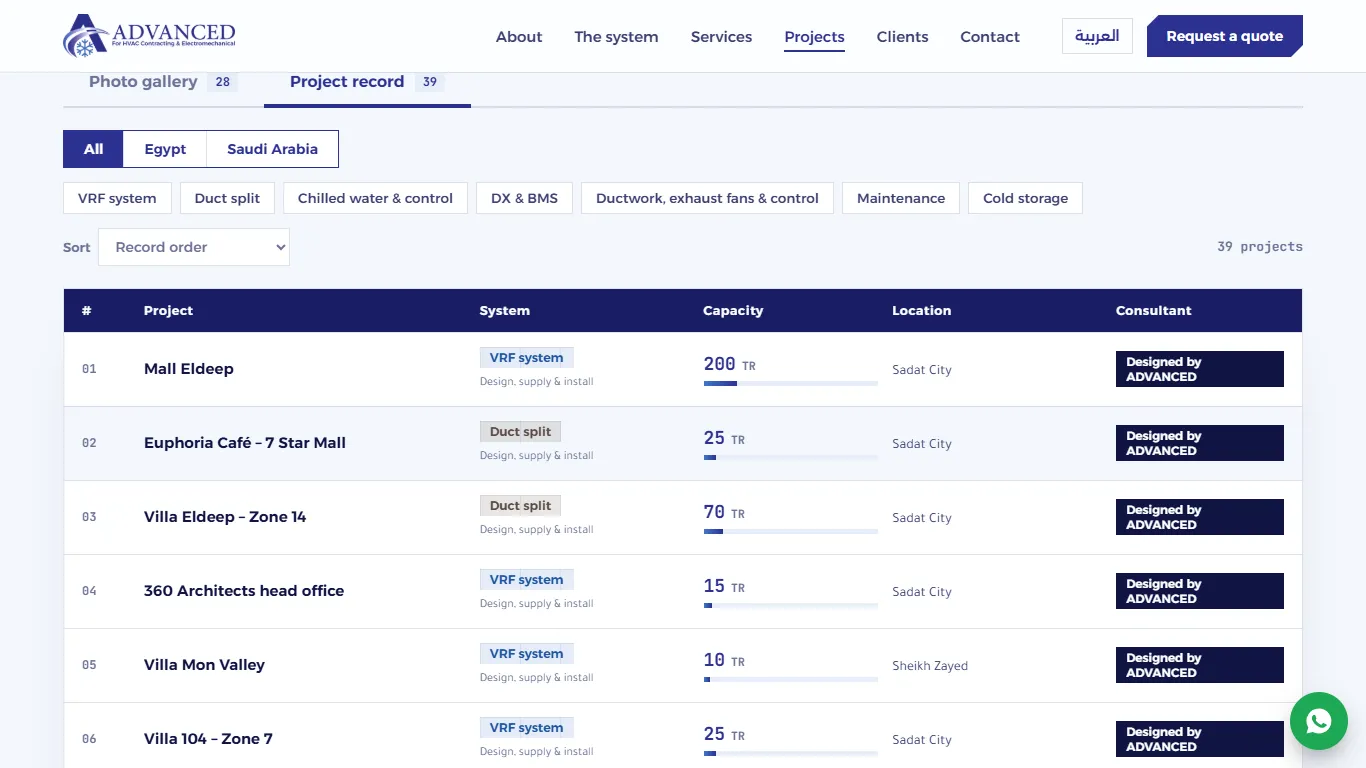
That sum became one of the numbers the site is allowed to say. Of the 39 rows, 24 are in Egypt and 15 are in Saudi Arabia. The Saudi rows hold 11,845 TR of the total, and the Egyptian rows hold 2,870 TR. In 23 of the 39 rows the consultant column reads ADVANCED, meaning the company did the design itself. The other rows name the consultant on each project. We kept that column visible, because a buyer who is checking a reference wants to know who designed the system, not only who installed it.
How buyers in this field actually search
Before we designed anything, we looked at the words people use. We have no search volume tool for this, so we make no claim about how often any phrase is searched. What we can report is what the search results and the related questions show.
In Egypt, the Arabic phrases that come up around this business are «شركة تكييف مركزي», «مقاولات تكييف مركزي», «شيلر», «VRF», «دكت سبليت» and «كونسيلد», usually followed by the city or a project type. The companies that rank describe the same sequence: study the project, calculate the loads, choose the system, install, test, commission. In Saudi Arabia, the wording leans toward «مقاول تكييف مركزي» with the name of an industrial city, mainly Jubail and Yanbu, and the English side talks about HVAC contracting, chilled water systems and district cooling. A large share of the results are contractors listing named projects with the owner and the capacity, which tells you what a buyer expects to see.
The questions around the topic were just as telling. People ask how many tons of cooling a building needs per square metre, and the answers they find disagree widely: some sources say one ton per ten square metres, hot-climate calculators say one ton per 16 to 20, and area-based rules of thumb range from about 520 to 800 BTU per square metre. They also ask whether to choose VRF or a chiller for a commercial building. The sources agree on the broad shape of the answer (VRF for medium buildings with many zones, chilled water for large and continuous loads) and disagree on where the crossover sits, with thresholds quoted anywhere from 150 to 1,000 TR.
Two things followed from this. First, a contractor website should answer the load question honestly and quickly, because that is the first thing a client wants to know. Second, a site that shows named projects with capacities speaks the language the best-ranking contractors already use, and does it better than a paragraph of claims.
What we decided before we built anything
We wrote down the decisions first, because a site like this is mostly a set of choices about what to show and what to leave out.
Show the record, not slogans
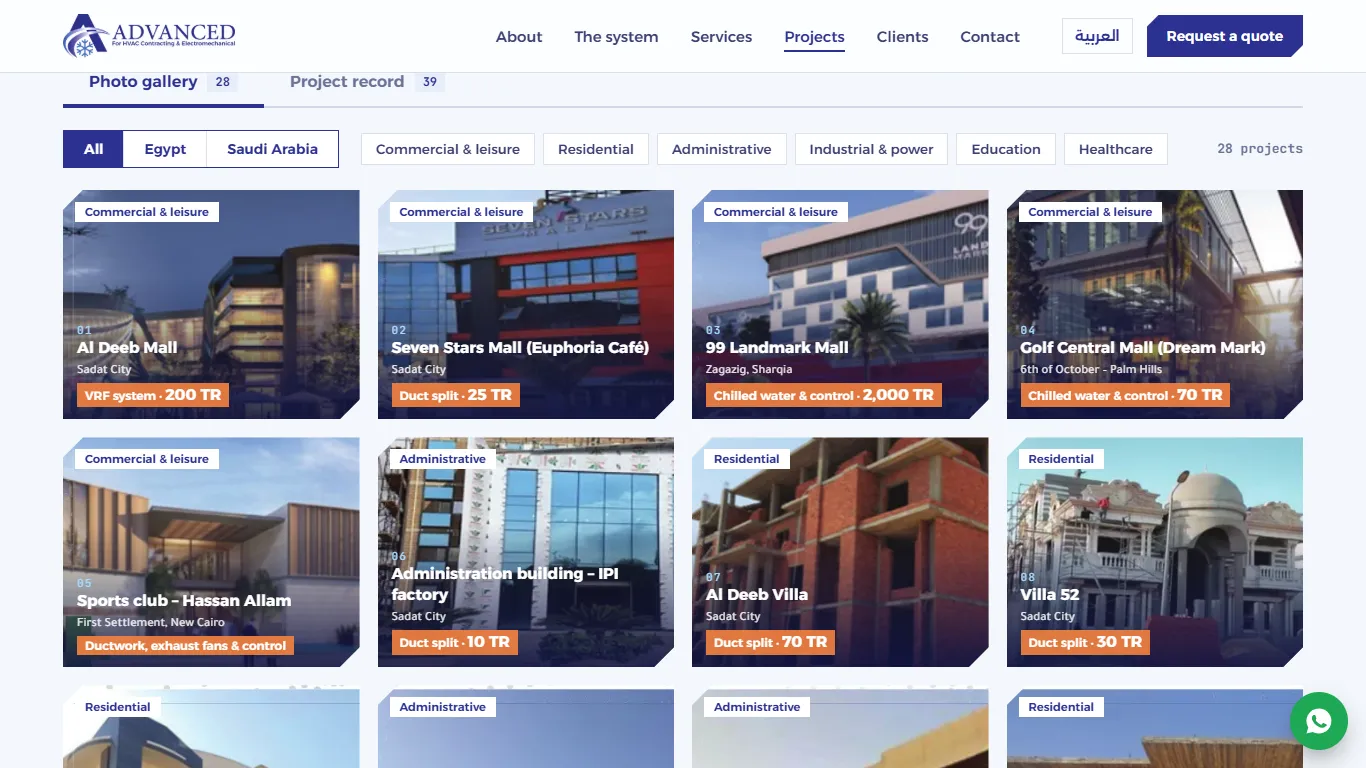
The 39-row table would be the centre of the project section, with the capacity drawn as a bar so that a reader sees the scale of a 5,400 TR plant next to a 10 TR villa without reading numbers. The 28 photos would sit in a gallery with filters by country and by sector. A photo would link to a record row only where the two documents clearly described the same project. That held for 20 of the 28 photos. For the other eight, we left the link out, because a wrong link would be a false statement.
Tools instead of adjectives
A contractor’s first meeting with a client is usually a question: what do I need for this building? So we put the first step of that conversation on the page. The estimator takes a building type and an area and returns an indicative capacity. The system explorer, an illustrated building section, lets a reader tap numbered parts and see which service covers each. Neither tool pretends to replace engineering work. Both say so in plain words on the page.
Design that belongs to this trade
We took the look from the world of mechanical drawings: a frost-white blueprint grid, the indigo of the company logo, chamfered corners borrowed from the logo and the profile, and an animated airflow canvas in the hero. The fonts are Alexandria and Tajawal for Arabic, chosen because they read well at technical sizes and because none of our earlier sites used them. The site comes in two languages, with Arabic at the root and English under /en/, both written for their own readers and not translated word for word.
The numbers decision
This one took the most thought. The Arabic profile says «100+ projects» on one page and «150+ projects» on another. Our first build used 100+, the safer figure. We decided to keep 150+, the figure on page 13 of the company’s own profile. We accepted that, and on the site the statement reads as the company’s own: a stat block saying 150+ projects, next to a record that lists 39 of them. We never presented 150 as something we counted, because we did not. The second number, 14,000+ TR, is different in kind. It is our arithmetic, the sum of the tons in the record the company gave us, rounded down from 14,715. Anyone can check it against the table on the page.
What we built, step by step
The hero and the first impression
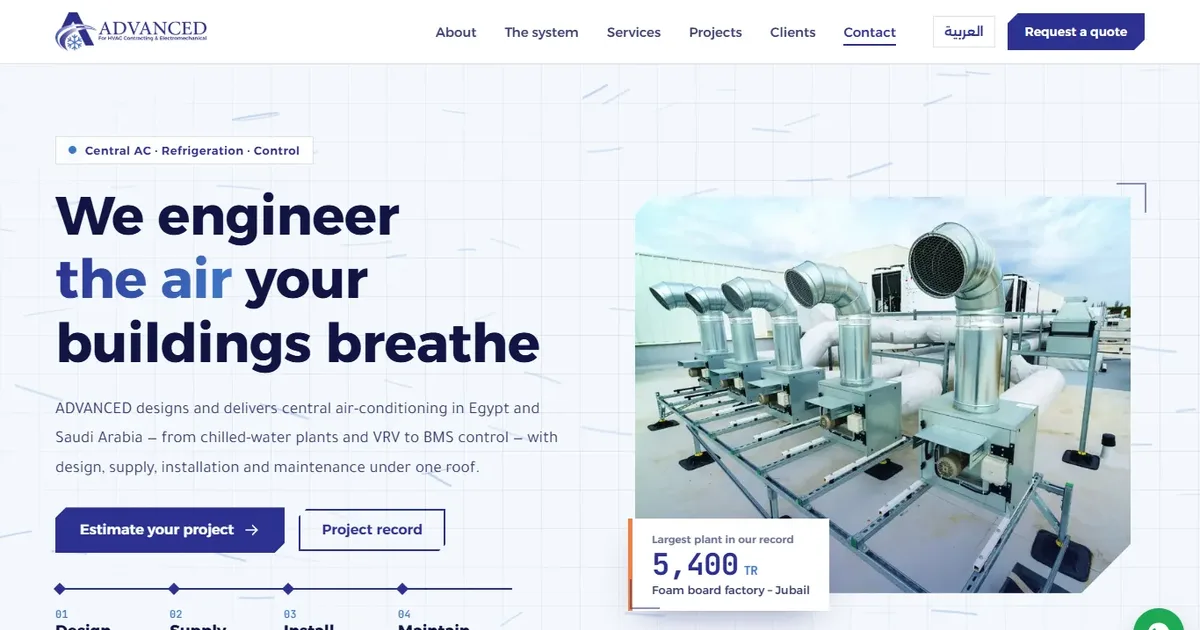
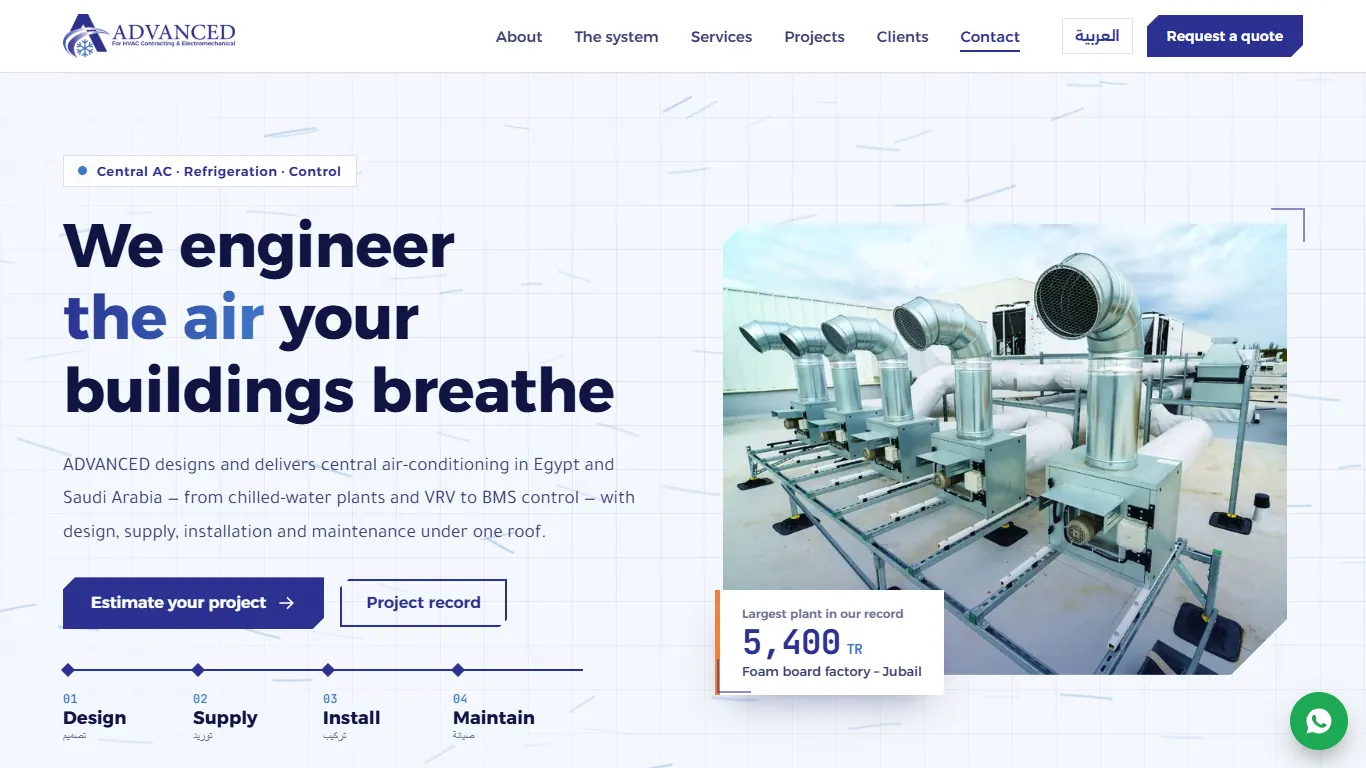
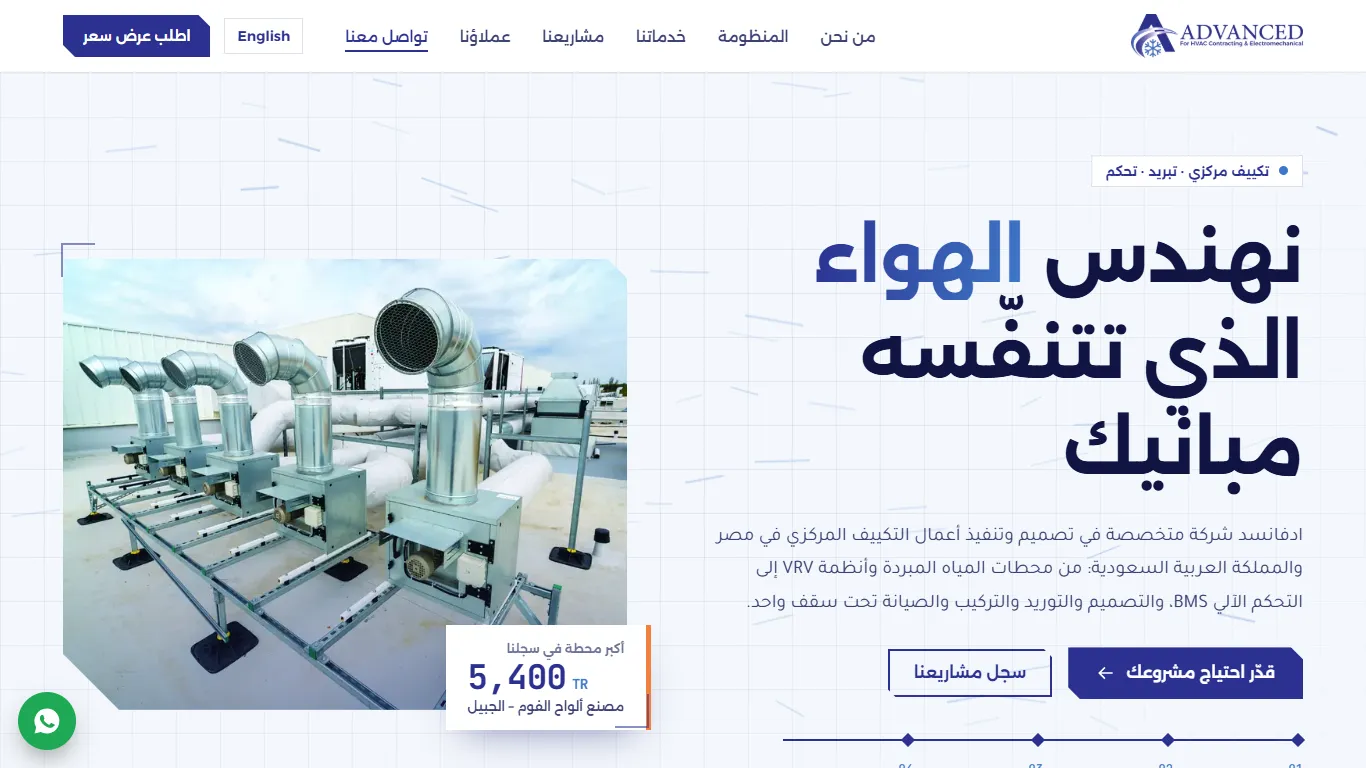
The first screen says what the company does in one line, and it puts one hard number beside a real photograph: the largest plant in the record, 5,400 TR, a foam board factory in Jubail. It is a number a visitor can verify two clicks later in the record. An airflow animation runs lightly behind the headline, and it stays out of the way of the text.

The system explorer
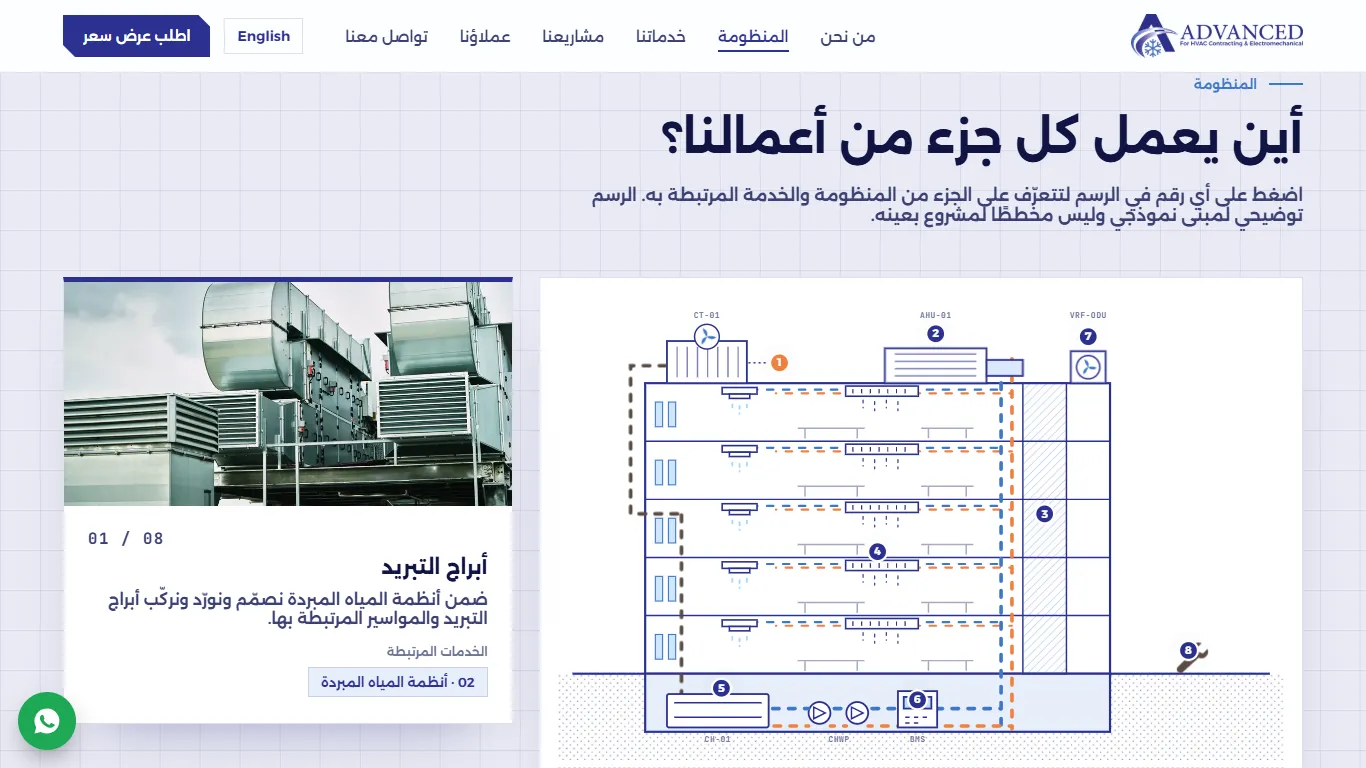
Further down, a drawing of a five-storey building shows a cooling tower on the roof, an air-handling unit, a riser, a chiller room in the basement with pumps and a BMS panel, and an outdoor VRF unit. Eight numbered hotspots open a card with a photo, a short explanation and the matching service from the list of twelve. The drawing is labelled as an illustration of a typical building and not a plan of a real project. We added that sentence on purpose, because a buyer should never wonder whether a diagram is a claim.
The cooling load estimator
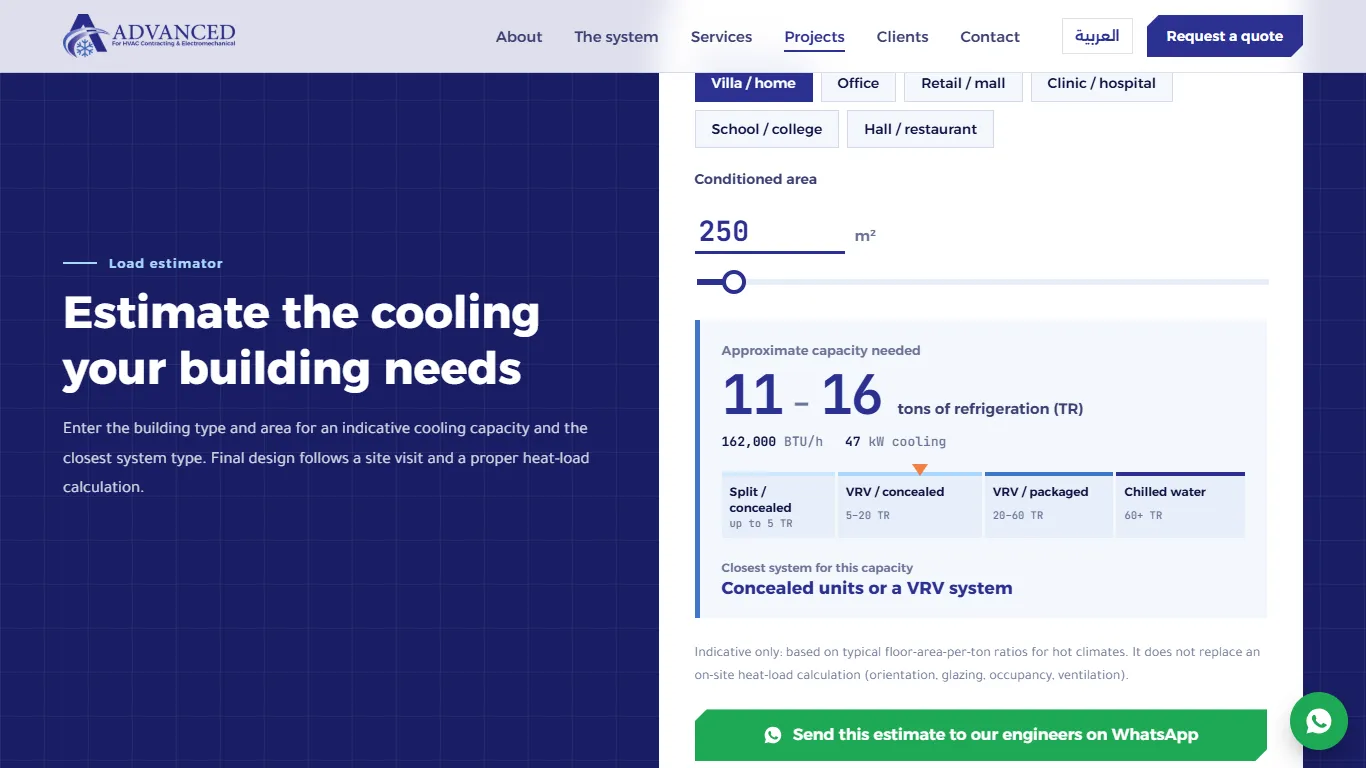
The estimator has six building types (villa, office, retail or mall, clinic or hospital, school or college, hall or restaurant) and an area slider. Each type has a range of square metres per ton, taken from rules of thumb for hot climates: a villa at 16 to 22 square metres per ton, an office at 18 to 24, a mall at 13 to 18, a hall at 8 to 12. For a 250 square metre villa the page shows 11 to 16 TR, which is about 162,000 BTU per hour and 47 kW, and it marks the nearest system type on a scale: a split or concealed unit up to 5 TR, VRV or concealed from 5 to 20 TR, VRV or packaged from 20 to 60, chilled water above 60. One button sends the result to the company’s engineers on WhatsApp.
The text under the result says it plainly: the figure is indicative, based on typical floor-area-per-ton ratios for hot climates, and it does not replace an on-site heat-load calculation that accounts for orientation, glazing, occupancy and ventilation. The search results we read said the same thing: rules of thumb can be off by a wide margin, and a proper calculation is what sizes equipment. We would rather the page be modest and useful than precise and wrong.
The 39-project record
The record is a sortable, filterable table: project name, system type, how the work was done (design, supply and install; installation only; rehabilitation; maintenance), capacity with a bar, location and consultant. A reader can filter to Saudi Arabia, to chilled-water systems, or to projects the company designed itself. It is the most useful part of the site for the people who will judge the company, and it is also the part that cost us the most hours, because every row was typed from a document and checked against the original.
The photo gallery
The 28 photographs open in a lightbox and can be filtered by country and sector: commercial and leisure, residential, administrative, industrial and power, education, healthcare. Each card carries the system type and capacity where the record gives them.
The rest of the page
The site also lists the twelve services exactly as the profile words them, the company values, a safety policy, two logo walls (one headed «Brands we work with» and one «Organisations that trusted us»), a Google map and the company’s Facebook page. The only contact address shown is the company email. The footer and the page metadata record that design and code belong to PRMAGLY and that the client’s name, logos, photos and project data belong to ADVANCED.
What we refused to claim
A contractor’s site is read by people who check things, so the list of things we left out is as long as the list of things we put in.
- No converted horsepower. The two cold-storage rows are in horsepower, and they stay out of the TR total; those two plus the ductwork and maintenance rows are the four without tons.
- No merged projects. One Saudi row is a foam board factory and another is the Al-Rashed polystyrene factory. They may be the same site, but the documents do not say so, so we did not combine them.
- No photo links that we could not stand behind. Twenty of 28, as explained above.
- No invented partnerships. The logo walls reproduce what the profile showed. We did not write that the company is an authorised dealer of anyone.
- No reviews, ratings or testimonials, because the company gave us none.
- No result claims. We have no traffic, enquiry or sales numbers for the site, so this article contains none.
- No precise map pin. The map points at the street, not at a building.
The bug that only the live site showed
We build and test on our own machines first. For this site we ran a local preview, checked it at four widths in both languages, and found no console errors and no failed requests. Then we uploaded it in one step, compared checksums of the files against the local copy, confirmed that http redirects to https, that the www address redirects to the bare domain, that the certificate was valid, and that configuration files return 403. Everything passed.
Then we opened the project record on the live URL, and every capacity bar was full width. A 10 TR villa looked as big as the 5,400 TR plant. The table was lying, and the only thing it was lying with was CSS.
The cause was the server’s Content Security Policy. We had set a strict policy, with style rules limited to the site’s own files, which blocks inline style attributes. The bars were drawn with inline widths, because that is the easy way to build them. Our local preview server sent no security headers at all, so the widths worked there and failed in production. The fix was to replace inline widths with a set of classes, one for every percentage from 0 to 100, and bump the version string on the stylesheet so the immutable cache would pick it up. It was quick to fix and is not easy to forget. The rule we wrote down afterwards is simple: run the quality checks against the live URL after every deploy, not only against the local copy.
We had another small mistake of the same family earlier. Tall sections on phones never revealed their content, because the scroll animation waited for a share of the element to be visible and a very tall block could never reach that share on a small screen. We lowered the threshold and stopped animating the largest containers.
What the live site measures today
We measured the live home pages on 2026-11-14 with a headless Chromium browser using a 390×844 mobile viewport and a device scale factor of 2, with no network or CPU throttling, from a desktop machine. These are single page loads and not Lighthouse scores, so treat them as a snapshot and not a benchmark. The load happened once cold and once more later on the Arabic page.
| Page | Time to first byte | Largest contentful paint | Layout shift (CLS) | Transferred | Requests | Console errors |
|---|---|---|---|---|---|---|
| Arabic home, first load | 759 ms | 4.2 s | 0.0105 | about 341 KB | 16 | 0 |
| Arabic home, second load | 504 ms | 2.6 s | 0 | about 341 KB | 16 | 0 |
| English home | 1,148 ms | 2.4 s | 0 | about 321 KB | 14 | 0 |
The honest reading: the page is light, with a little over 300 KB and fewer than 20 requests before any gallery image loads, and the layout does not jump. Largest contentful paint ranged from 2.4 to 4.2 seconds, and the slowest value came on the first, cold load of the Arabic page, which is the one a new visitor gets. That is acceptable but not something to boast about, and it is the first thing we would look at in a tuning pass, probably the hero photo and the web fonts. We measured on a fast connection, so a visitor on a weak mobile signal in an industrial zone will wait longer.
What changed, and what we cannot say
What changed is verifiable. A company with two hard-to-use PDFs now has a live bilingual site at advanced-f-hvac.com and advanced-f-hvac.com/en/. A buyer can filter 39 projects by country and system, see the capacities side by side, estimate a building’s cooling load, tap through the parts of a chilled-water system, and open a WhatsApp message with the estimate already written. The site also appears in our own portfolio.
What we cannot say is whether any of that has produced enquiries. We have no analytics, rankings or lead numbers from the client, and we will not make them up. If the company shares them, we will add them to this story.
Lessons for contractors with a profile in a drawer
- Start from the record. If you have a list of projects with capacities, owners and locations, that list is your most persuasive page. Build around it and make it sortable.
- Fix the source before you publish it. Duplicate numbers, typos and unreadable PDFs are normal. Clean them once, in one data file, and let the site read from it.
- Separate your claims from your arithmetic. Years in business and project counts are your statements. Totals you can add up yourself are facts. Label them differently.
- Be modest in calculators. An estimator that says “indicative” and invites a conversation is more credible than one that pretends to be a design.
- Show who designed it. The consultant column answers a question every serious client asks.
- Test the live site, not only the preview. Security headers, caches and redirects behave differently in production. Ours taught us the check.
- Write in the words your buyers use. Egyptian developers and Saudi factory owners search in different phrases for the same plant. Reflect both in the Arabic and English pages.
FAQ
What should an HVAC contractor website include?
At minimum: the services in plain words, a project record with system types, capacities, locations and consultants, real photographs, the countries you work in, a way to ask for a quote, and clear contact details. Tools such as a load estimator help, as long as they say they are indicative.
Can a PDF company profile be turned into a website?
Yes, and it is usually the fastest way to get real content. The work is in the cleaning: extracting text from scanned pages, fixing colours in embedded photos, correcting numbering and typing tables into structured data. In this project the Arabic profile had no extractable text, so every page was read as an image.
How do you decide how many projects to claim?
The company decides, and the site attributes it. ADVANCED’s profile gives two figures, over 100 and over 150, and we kept 150+, the figure on page 13. We show it as the company’s claim, next to a record that lists 39 projects, and we calculate the total capacity ourselves from that record.
Is a cooling load estimator accurate?
It gives an indicative range, not a design. The sources we read quote anything from one ton per ten square metres to one ton per twenty, depending on climate and building type, and recommend a proper heat-load calculation before choosing equipment. Our estimator uses ranges per building type and says on screen that it does not replace a site calculation.
Should a contractor choose VRF or a chiller?
It depends on the building. The sources we compared agree that VRF suits medium buildings with many separately controlled zones, and chilled water suits large, continuous loads such as factories and hospitals. They disagree on where the crossover falls. A contractor’s site should explain the options and let an engineer decide per project.
Why did the capacity bars break only on the live site?
The live server sent a strict Content Security Policy that blocks inline style attributes, and the bars used inline widths. The local preview sent no policy, so the problem was invisible there. We replaced the inline widths with CSS classes and re-tested on the live URL.
Does the site include reviews or ratings?
No. The company supplied none, and we do not invent them. The site shows its project record, photos, logo walls taken from the company profile, and its own claims, labelled as the company’s.
How long does it take to build a site like this?
We do not have a timeline for this project that we can state accurately, so we will not quote one. For a quote on your own project, message us with your brief and your existing material.
Next step
If you run a contracting company and your best proof is sitting in a PDF, send it to us on WhatsApp and we will tell you what a site built around your projects would look like. You can read about our web development service, our web design service and our SEO basics guide, or look through our portfolio. The ADVANCED site is live at advanced-f-hvac.com/en/.
خدمات مرتبطة
- تصميم مواقع الشركات في مصر
- إنشاء متجر إلكتروني
- برمجة مواقع وأنظمة خاصة
- ايميل رسمي للشركات
- أتمتة واتساب للشركات
- نظام شركات السياحة