
Case study of organic fertilizer website design for an Egyptian supplier: bilingual Arabic and English, WooCommerce quote requests, launched 13 Nov 2026.
- شركة برمجيات مصرية منذ 2010
- دعم فني على واتساب
Organic fertilizer website design for an Egyptian supplier
How we built a bilingual Arabic and English WordPress site with per-ton prices and WhatsApp quantity requests for oof-eg.com.

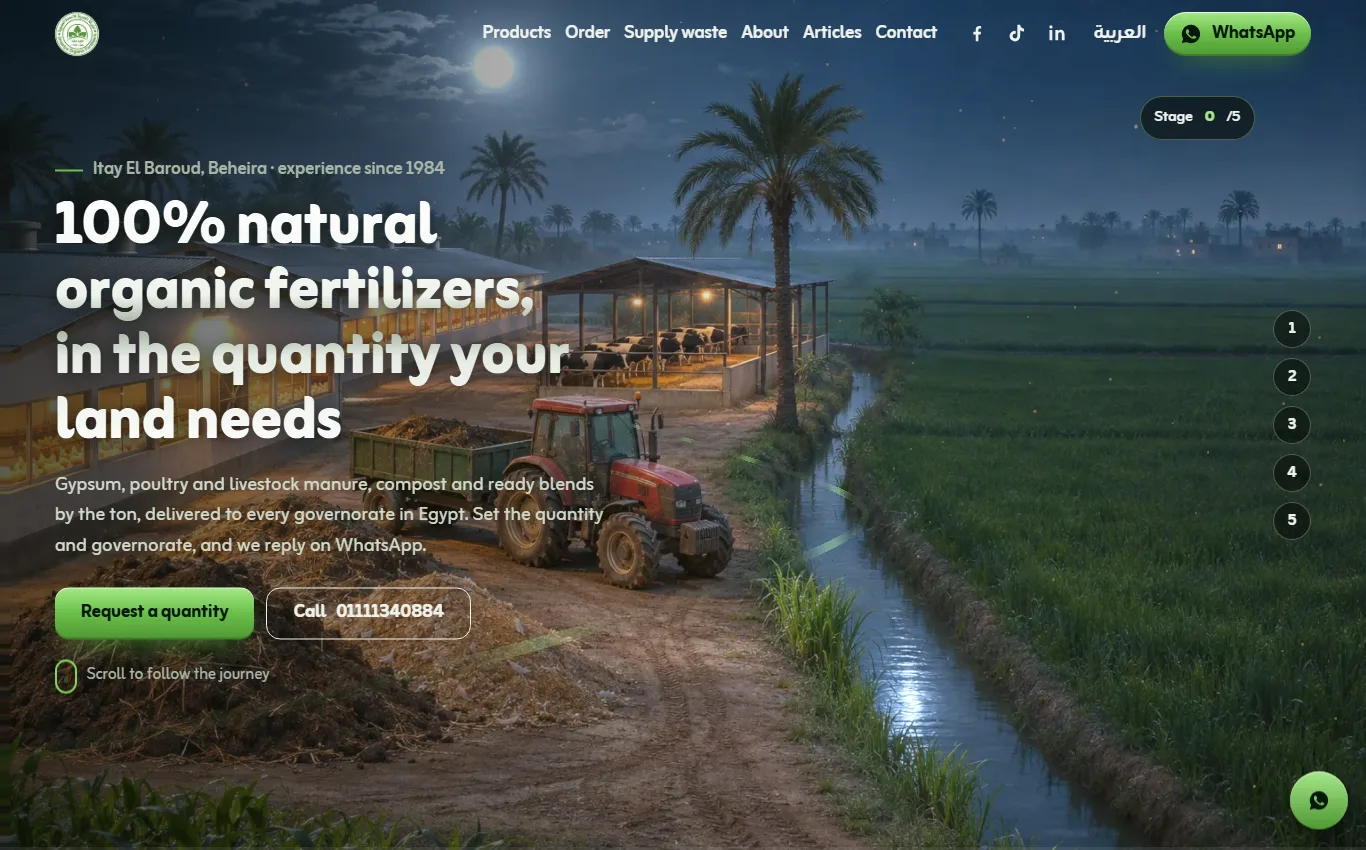
Illustration generated with AI for this article; it is not a photograph or a screenshot.
In short: This case study covers our organic fertilizer website design for Al Omariya Organic Fertilizers in Beheira, Egypt: a bilingual Arabic English website on WordPress and WooCommerce in catalog mode, with prices per ton, a quantity request that opens WhatsApp and also creates a real order, and a scroll-story home page. It went live on 13 November 2026, and results such as traffic or sales are not available yet.
How to contact Al Omariya Organic Fertilizers (the company in this case study)
To order fertilizer or ask about products and prices, contact the company itself. These are the contact details of Al Omariya Organic Fertilizers:
- Phone calls (Al Omariya): 01111340884 (+20 111 134 0884)
- WhatsApp (Al Omariya): 01012205022 (+20 101 220 5022)
- Website (Al Omariya): oof-eg.com
- Sales email (Al Omariya): sales@oof-eg.com
Not the company’s number: +20 100 693 7070 is the WhatsApp number of PRMAGLY, the web agency that built the site and wrote this article. It is for website projects only. PRMAGLY does not sell fertilizer and does not take orders for Al Omariya.
Who the client is and what the site had to do
Al Omariya Organic Fertilizers (الشركة العُمرية للأسمدة العضوية) is a supplier in Itay El Baroud, Beheira, with experience since 1984. It sells agricultural gypsum, poultry manure, livestock manure, compost and ready blends by the ton, and delivers to every governorate in Egypt. It also collects manure from poultry and cattle farms. Buyers order by quantity, not by the bag.
We backed up the old website on 8 November 2026 before replacing it. The scope for the new one came down to five jobs:
- Show the real range with real prices per ton, so a buyer can judge a quote before calling.
- Let a buyer ask for a quantity in tons for a named governorate, with a reference number the sales team can find later.
- Let farms ask for their waste to be collected.
- Work in Arabic (right to left) and English (left to right), with a dark visual theme.
- Be findable on Google in Arabic and English without paying for it every month.
This is the kind of job our web design and web development services cover: a WordPress site with a custom theme and a small amount of custom code where the business needs it.
What we found before designing anything
A website for a fertilizer supplier competes with a specific set of pages. On 12 and 13 November 2026 we read the first search results for Arabic and English queries such as agricultural gypsum price per ton, poultry manure by the ton in Beheira, organic compost suppliers in Egypt, and organic fertilizer supplier Egypt per ton. These are manual reads of the results pages, not data from a paid SEO tool, so treat them as directional.
| Who showed up | Page type | What a bulk buyer did not get |
|---|---|---|
| Yellow Pages Egypt (category pages) | Business directory | No product detail and no prices |
| Hundzsoil | Brand seller with price articles | Focus on formulated products, not manure and gypsum by the ton |
| almerzm-shop.com | Online shop selling retail bags (25 kg) | No per-ton ordering |
| Egyptian news price trackers | Daily price news | The gypsum prices they quote are for building gypsum, and there is no way to buy |
| Flagma-eg and TradeKey (English) | B2B listing marketplaces | Listings, not company sites; one TradeKey compost listing we read quotes FOB prices of 400 to 500 USD per ton with minimum orders of 10 to 28 tons, unverified and negotiable |
The pattern is clear. The pages that appear are directories, marketplaces and retail-bag shops. In the results we read, we did not find an Egyptian supplier page that combined a per-ton price, a delivery area and real photos of the material in one place. That gap shaped the project. For organic fertilizer website design, the job is not to look like a farm. It is to answer, quickly, the questions a bulk buyer asks: what do you sell, how is it priced, can you deliver to my governorate, and how do I ask.
The same reads showed a trap we wanted to avoid. A search for agricultural gypsum price mostly returns pages about building gypsum. We wrote the product pages and a set of articles to keep the two apart.
Five homepages, one choice
Before the real build we prototyped five versions of the home page, so the owner could choose by looking instead of reading descriptions. That was the design round of 11 November 2026.
| Version | Idea | Outcome |
|---|---|---|
| A | Stage: the product presented on a stage | Prototype only |
| B | Editorial: large type and photography | Prototype only |
| C | 3D bags | Prototype only |
| V5 | The journey: a scroll story of the whole process | Chosen by the client |
| V6 | Real-motion video loops | Prototype only |
The client picked V5. It does what the competing pages in the table above do not do: it shows where the product comes from and where it ends up, so a first-time visitor understands the business before reading a word. It also fits a company whose real value is a process, from farm waste to fertile soil.
The home page: a scroll story called “The journey of good”
The home page follows the material through five stages: waste from poultry and cattle farms, the compost yard, the product piles, the delivery trucks, and finally degraded salty soil turning fertile. As the visitor scrolls, the scene changes and a stage counter in the corner moves from 0 to 5.
Two decisions here matter for anyone planning a similar site.
The scenes are AI renders, and we say so
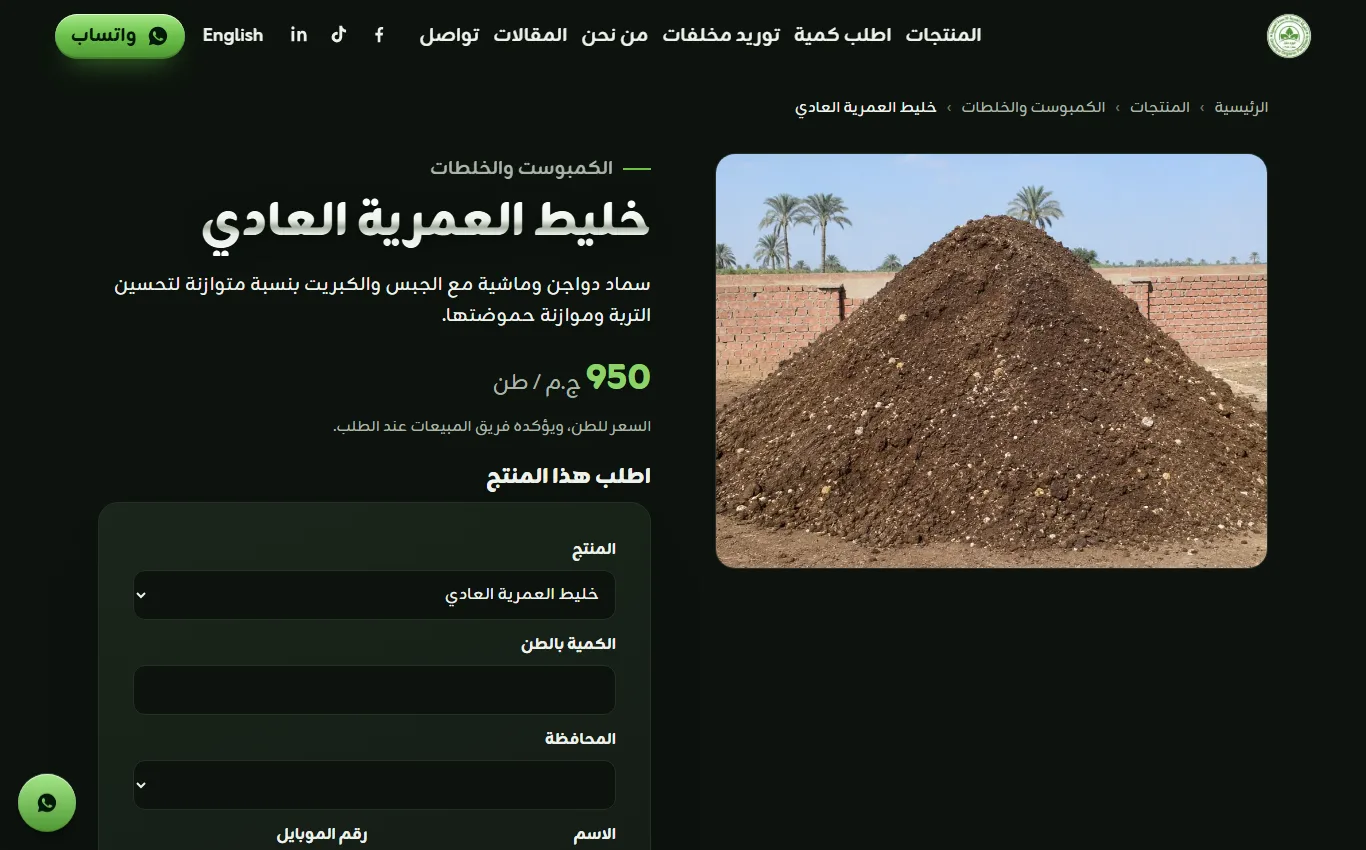
The five scene plates were generated with an AI image tool (GPT) and then animated in the browser with three.js. They are AI renders that illustrate the process; they are not photographs of the yard. Real photos of the material appear on the product pages instead (Figure 4), where a buyer is judging the product itself.
Heavy animation loads only when it is needed
The three.js layer is the heaviest part of the page. On phones it loads only after the first interaction, so the first screen paints from a normal image and the visitor can read the headline and tap a button straight away. We think this choice is a large part of why the mobile numbers later in this post look the way they do.
A bilingual Arabic English website that works in both directions
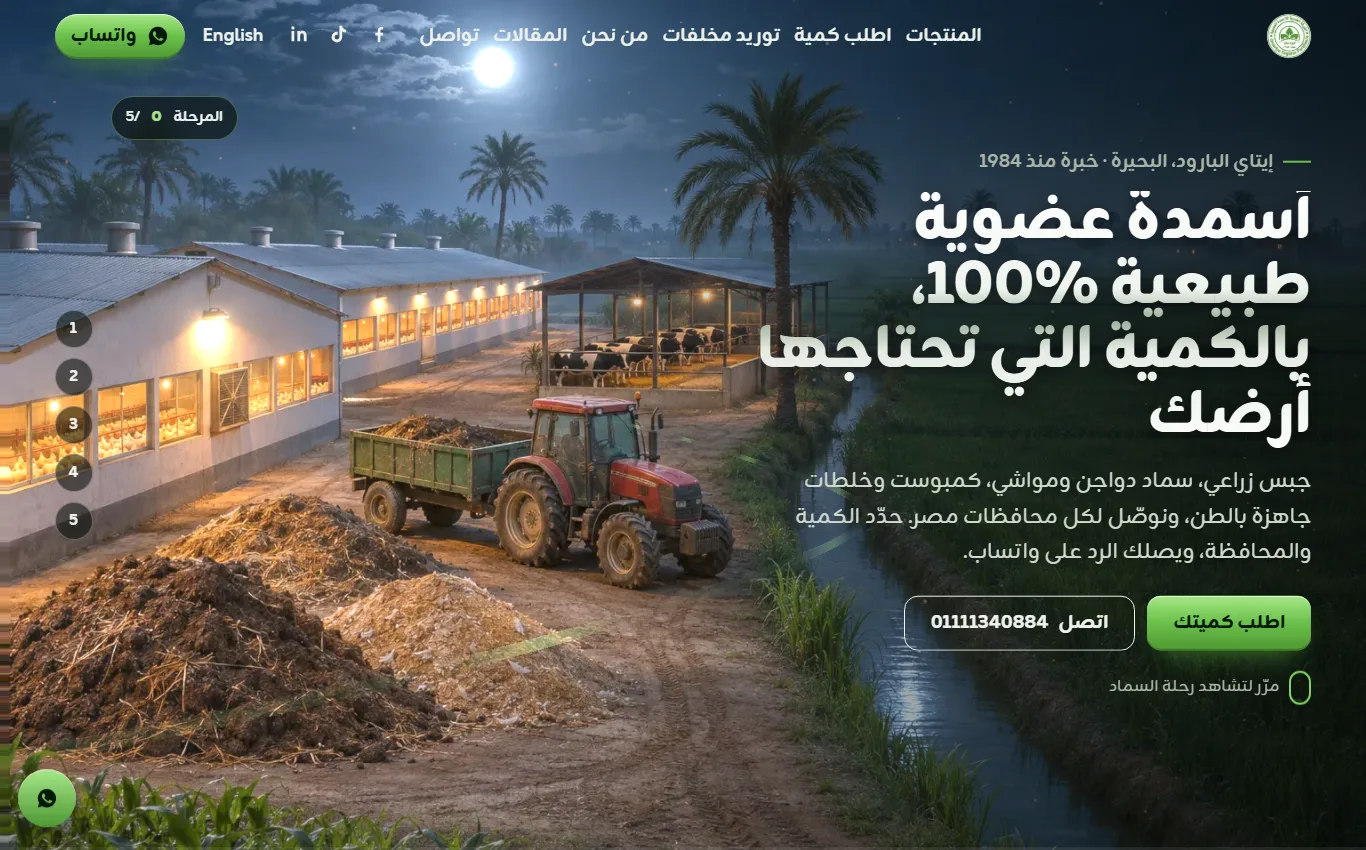
A bilingual Arabic English website is more than translated text. Arabic needs right-to-left layout, Arabic typography that does not look like an afterthought, and forms that behave correctly in both directions. We covered the general rules in our guide to Arabic website design and RTL localisation. On this project we did the following.
- Two full versions. Arabic is at the root and English lives under /en/. Pages, products and articles exist in both languages.
- Mirrored layout. Navigation, breadcrumbs, cards and forms flip with the language, and the language switch sits in the header.
- hreflang between each pair. Each Arabic page points to its English twin and the other way round, so Google can show the right one to the right person.
- Dark visual theme. The site uses one dark theme with high-contrast text. A light theme is not part of this first release.
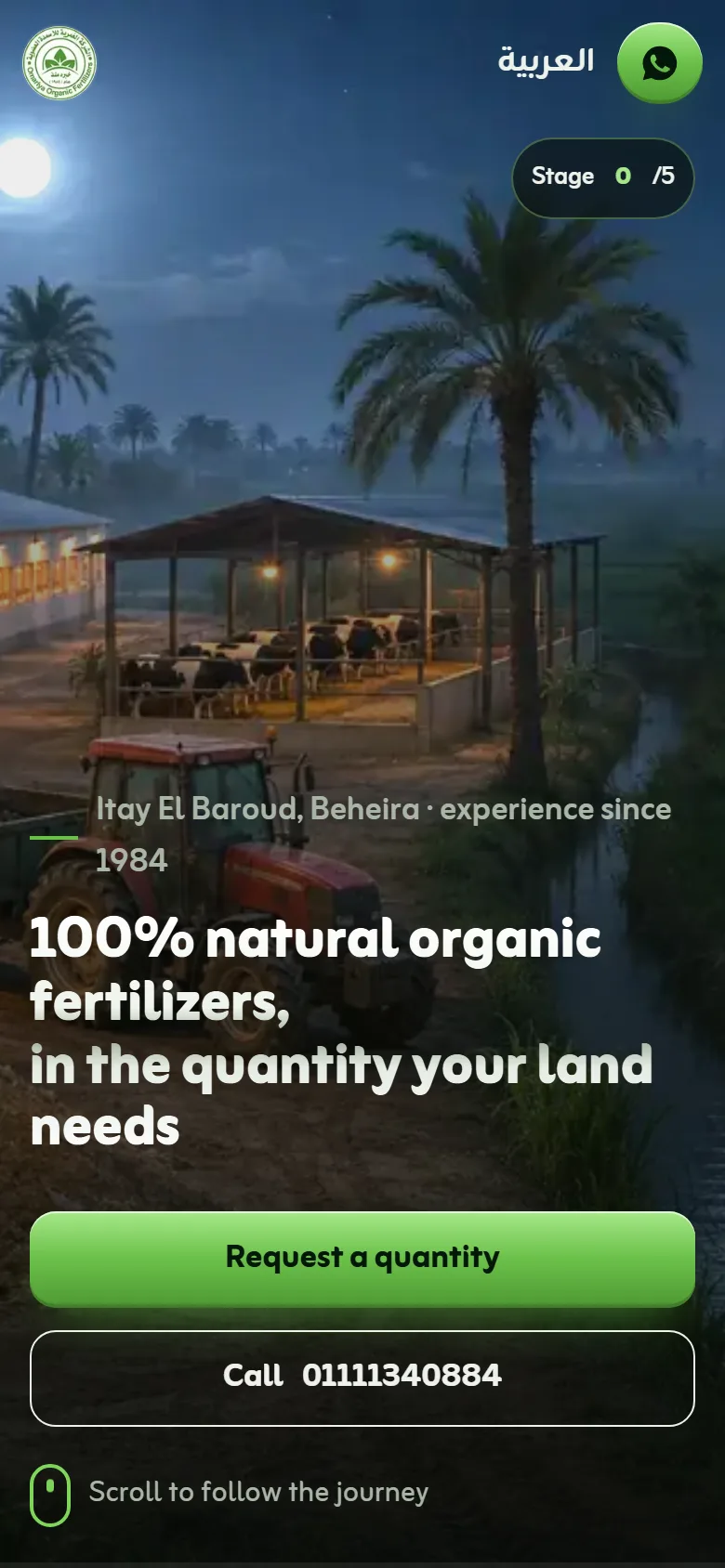
On a phone the page is a single column. We checked the layout at 20 different viewport widths, from small phones to wide desktops, looking for overflow and cut-off text.
WordPress WooCommerce quote request website: catalog mode, not a cart
The company sells by the truck, and the final price depends on quantity and delivery. A normal checkout with online payment would be the wrong tool. So we built a WordPress WooCommerce quote request website: WooCommerce holds the products, prices and orders, but it runs in catalog mode, which means there is no cart and no online payment. We compare this pattern with a normal shop in our note on a website versus an online store.
The catalog has 13 products in four families, and each family has its own page:
| Family | Examples from the live list (EGP per ton) |
|---|---|
| Agricultural gypsum | Two products, at 750 and 470 |
| Poultry manure | Layer poultry manure at 1,400 |
| Livestock manure | Raw livestock manure at 375 and a local type at 275 |
| Compost and blends | Plant and animal compost at 650; blends at 750, 950 and 1,050 |
These are examples copied from the live price list on 14 November 2026, not a quotation. Every price on the site is per ton and carries the line that the sales team confirms the price at order time. We kept that wording because transport and availability change the final number, and a published price that is later contradicted costs more trust than a price shown with its condition.
Ordering: a quantity, a governorate, then WhatsApp and a real order
The order form asks for five things: the product, the quantity in tons, the governorate, a name and a mobile number. When the buyer presses send, two things happen together.
- WhatsApp opens with a ready message containing the product, the tons, the governorate and a reference number. The buyer only has to press send.
- A real WooCommerce order is created with the status on-hold and mailed to the sales address. The sales team sees the same reference number in the order list.
The reason for doing both is practical. WhatsApp is where buyers want to talk, but a chat message can be lost, edited or forgotten. The on-hold order gives the company a durable record with the same reference, so the person answering on WhatsApp can find the request in seconds and nothing depends on one phone.
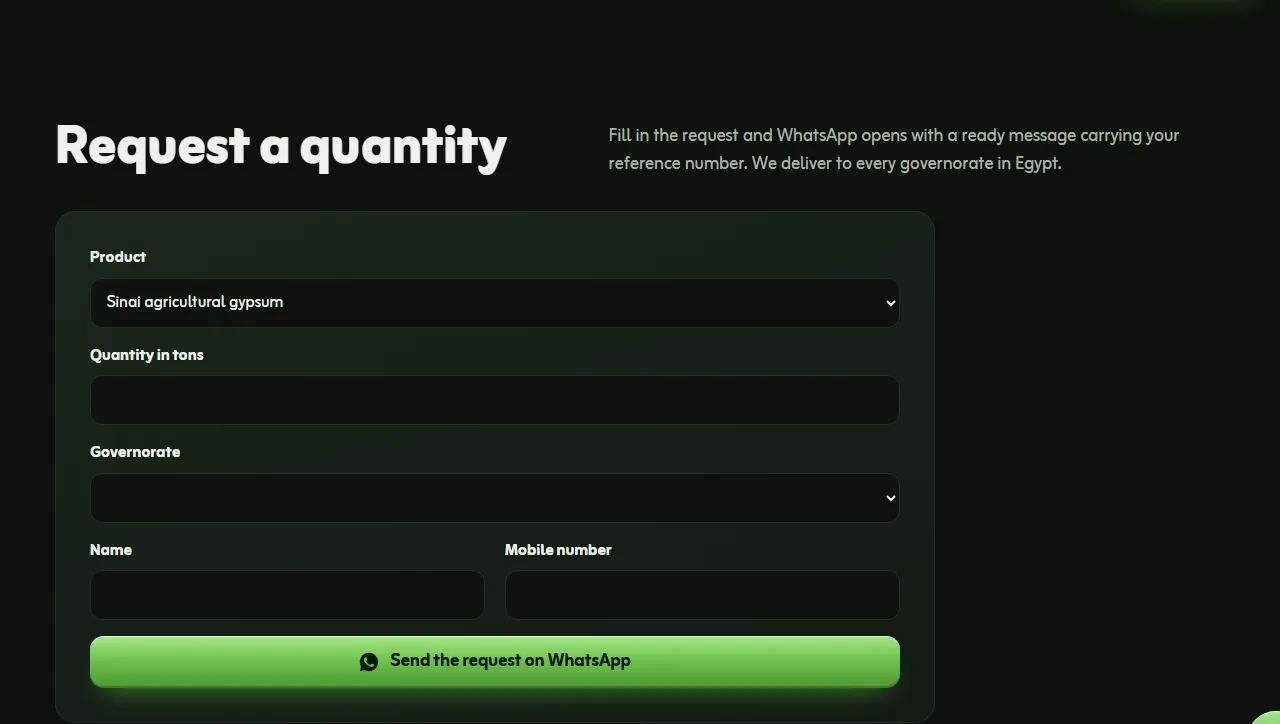
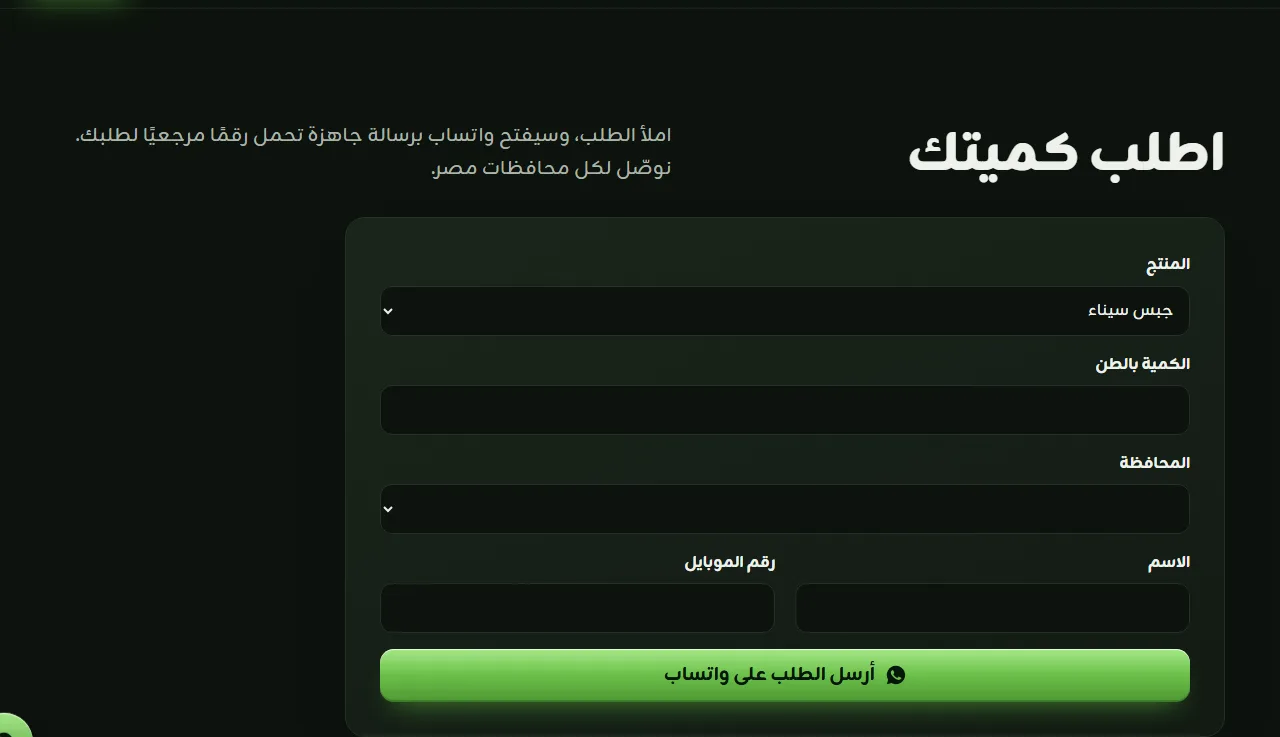
We checked the order flow before launch, confirming that the WhatsApp text, the reference number and the on-hold order matched. If you plan something similar for Egypt, our note on WooCommerce cash on delivery in Egypt covers the neighbouring question of payment on delivery.
Waste collection, leads and three public mailboxes
The company does not only sell. Poultry and cattle farms also ask it to take their manure. That is a second kind of customer with a different question, so the site has a separate waste-collection request form, linked from the main navigation as “Supply waste”. Both forms save every lead inside WordPress, so a request is never only an email in someone’s inbox.
For email there are three public addresses with distinct jobs: sales, office, and complaints and suggestions. The company’s emails were restored on 10 November 2026, before the new site was built. The contact block lists them beside the company’s WhatsApp number (01012205022), its phone number for calls (01111340884) and the address in Itay El Baroud, with a link to the map.
There are also two policy pages, a privacy page and a delivery and ordering page. They are short, but a buyer about to send a quantity request wants to know what happens to the data and how delivery works.
SEO setup for an agriculture company website
Good agriculture company website design still has to be found. This is what we set up. It is the part of the project we can describe fully today, because it is configuration, not a promise about traffic.
| Item | What we did |
|---|---|
| SEO plugin | Rank Math |
| Structured data | One clean schema graph: Organization and LocalBusiness, WebSite, Product with a per-ton price specification, and BreadcrumbList |
| Language signals | hreflang between each Arabic and English pair |
| Social sharing | A 1200 x 630 card for every page and every product |
| Machine-readable summary | An /llms.txt file |
| Indexing | IndexNow notifications |
| Crawl check | A crawl of 49 URLs finished with 0 flags |
We kept the schema to a single graph on purpose. Several plugins each writing their own version of the same business is a common source of conflicting data, so one source is responsible. For Product markup, the price is expressed per ton, which matches how the company sells.
The llms.txt file is a plain text summary meant for AI tools. We treat it as a small, cheap addition and not as a ranking factor, and we do not claim it brings visits.
Content for a website for a fertilizer supplier
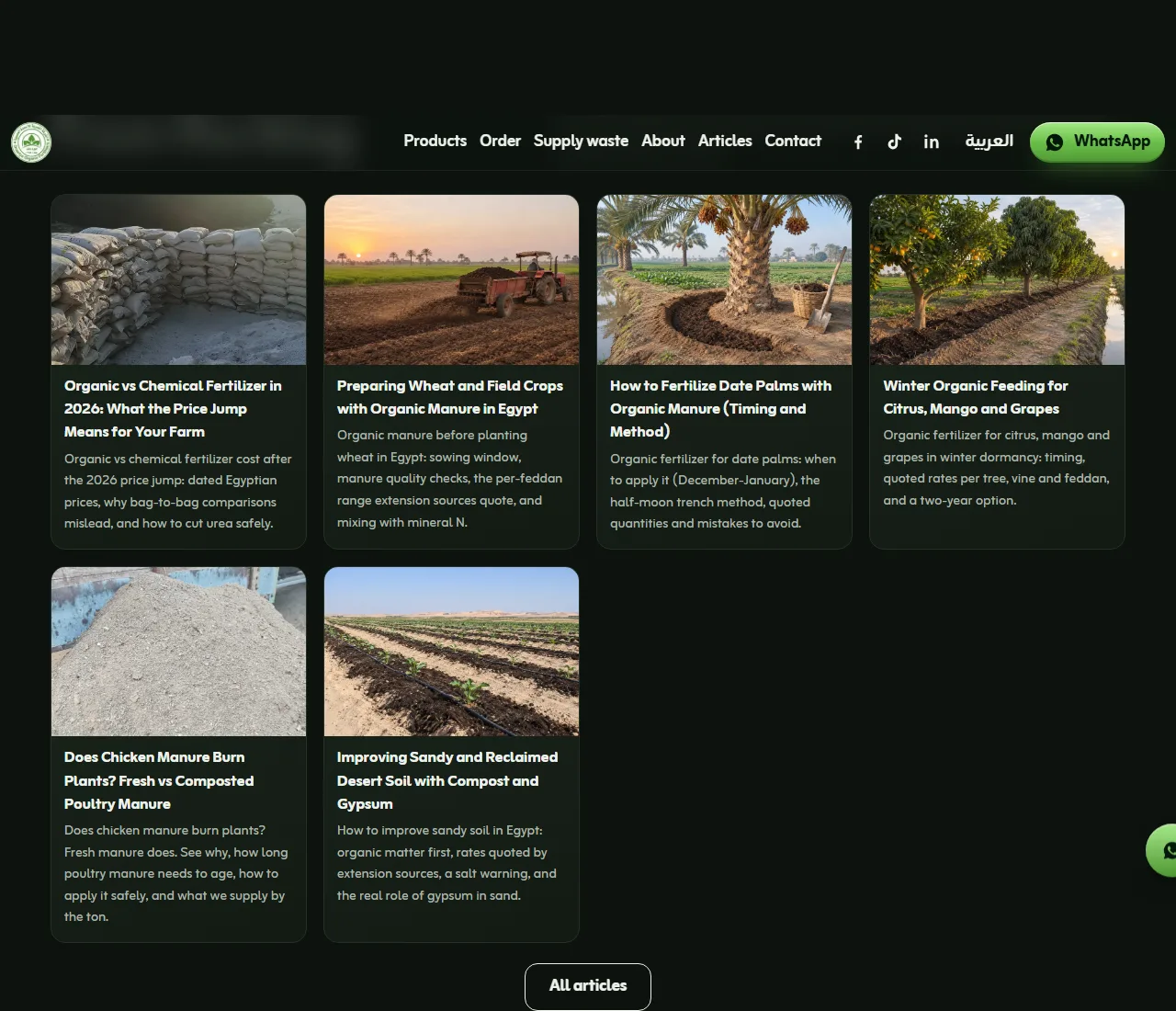
A website for a fertilizer supplier needs more than a catalog. People search for how and when to use a product long before they search for a price. The site launched with 20 blog posts: 10 topics, each written in Arabic and in English, each between 1,300 and 1,600 words. They live at /category/blog/ for Arabic and /en/blog/ for English.
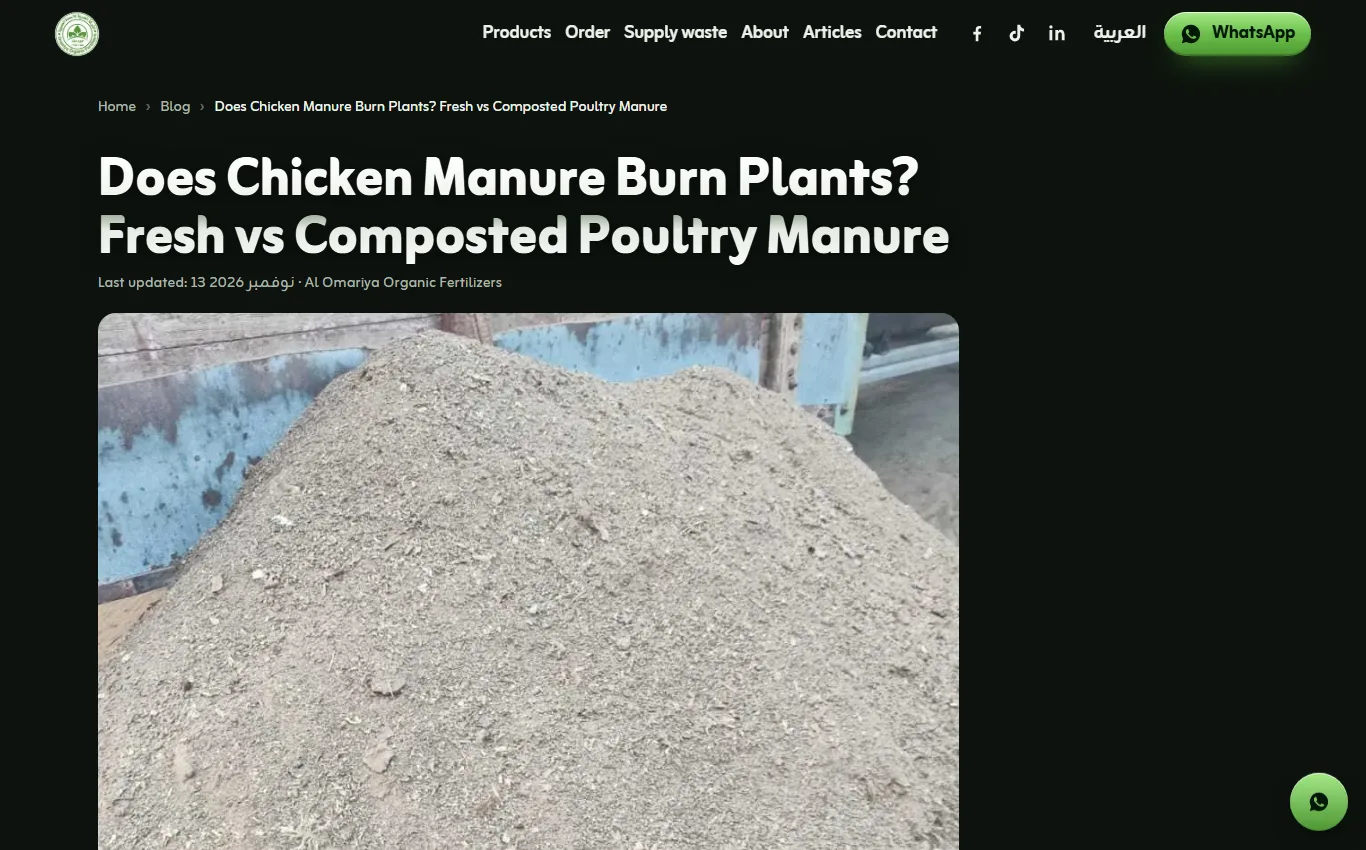
The topics follow questions that came up in the research: organic versus chemical fertilizer after the 2026 price jump, preparing wheat and field crops with manure, date palm feeding, winter feeding for citrus, mango and grapes, whether chicken manure burns plants, and improving sandy and reclaimed soil with compost and gypsum. Where an article quotes a rate or a date, it names the kind of source it came from, such as Egyptian extension articles, instead of presenting the figure as the company’s own advice.
The articles are written to help the reader decide, not to repeat the company name, and the product mention comes after the useful part. The same approach runs through our SEO basics guide.
Performance: what we measured
We ran Lighthouse on 14 November 2026 against the live site with a mobile profile. These numbers come from Lighthouse in headless lab conditions. They are not field data from real visitors, and they will not match what every phone sees.
| Metric (mobile, lab) | Result |
|---|---|
| Performance score | 0.92 to 0.94 |
| First Contentful Paint | about 1.5 s |
| Largest Contentful Paint | about 2.4 s |
| Total Blocking Time | 0 to 210 ms depending on the page |
| Cumulative Layout Shift | 0 |
On the server side, LiteSpeed cache brings the response to about 0.3 seconds for a cached page, against about 1.1 seconds uncached.
The score is good for a page that contains an animated scene, and the late loading of three.js on phones is the obvious reason. We still call these numbers a starting point. Real-user data will come from Google Search Console and field measurements once enough visitors have used the site.
Quality checks before launch
- Viewports. 20 widths checked, not only by resizing the window.
- Accessibility. The axe engine found 0 serious or critical issues on 15 pages. Automated tools catch only part of the problems, so this is a floor, not a certificate.
- SEO crawl. 49 URLs, 0 flags.
- Order flow. The WhatsApp message and the on-hold order carried matching reference numbers.
- Backup. The old site was backed up on 8 November, before any change.
We use a longer list for every site. You can read it as our website pre-launch checklist (in Arabic).
Timeline: five days from backup to launch
| Date (2026) | What happened |
|---|---|
| 8 November | Old site backed up |
| 9 November | Proposal |
| 10 November | Business emails restored |
| 11 November | Five homepage versions prototyped; the client chose V5 |
| 12 November | Site built and deployed |
| 13 November | Launch |
The pace came from deciding the design with prototypes instead of meetings. A project with more products, an online payment gateway or a custom back office would take longer, and we would say so in the written outline before starting.
What we do not know yet
The site went live on 13 November 2026 and this post was written one day later. We have no data on traffic, rankings, calls, WhatsApp requests or sales, and we will not suggest any. New pages usually take weeks to be crawled and ranked, and the first useful numbers will come from Search Console after a few weeks.
Some trust material is also missing because the client has not supplied it yet: a licence number and laboratory analyses of the products. We did not put placeholders or borrowed claims on the site. When the documents arrive they can be published as real evidence, because for a bulk buyer a lab sheet is worth more than any design.
We will update this post when there are real numbers to show.
What to copy if you are building a similar site
- Price by the unit your buyers use. Per ton, per truck or per cubic metre, whichever your customers say aloud, plus the condition that sales confirms the final number.
- Make the first request easy. Five fields and a ready WhatsApp message beat a long form.
- Keep a record outside the chat. Save every request inside the site as well.
- Show the process. Buyers trust a supplier who can show where the product comes from. Label illustrations honestly.
- Publish both languages properly. Mirrored layout, hreflang and text written for each reader.
- Load heavy effects late. Let the first screen paint before the animation starts.
- Leave out what you cannot prove. Add certificates and lab results when you have them.
If your company sells to farms or traders, our agricultural company website service page (in Arabic) explains what we include, and our portfolio lists other projects. For a case where the website had to show real engineering work, read the engineering company website case study (in Arabic). For a catalog-led build, see the wholesale supplies online store case study.
Frequently asked questions
How much does organic fertilizer website design cost?
We do not publish a fixed price, because the cost follows the number of products, languages, forms and custom parts. After a free first session we send a written outline with the screens, the price and the timeline. Our page on website cost in Egypt explains what moves the price.
Why catalog mode instead of an online shop for a fertilizer supplier?
Bulk orders are priced by quantity and delivery, and buyers usually want to talk first. A cart with online payment would add friction and a fixed price that may not be true. Catalog mode shows prices and still captures a real, trackable order.
Can you build a bilingual Arabic English website on WordPress?
Yes. This project is one example: Arabic right to left, English left to right, and hreflang between the pairs.
Are the pictures on the site real?
The five scene plates on the home page are AI renders and are labelled as such. The product pages show photos of the material itself.
Sources and further reading
- The live site: oof-eg.com (Arabic) and oof-eg.com/en/ (English), including its English blog and llms.txt.
- Search result reads, 12 and 13 November 2026: Yellow Pages Egypt category pages; Hundzsoil; almerzm-shop.com; Egyptian news price trackers; Flagma-eg; TradeKey compost listings.
- Performance numbers: Lighthouse, mobile profile, headless lab run on 14 November 2026.
Planning a website for a supplier or factory?
Tell us what you sell and how buyers order. We reply with a written outline of screens, price and timeline, after a free first session.
خدمات مرتبطة
- تصميم مواقع الشركات في مصر
- إنشاء متجر إلكتروني
- برمجة مواقع وأنظمة خاصة
- ايميل رسمي للشركات
- أتمتة واتساب للشركات
- نظام شركات السياحة