
How we built a website for a scrap buyer in Riyadh around a weighbridge ticket, with 20 guides, no invented prices and real speed numbers.
- شركة برمجيات مصرية منذ 2010
- دعم فني على واتساب
Read this case study in Arabic
In short: Metal Gate Scrap is a scrap buyer in Riyadh whose competitors sell through classified ads, Facebook pages and WhatsApp, with almost no real web presence. We built metalgatescrap.com around one idea, a digital weighbridge ticket that turns a visitor’s pile of scrap into a ready-written WhatsApp message. This is the honest account: a rejected first design, a second one that looked empty, twenty guides written without a single invented price, a speed bug we caused ourselves, and the facts the client has not yet confirmed.
The call: a scrap buyer, a fresh WordPress install, one sentence of brief
Metal Gate Scrap (in Arabic, بوابة المعادن للسكراب) came to us on 26 October 2026. The business buys scrap in Riyadh, Saudi Arabia. The list the client gave us was long and physical: copper, cables and wires, aluminium, kitchens, windows and doors, air conditioners, batteries, iron, and general scrap. The brief was one sentence: get me work.
We had a business card, a phone number that doubles as the WhatsApp number, and a blank WordPress install with nothing on it but a default theme. We had no photos of the yard, no price list, no company history, and no list of licences. That last point shaped almost every decision that followed, because a website for a trade business is tempting to fill with claims. We decided early that anything the client had not told us would not appear on the page.
The card itself was black and gold, with artwork that looked computer-made. We noted it and moved on to the harder question: who is this site actually for, and what does that person do the moment they decide to sell?
What we found: a market that lives in classifieds and chat threads
Before drawing anything we spent time on the field. Our research tools in this project cannot give search volumes, so what follows is what the results pages showed us, not a measurement of demand.
When you search in Arabic for words like شراء سكراب الرياض (buying scrap, Riyadh), the first page is crowded with near-identical business sites. A phone number sits inside many of the page titles. Several pages promise the highest price, instant payment, free transport and a 24-hour service in the same breath, and several quote prices per kilo that disagree with each other by a wide margin. Alongside them are classified listings, including pages on Hiraj-style ad platforms, and Facebook pages that are little more than a phone number and a list of materials. The English results look the same, only translated: pages titled along the lines of “Scrap Buyer in Riyadh” with a list of metals and a promise of fast pickup.
Two things stood out. First, almost every competitor sells the same promise, which means a promise alone cannot separate one buyer from another. Second, almost nobody helps the seller prepare. A person with a pile of old air conditioners, a van of cable offcuts or a workshop clear-out has real questions: is this copper or brass, should I burn the insulation off, does a rusty compressor still count, who comes to collect it, and when do I get paid. The ad pages answer none of that. They ask you to call.
That gap is where a small business can be useful without shouting louder. So the website had two jobs. One was to make the first message effortless. The other was to be the place that actually answers the seller’s questions, in the seller’s own words, and to let Google find those answers.
The words people use, and the ones we chose
The vocabulary of this trade is not obvious from outside, and it differs by country. In Saudi Arabic the everyday word is سكراب, borrowed from English. Egyptian readers might say خردة, and you will see خردة on some Saudi pages too. The same goes for metals. Copper is نحاس, split in practice into red copper and yellow copper, and yellow copper is also called براص. Windows and doors in aluminium or iron are called درايش in the Gulf. Air conditioners are مكيفات, usually split, window or central, and the phrase people use for a broken one is closer to “damaged” than “scrap”.
We built the pages around phrases that follow the pattern people really type: buying scrap in Riyadh, selling copper, aluminium scrap, old air conditioners, selling at home versus through an ad. For the English version the focus was the plain phrase a visitor would use, a scrap buyer in Riyadh. We did not guess at volumes, and we did not chase a single keyword. Each material got its own page and its own title, so that a search for one metal lands on a page about that metal and nothing else.
Decision one: the sale is a ticket
Anyone who has sold scrap knows the weighbridge ticket: a numbered slip with a date, the material and the weight. It is the one document in the whole transaction that both sides trust. We decided the homepage would be that slip.
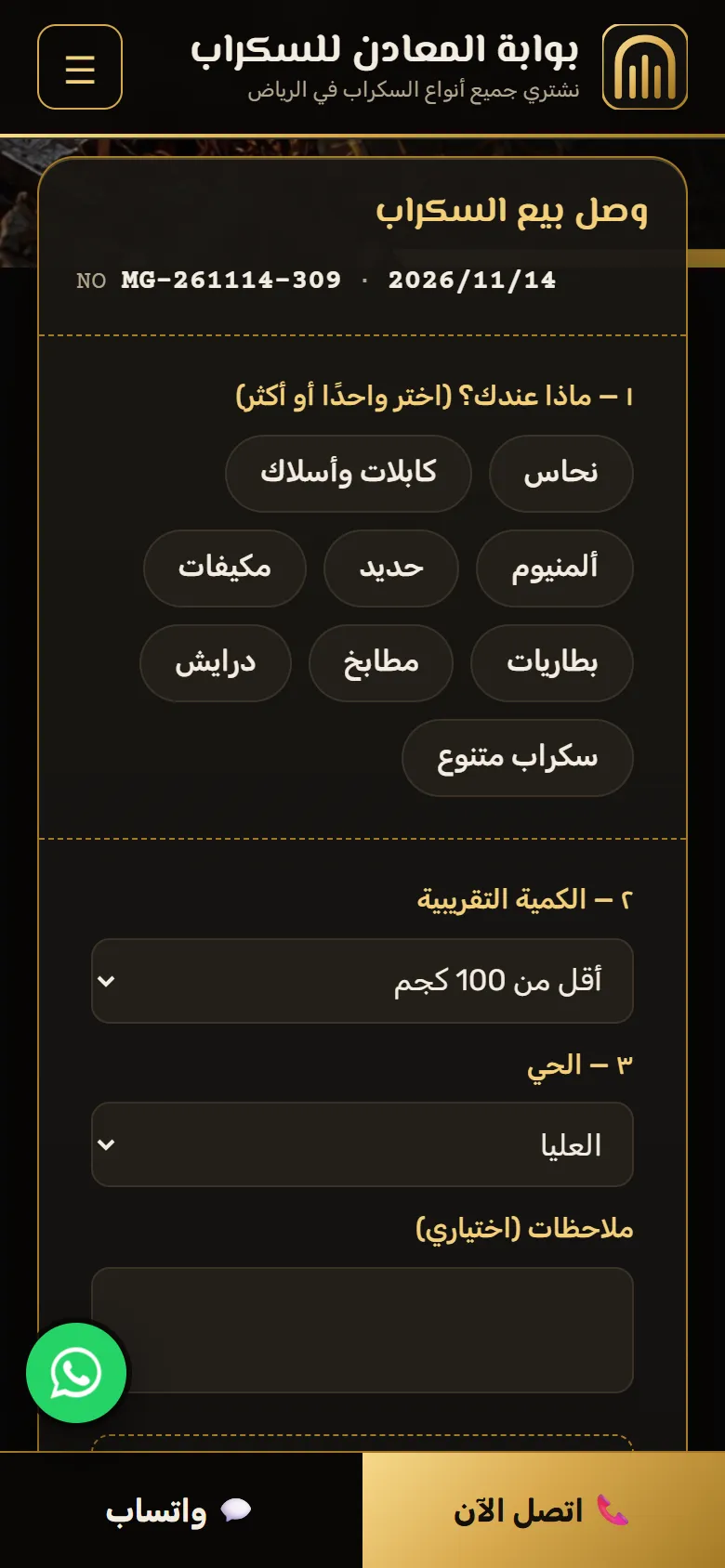
The ticket sits near the top of the page. The visitor taps the materials they have, picks an approximate quantity from five bands, and chooses a district from a list of Riyadh neighbourhoods. Each ticket gets a number and a date, in the same spirit as a real weighbridge slip. A summary line shows what has been chosen, and the green button stays disabled until at least one material is picked. When it is pressed, WhatsApp opens with a message already written: what the person has, roughly how much, the district, the ticket number, and a line saying it was sent from the site. The seller adds photos and presses send.
The list of districts has 25 entries, ending with an “other district in Riyadh” option, so nobody is stuck. The quantity bands start at under 100 kg and go up past a tonne, with a “don’t know exactly” choice, because most people honestly do not know how heavy their pile is. The form never asks for a name, an email or a phone number. WhatsApp already knows who the sender is.
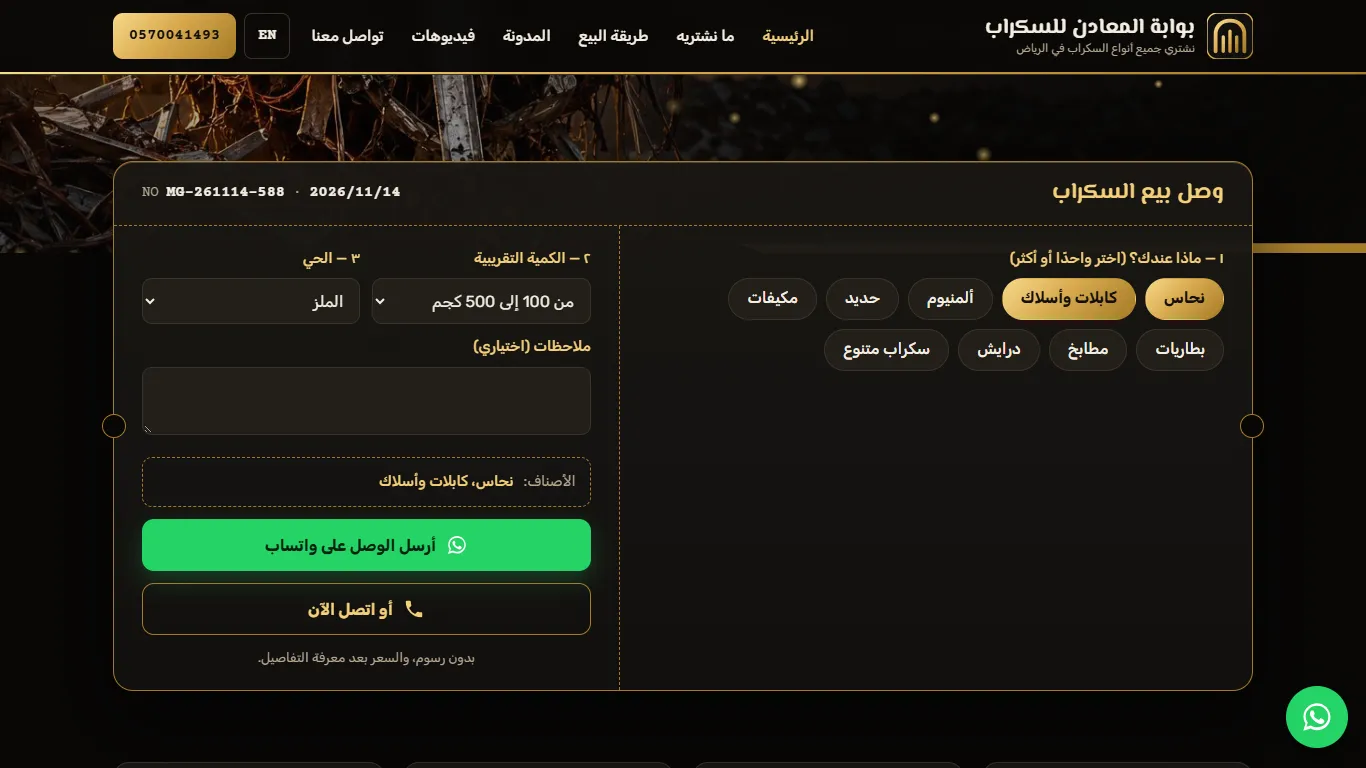
We should be clear about why this suited this client. The business closes on WhatsApp. A contact form that emails someone is a step backwards for people who already live in chat, and a “request a quote” page that waits for a callback loses the seller in the gap. The ticket meant the first message that reaches the buyer already contains the three things he would otherwise have to ask for.
Mistake one: the first design was rejected, and it deserved to be
Our first version used a cream and oxblood palette with hi-vis yellow accents and a set of friendly cartoon-style icons for each material. We chose it deliberately. We deliberately stayed away from the colours of the client’s card, because we wanted something that would not look like every other scrap site.
When our founder reviewed it, his verdict was that it was neither our style nor his, and that the client would not accept it. He was right. An industrial buyer’s customers are people with trucks, workshops and demolition jobs. Cartoon icons told them nothing about whether this company could handle a tonne of aluminium profile. We had designed for ourselves and not for the person standing next to the pile.
The lesson we wrote down was short: never ship cartoon icons for an industrial buyer, go photographic first. The decision for the second version was to take the one asset the client already had, the black and gold of his card, and treat it as a premium look rather than as something to avoid.
Version two, and the review that said it looked empty
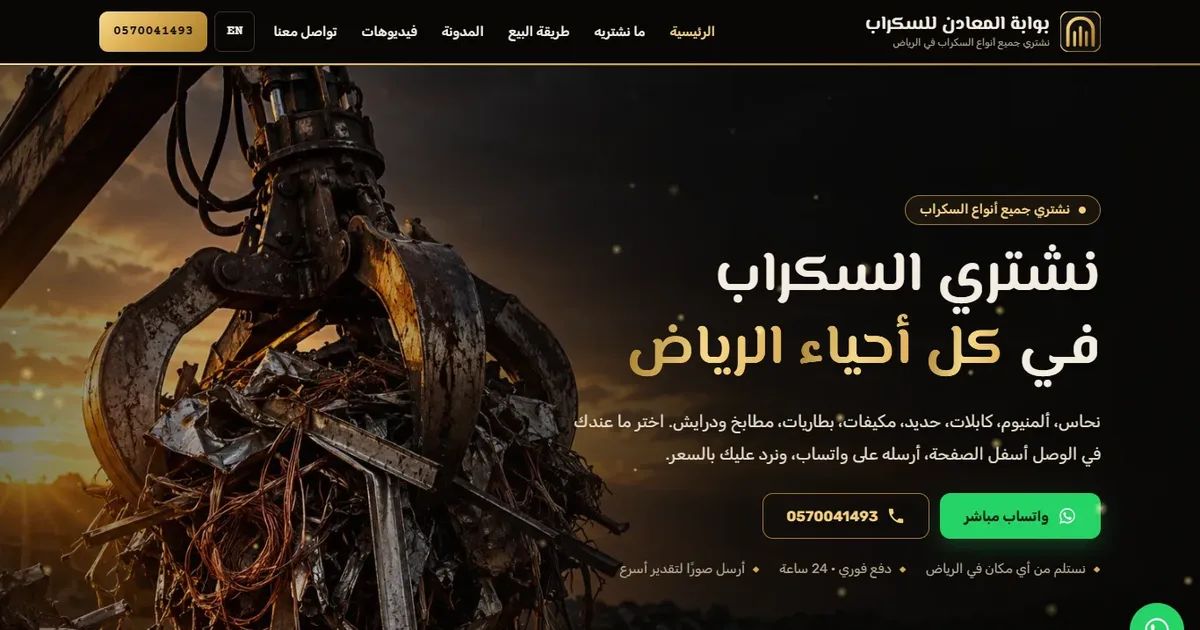
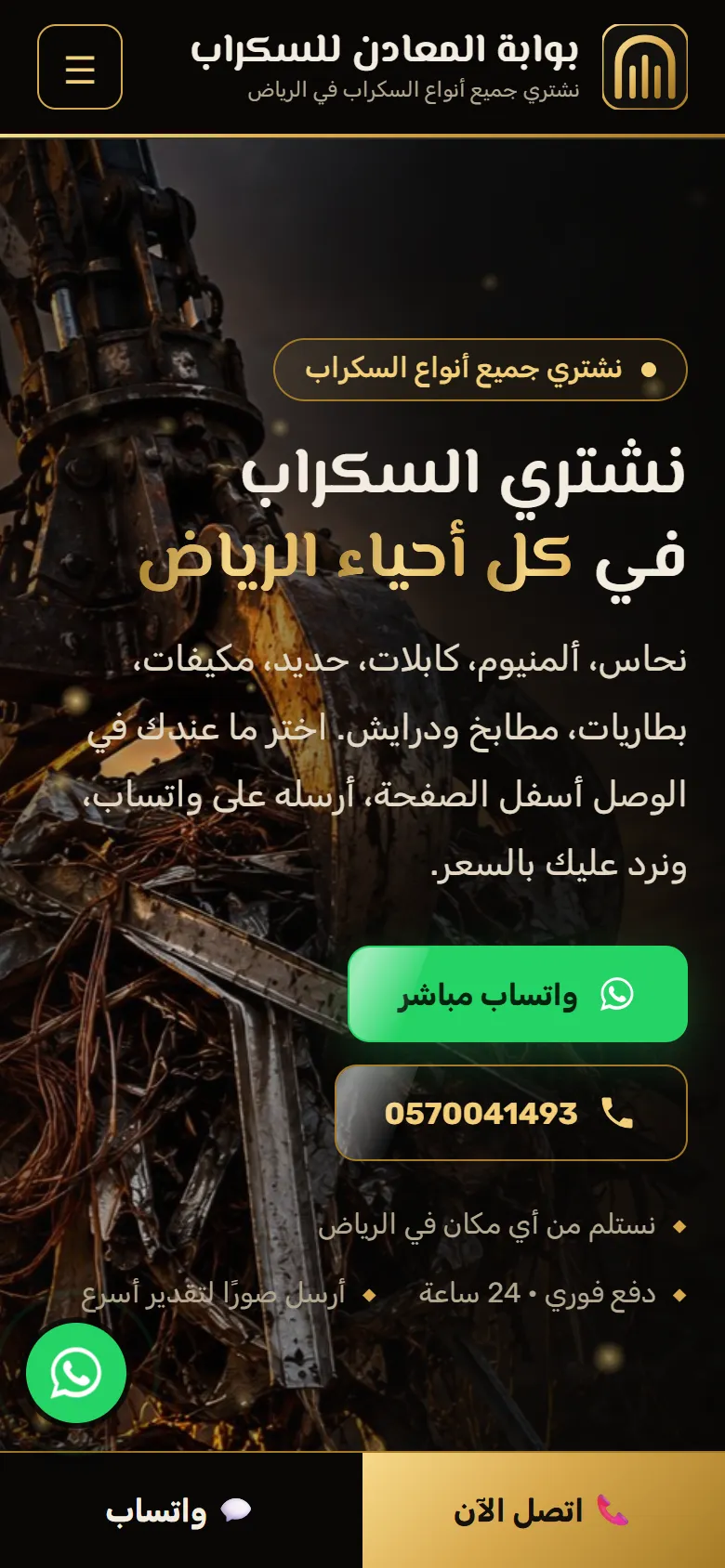
The second design is the one live today. The page is black with a warm gold used sparingly, a display face with Arabic character for headings, a clean text face for reading, and a typewriter-style face for the ticket digits so the slip feels like a slip. The hero is a full-bleed photograph of a crane grapple holding a bundle of mixed metal with copper wire visible in it.
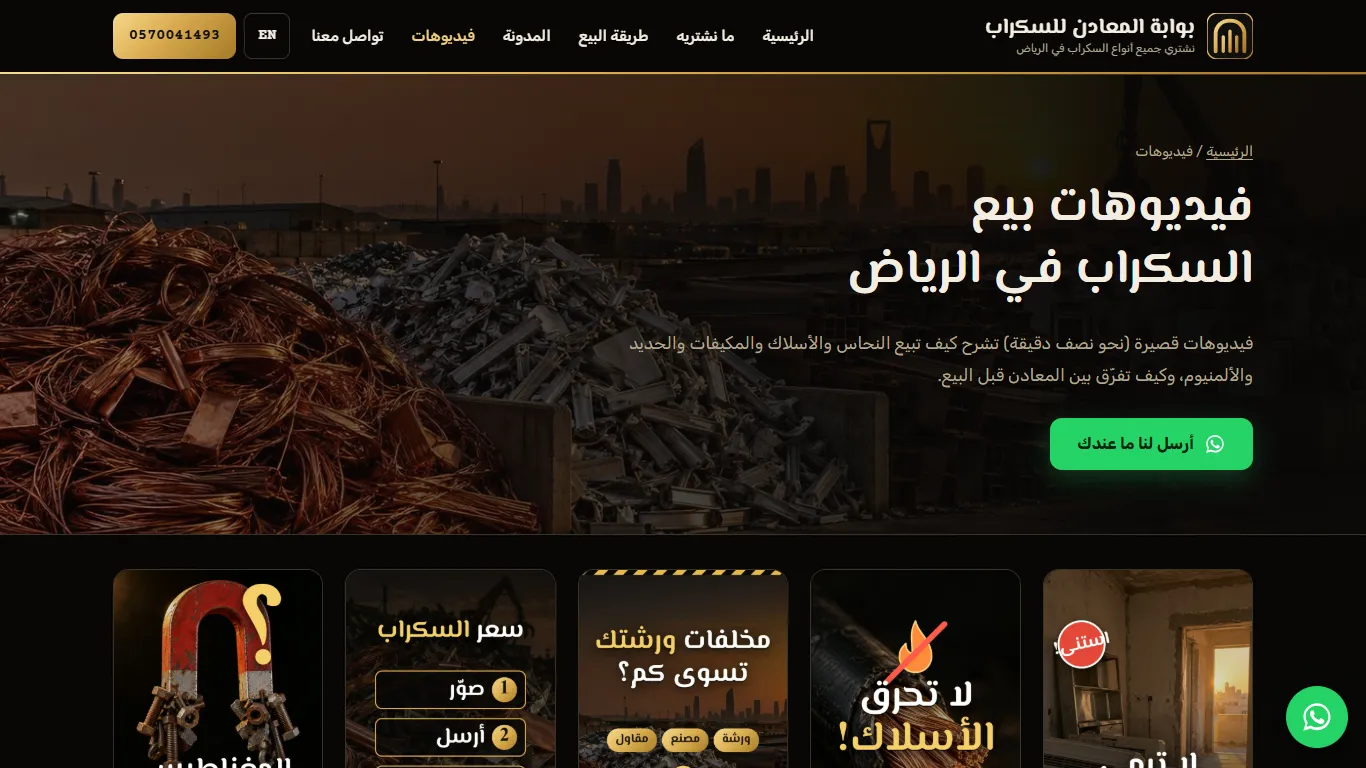
A word about the images, because honesty matters here. The client had no photographs we could use, so the pictures on the site are AI-generated, produced for each material and for the hero, and they are not photos of the client’s yard. We said so internally from the start, and we told the client that real photos would replace them when he sends some. This is still an open item.
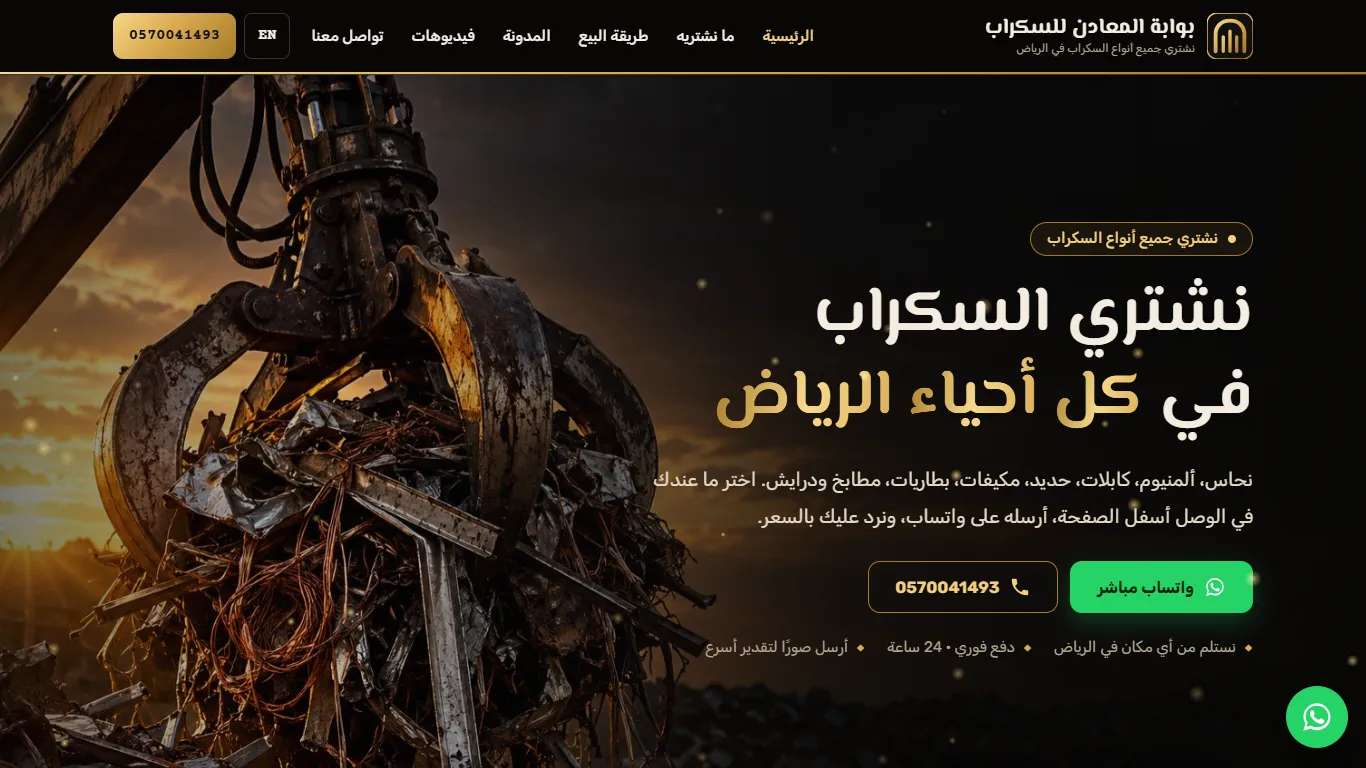
Even so, the first photographic build drew a different complaint. The reaction we got was that it was better now, but the website looked empty. Fair again. The first draft of the homepage had a hero, a ticket and a grid of materials, and then it ended. A visitor who scrolled looking for reasons to trust a stranger found very little.
We added four more images (a weighing scale, a truck, the Riyadh skyline and a scrap yard), a short trust strip, a slow ribbon of material names, a pricing explanation next to the scale, a yard band, a coverage section that lists neighbourhoods, three tips for preparing scrap, per-material notes on what raises and what lowers the price, and, on the material pages, a sticky side card with the WhatsApp action. At 1366 px wide the homepage now measures about 8,880 px tall. It is a long page, but every section answers a question a seller would ask.
The page also has a small line we are fond of, in the pricing section: there is no fixed price for scrap, because metals move with the market, and four things decide what you get. Those are the type of metal, how clean it is, the quantity and weight, and the market price on the day of the sale. It is a plain statement, and it also keeps us honest, because it means the site never has to carry a number that will be wrong by next week.
A walkthrough of what is live
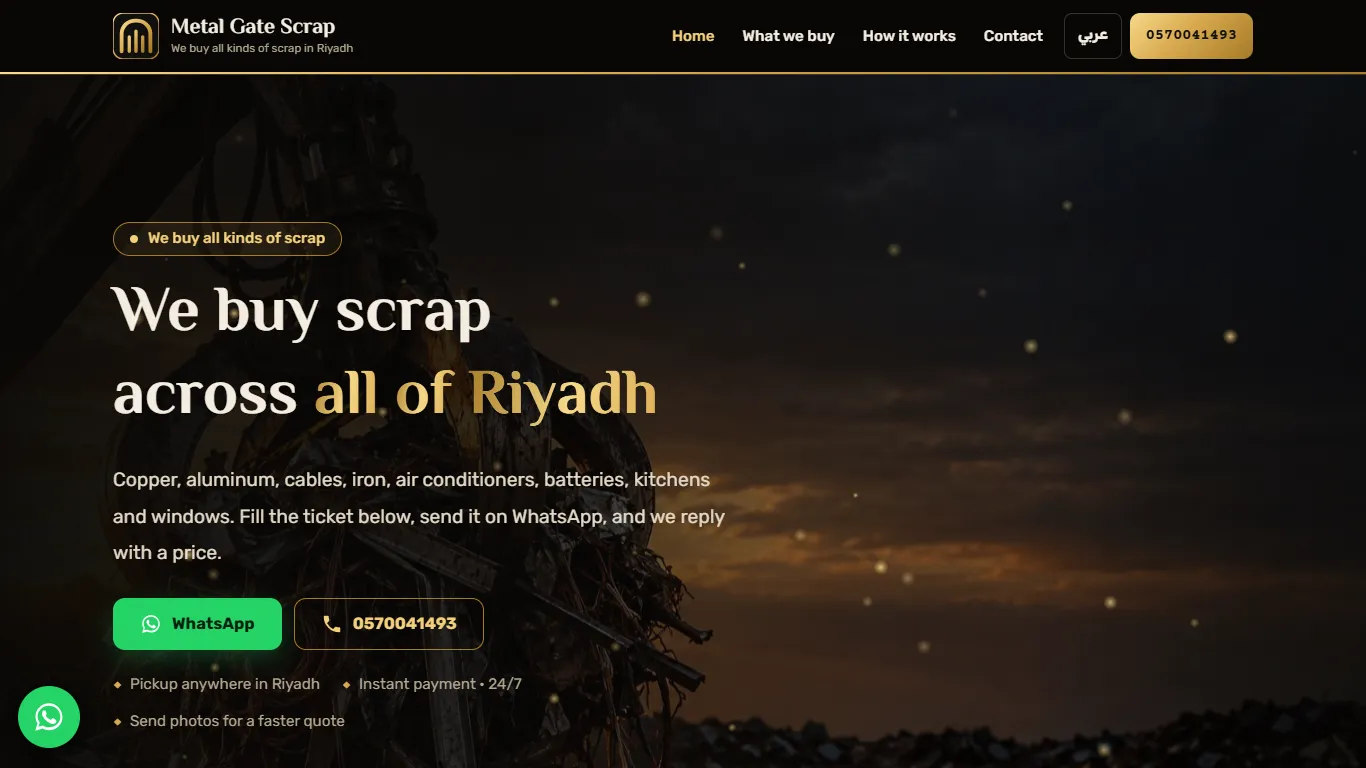
The site has an Arabic main version and an English version under /en/. The structure is deliberately flat: a homepage with a how-it-works section, nine material pages, a contact page, a guides section, and a videos section.
On a phone, which is probably how many sellers arrive, the header collapses to a menu button, the hero keeps its two actions (WhatsApp and call) on full-width buttons, and a fixed bottom bar keeps WhatsApp and the call button within reach as the person scrolls.
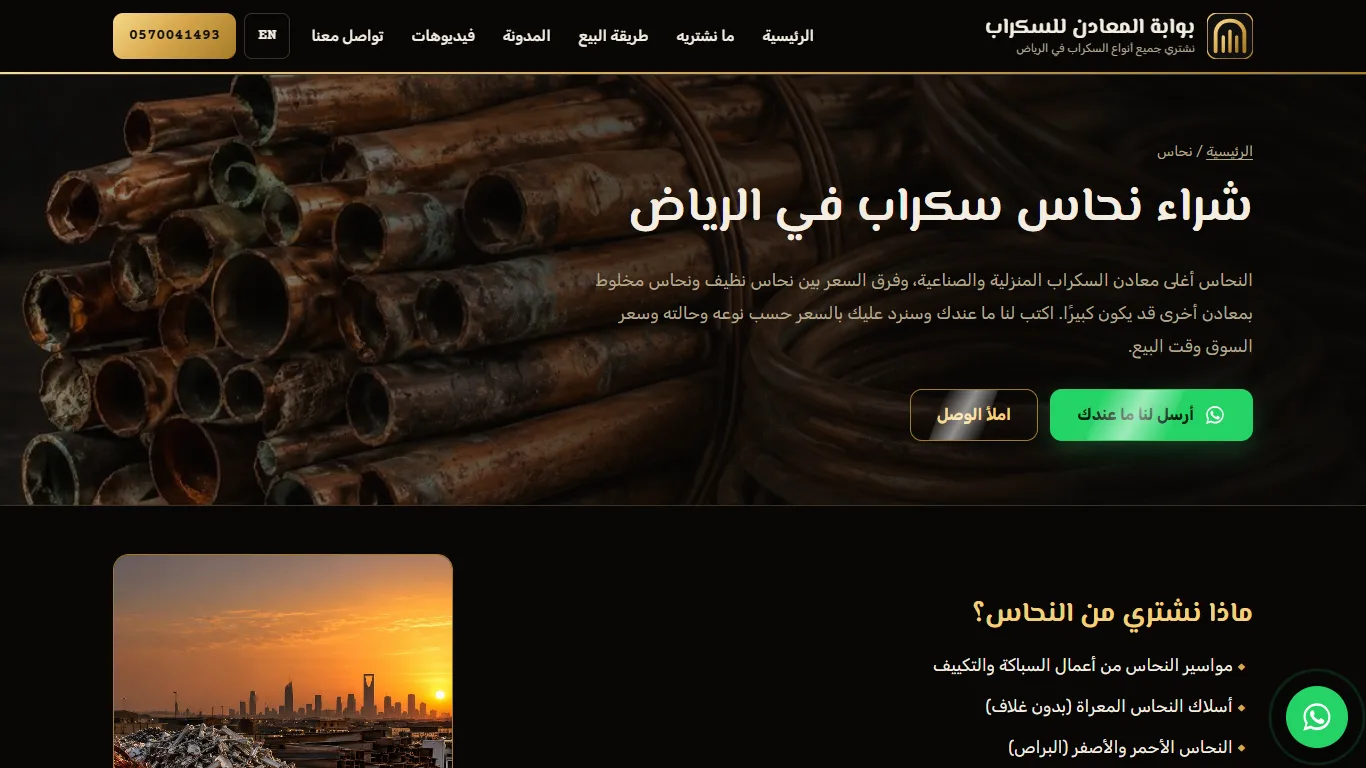
Each material page repeats a simple structure so a seller never has to guess. It says what we buy within that category, how to prepare it, how the price is decided, what raises it, what lowers it, and a short set of questions, with the WhatsApp action at the top and the bottom. Copper, for example, lists plumbing and air-conditioning pipe, bare wire, red and yellow copper, and the copper inside motor windings and compressors. It tells the reader to separate copper from iron and plastic and not to mix yellow with red, because each has its own price.
Twenty guides, and no invented prices
Within two days of the launch we published twenty Arabic guides, in two batches of ten, under the heading “scrap guide”. We planned them from the questions in the search results and the gaps we saw: how to tell copper, aluminium and iron apart, what to do with renovation leftovers, selling from a workshop or factory, the difference between scrap and the other words buyers use, selling through an ad versus to a buyer directly, getting scrap collected from a home, old motors and transformers, how to write a WhatsApp enquiry, restaurant and shop equipment, and one hub page that explains selling by area of the city.
The hardest rule we gave ourselves was the simplest: no invented prices. The phrase that keeps showing up in this field is some version of “price of a kilo of copper scrap”. The pages that answer it quote figures, and as we saw in our research, the figures disagree widely from one site to the next. Some name a number with no unit. We have no price list from the client and no right to publish one for him. So the guide on copper pricing explains what moves the price and how to find your own number before you sell, and it stops there. A sentence we are happy with: ask for the price of what you actually have, instead of asking for a number that does not fit it.
There was a practical cost. A guide that refuses to name a figure will not satisfy every visitor who arrives hoping for one. We accepted that. A false number would cost the client more, because the first seller who got a different offer would stop trusting the whole site.
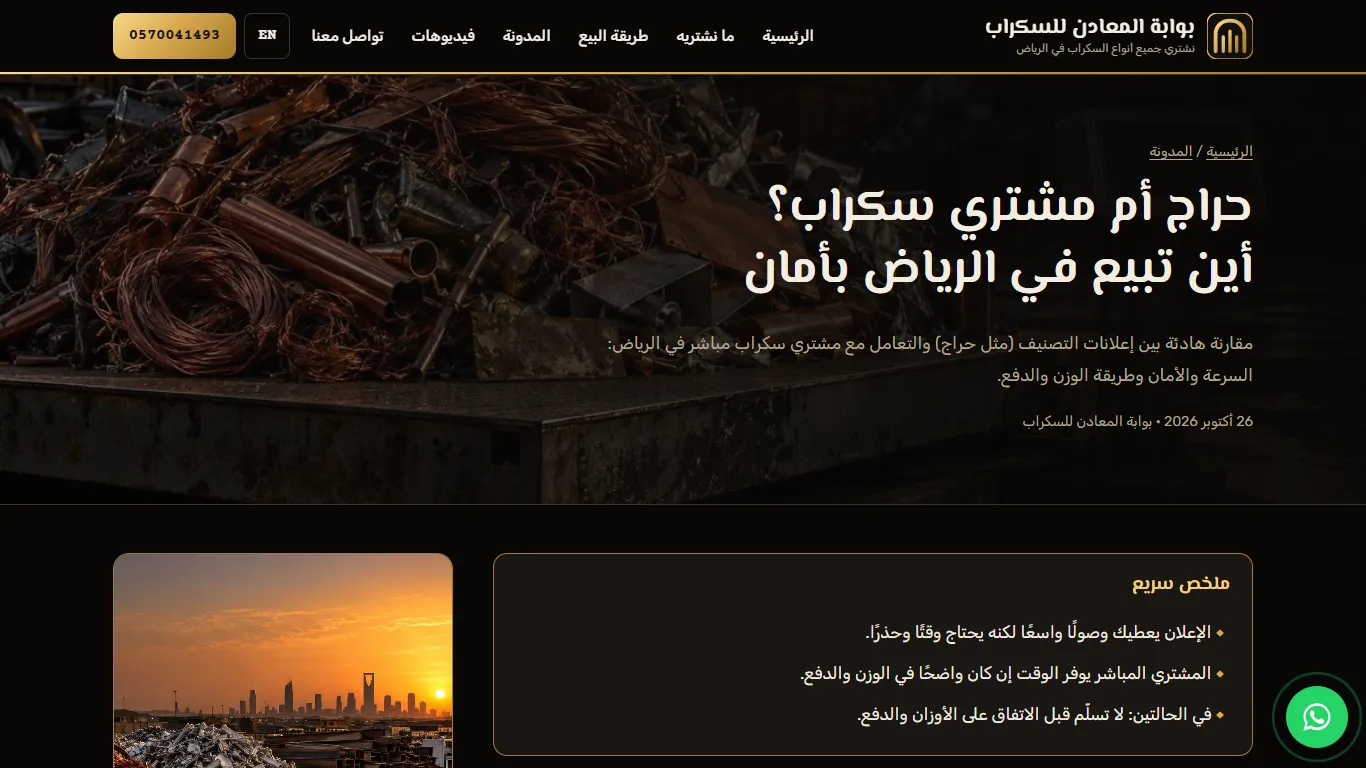
This particular guide is our favourite for the angle of this story. It does not tell the reader that classifieds are bad. It says an ad gives wide reach but needs time and care, that a direct buyer saves time if the weight and payment are clear, and that in both cases you should not hand anything over before you agree the weights and how you will be paid. It lists the signs of an unserious buyer: asking for a deposit before seeing anything, refusing to explain how the pricing works, changing the number at the scale without explanation, and rushing you to load. That is a competitor’s channel being described fairly, on the client’s own site. It reads as credible because it is.
Later we added a twenty-first article, about selling old fridges and washing machines, as a live demo for the client’s own training. We will come to that below.
What the client told us, and what he has not
Our first set of articles hedged on purpose. Where we did not know whether the business really bought something, such as electric motors, restaurant equipment or stainless steel, the page said to send a photo and the buyer would say. Then the client’s answers came through the owner of our agency, and they were clear:
- He buys everything, in every category listed.
- He collects from anywhere inside Riyadh.
- Payment is instant.
- The business answers 24 hours a day, every day.
We applied those four facts across the site the same day: the how-it-works step now reads “pickup and instant payment”, the hero carries the pickup, payment and hours line, the frequently asked questions answer all four, the footer repeats them, and the business’s structured data states opening hours around the clock. We also removed the hedges from the articles on motors, restaurant equipment, stainless steel and home pickup.
A list of what is not confirmed matters just as much, and we have kept it out of the site. We do not claim a “highest price”, because no price list has been shown to us. We do not state years in business, trade licences, a response-time promise, free transport or a minimum quantity. One of the short sales videos contains a line about replying at any hour, and that promise still needs the client’s confirmation. If you read a competitor’s page with all of those claims side by side, you will see why we left them out.
The search plumbing, kept short
We first set up Rank Math for on-page SEO, with a sitemap, structured data and redirect and 404 monitoring. It went in, it worked, and then our founder asked us to switch to Yoast SEO, so we did. Rank Math was deactivated, not deleted, and Yoast was configured with a company profile, a default share image, author archives off, and titles in the form “page title | بوابة المعادن”. Every page in the sitemap was then audited for a single title, a single canonical, a single description, a single H1 and a share image. One small trap worth sharing: enabling Rank Math’s modules through a setting did not create their database tables, so the logs filled with “table doesn’t exist” errors until we created the tables by hand. We catch that kind of thing by reading the error log after any plugin change.
We also did the work that is rarely shown. Security headers, closed user enumeration, xmlrpc blocked, branded error pages, a sitemap, a robots file, and structured data for the business, the services and the questions. A video sitemap went in for the five short videos we produced and put on their own pages with a transcript each. For measurement we connected Google Search Console and Google Analytics 4, and the site sends two events we care about more than page views: a tap on a WhatsApp link, and a tap on a phone link. A small visitor counter that stores no cookies and no IP addresses sits in the WordPress dashboard for the owner.
One detail on indexing, because it surprised us. By 31 October, five days after launch, Search Console showed all 42 URLs in the sitemap as indexed by Google. Google’s first crawls were on 28 October, and the pages were found through links in the descriptions of the short videos we had published on our YouTube channel. We had told the client’s owner earlier that the site was not on Google, and that was wrong. We had judged from a search that is limited to US results, and from an unreliable operator query. The Search Console URL inspection is the tool that tells the truth. We use it now and nothing else for this question.
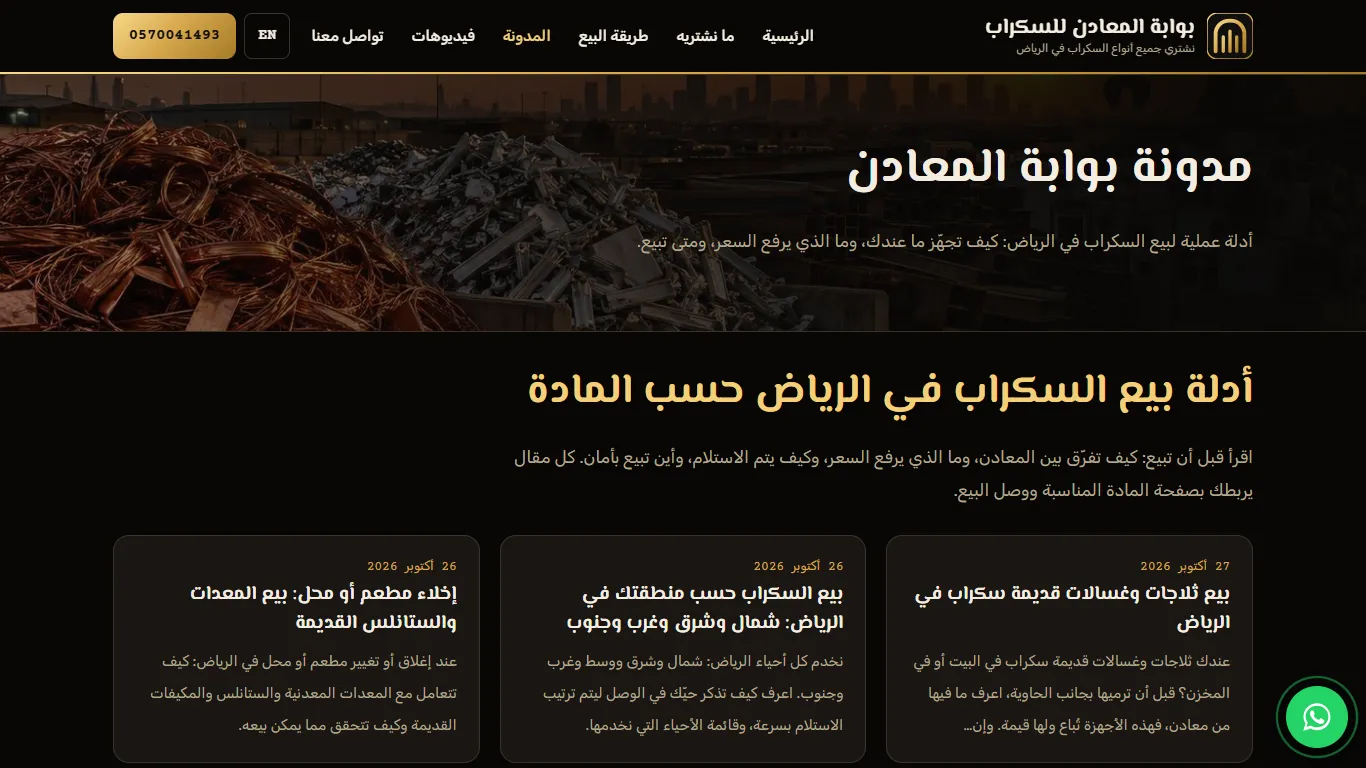
For the owner of the business, we recorded a walkthrough of how to add an article and read his visitor numbers, and created an editor account for him. We published one real demo article during that recording, the fridges and washing machines guide, using only confirmed facts.
The speed bug we caused ourselves
We wanted the Arabic headline in the hero to arrive with a little movement. The first version split the headline into words and animated each one. It looked fine, and it made the page jump. The headline reflowed as each word arrived, and the layout shift score, which measures exactly that kind of jump, came out poor.
The fix was to make the headline animation affect opacity only, on inline spans, so no word ever changes size or position. After that the shift dropped to effectively zero. The Lighthouse check we ran on a material page in late October showed accessibility, best practices and SEO all at 100 on mobile, and a Largest Contentful Paint of about 1.2 seconds. The lesson is a rule we now apply to every site: an animation may change opacity or transform, but never anything that moves other content.
Measured today, 14 November 2026
We measured the live site again for this article. The method: a headless Chromium browser emulating a phone at 390 by 844 pixels with a device pixel ratio of 2, no network or CPU throttling, the browser cache disabled, and the Google analytics tag blocked so that our test visits did not pollute the client’s numbers. Layout shift and Largest Contentful Paint came from the browser’s performance observers, and transfer size is the sum of compressed bytes reported for the page and its resources. The tests ran from Egypt, over an ordinary office connection. These are not Lighthouse scores, they are single-machine readings, and they will vary from one run to the next.
| Page | Server response (TTFB) | LCP | CLS | Requests | Transferred |
|---|---|---|---|---|---|
| Arabic homepage, run 1 | 867 ms | 2.37 s | 0.0015 | 19 | 535 KB |
| Arabic homepage, run 2 | 602 ms | 2.20 s | 0.0001 | 19 | 535 KB |
| English homepage | 412 ms | 1.47 s | 0 | 18 | 630 KB |
| Copper page (Arabic) | 447 ms | 1.29 s | 0.0002 | 18 | 450 KB |
The honest reading: layout shift is essentially nil everywhere, which confirms the animation fix has held. The material page loads its main content in about 1.3 seconds, in line with the 1.2 seconds we saw in October. The Arabic homepage is slower, at 2.2 to 2.4 seconds, because its largest element is the full-bleed hero photograph. That is still inside the 2.5 second line that Google calls good for Largest Contentful Paint, but only just, and it is the page we would tune next, by serving a smaller hero image to phones. The only console message we recorded on each page was the failed request for the analytics tag that we had blocked ourselves, so the site produced no console errors of its own.
What changed, and only what we can verify
- A bilingual site is live in Arabic and English: a homepage with a how-it-works section, nine material pages, contact, a guides section and a videos section.
- The homepage turns a visitor’s materials, quantity and district into a pre-written WhatsApp message, with a ticket number.
- Twenty guides were published in the first two days, plus one demo article later, with no prices in any of them.
- Search Console shows the 42 sitemap URLs checked on 31 October as indexed by Google.
- WhatsApp taps and phone taps are recorded as events in Analytics.
- The page loads quickly, as the numbers above show, with one page we would still improve.
What we cannot tell you is how many enquiries the site has produced. The client has not shared lead counts with us, and we have not recorded search rankings, so there is no results paragraph in this story. We would rather leave it out than invent a percentage. If the client shares his numbers, we will add them, with his permission.
Lessons for anyone building a site for a trade business
Design for the person next to the pile
Your customer is a tradesperson with a truck, not a design reviewer. If your icons would not look right on a weighbridge office wall, change them. We learned this by getting it wrong.
Take the existing habit and shorten it
The seller already messages on WhatsApp. A form that ends in a pre-filled chat message respects that habit, and costs the visitor ten seconds.
Answer the questions the ads do not
The competition in a classifieds-driven field sells the same promise. The seller’s actual questions, such as how to separate metals, who collects, and how to avoid a bad deal, are mostly unanswered, and those answers are what earn a click and then a message.
Leave out any fact you cannot prove
No price, no ranking, no year of founding, no licence number, until the client confirms. A site that hedges honestly can be improved. A site that exaggerates has to be defended.
Test the animation, then test it on a phone
Beautiful movement that shifts the layout costs you search performance and trust. Keep motion to opacity.
Check indexing with the right tool
Search Console URL inspection tells you what Google has. A web search from the wrong country does not.
If you run a similar business, you may want to read about our website development service, our approach to SEO for service businesses and how we handle web design.
FAQ
What is Metal Gate Scrap?
It is a scrap buyer in Riyadh. According to the information the client gave us, it buys copper, cables and wires, aluminium, iron, air conditioners, batteries, kitchens, windows and doors, and mixed scrap, collects from anywhere in Riyadh, pays instantly and answers around the clock.
Why did the homepage become a weighbridge ticket?
Because a numbered slip with a date, the material and the weight is the document everyone in this trade trusts, and because the sale itself happens on WhatsApp. The ticket turns three choices into a ready message.
Does the site show scrap prices?
No, on purpose. Prices move with the market, the client has not given us a price list, and the figures that appear on other sites disagree widely. The site explains what decides the price and invites the visitor to send details.
Are the photographs on the site real?
No. The images are AI-generated illustrations and photographic-style images made for the site, because the client had no pictures of his yard available. Real photos will replace them when the client provides them.
Why did you switch from Rank Math to Yoast?
Our founder asked for Yoast on this project. Both plugins can produce clean titles, descriptions and structured data. The switch was done with a backup first, and the old plugin was deactivated rather than deleted.
How fast is the site?
On 14 November 2026 we measured the Arabic homepage at about 2.2 to 2.4 seconds Largest Contentful Paint and the copper page at about 1.3 seconds on an emulated phone, with essentially no layout shift. The method and the numbers are in the table above.
Did the site bring in customers?
We do not have the client’s enquiry numbers, so we cannot say. What we can say is that the site is indexed and tracks WhatsApp and phone taps, so the client can measure it.
Can you build something like this for my trade business?
Yes. The steps are the ones in this story: research your field, decide the one action a visitor should take, build it, and publish honest guides. Send us a message and we will talk through your case.
Talk to us about your own site
If you buy, sell, repair or haul something and your customers already message you, we can build the website around that habit. Message us on WhatsApp at +20 100 693 7070, read about our web development service, or see more work in our portfolio.
خدمات مرتبطة
- تصميم مواقع الشركات في مصر
- إنشاء متجر إلكتروني
- برمجة مواقع وأنظمة خاصة
- ايميل رسمي للشركات
- أتمتة واتساب للشركات
- نظام شركات السياحة