
How we backed up and rebuilt a steel fabricator's website: unverified claims left out, tank and hangar estimators, English and Arabic, and a DNS trap.
- شركة برمجيات مصرية منذ 2010
- دعم فني على واتساب
Read this case study in Arabic
In short: Egyptian Steel Fabrication Co. (ESF) came to us with an old single-page site whose whole content sat inside a JavaScript bundle on a third-party platform. Before we designed anything for this steel fabrication website, we backed up every file and every older copy we could find, then rebuilt it as a bilingual scroll story with a tank and hangar estimator, and moved the domain to our hosting. This is the account, including the mistakes.
The client and the situation
ESF is a steel fabricator in the 1st Industrial Zone of 6th October City, west of Cairo. Its own profile says it makes steel structures, storage tanks and pressure vessels, and that its crews erect the work on site, in Egypt, the Middle East and Africa. The company says it was established in 2005; that line comes from its own Facebook page, and we attribute it to the company here for that reason.
Our owner gave us the job in October 2026 with a short instruction: fetch the site, take a backup of its data, and prepare a new one from the client’s own material. Nobody asked us to be careful, but that is what the first week turned into, because of how the existing site was built.
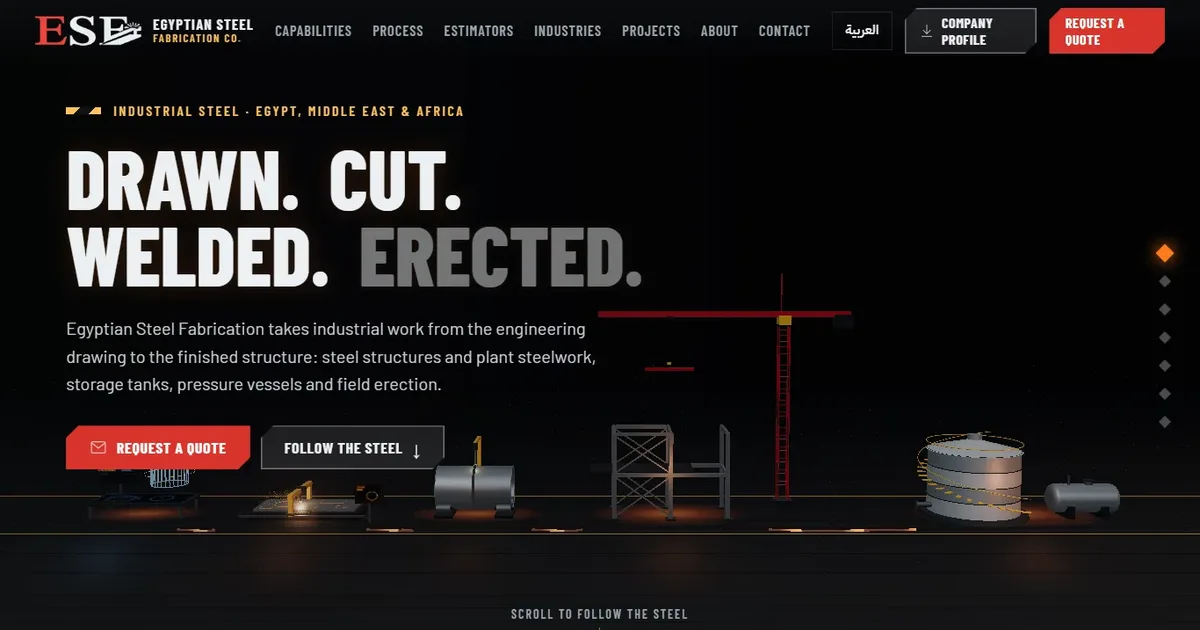
The old site was a React single-page app. Open it in a browser and you see a clean page. View the source and you find an almost empty HTML file and one large JavaScript file. The headline, the project list, the contact details and the intro text for each gallery all lived inside that bundle as variables. There was no robots file, no sitemap and no social preview image. The domain’s DNS sat with a registrar, the site was served from a platform we had no login for, and the mail was handled by a separate provider.
For a steel company, that arrangement carries a specific risk. Buyers of tanks and vessels send enquiries when they are comparing three or four fabricators. If the single page disappears when a subscription lapses, or the next developer rebuilds it and loses the project list, the company loses the one document it can send to a procurement engineer as a link. So the first decision was not about design. It was about keeping what existed.
Backup first, design second
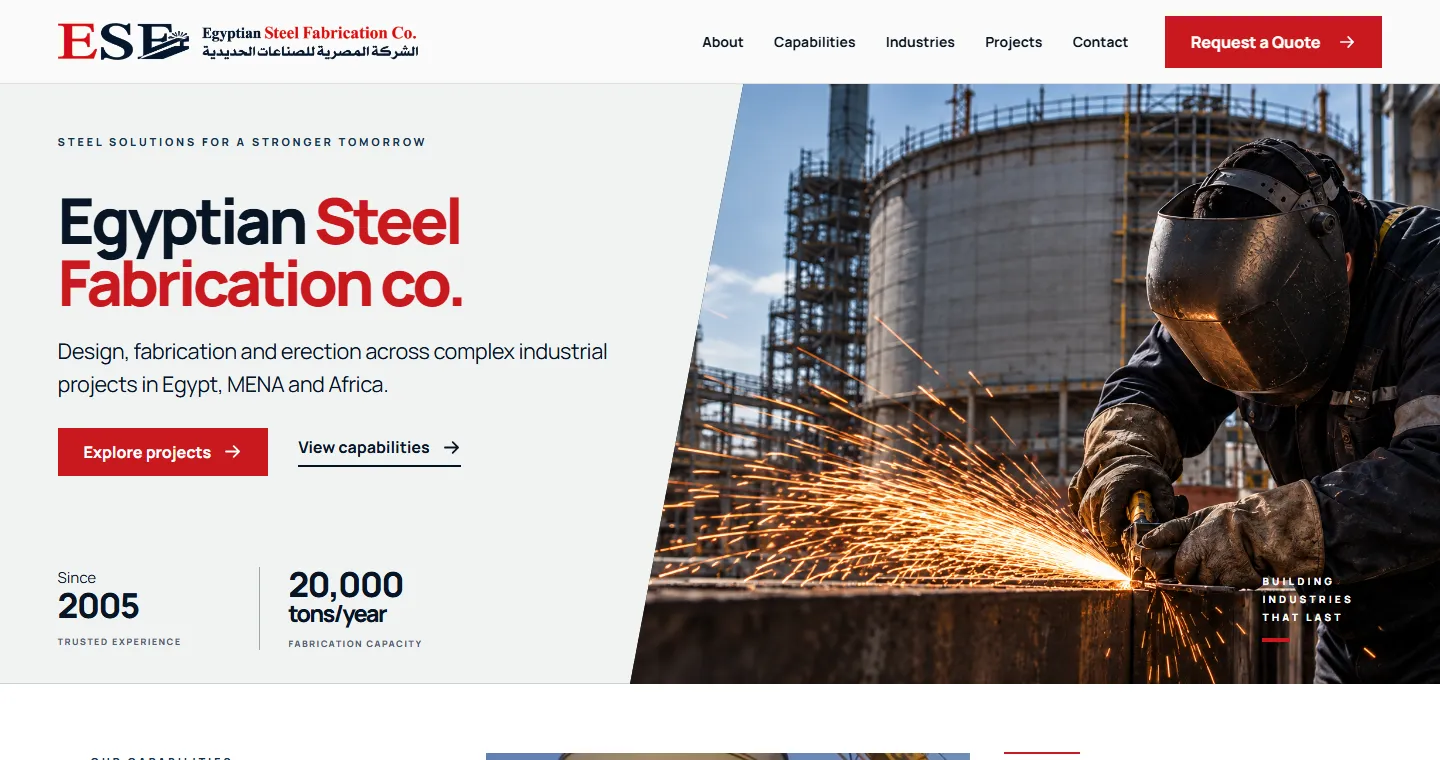
On 17 October we saved the live site exactly as it was served: the HTML shell, the JavaScript and CSS bundles, the fonts, the logo, the hero photo and 44 other assets. Then we opened every route of the single-page app one at a time and took a full-page screenshot of each, so that the visible state of the old site would exist as pictures even if the code never ran again. The content went into a plain text file we called CONTENT.md, written by reading the variables out of the bundle.
The same day we asked the Wayback Machine what else existed. It had two older versions. One was the 2013 site, on a different domain, built in the Flash era, with a Flash header and a table-style layout. The other was a plain HTML version from July 2025, with pages for About, Projects, Gallery and Contacts. We saved both. In the end the backup folder held 63 files and was packed into a single zip with a checksum, so anyone could later prove the archive had not changed.
It felt like overkill at the time. A fabricator’s site is not large. But the backup earned its place within hours, because it let us do something we could not have done from the live page alone: compare the three versions side by side.
What the three versions told us
The 2013 site was a company brochure from another decade, with a different web address. It told us the company had been presenting itself online for a long time, and not much else.
The July 2025 version held the real material. Its Projects page listed 28 reference projects in plain text, numbered one to twenty-eight: offshore facilities for ExxonMobil in Angola, an extension at QAFCO in Qatar for UHDE, a steel building in Algeria for SPI Capag, a jetty trestle at Damietta port for Petrojet, power station work at Nubaria, a factory for Domty in 6th October City, and so on. Its About page had six tab headings (Strategy, Social Responsibility, Safety Policy, Financial Vision, Our Target Markets) and a few paragraphs of general text, but nothing under most of the tabs. No body text had ever existed there.
The newer single-page app, the one live when we started, had more confident copy. It said “Since 2005”. It said “20,000 tons/year fabrication capacity”. It carried a band of engineering standards: API 650, API 620, API 653, ASME Section VIII and AWWA. None of those lines appeared in the 2025 original. They had been added by whoever built the single-page version.
This is where the backup changed the job. A buyer reading a tank fabricator’s website looks for exactly these things: capacity, the codes the shop works to, and references. If we copied the new-looking claims into our rebuild, we would be publishing numbers that the client’s own earlier material did not support and that nobody at ESF had told us to use. If we dropped them, the site would look thinner than the one it replaced.
We dropped them. The rule we wrote at the top of our README was: only facts from the client’s own record. The tonnage, the standards list and the “since” line were marked unverified and left out until someone from the company confirmed them. Later, the company’s own PDF profile turned up and gave a capacity figure that was nowhere near the 20,000 on the old page. That settled it. We still have not put any tonnage on the site, and the question of which figure is right sits in our open list for the client.
The “established in 2005” line had a better fate. ESF’s Facebook page bio states it, so we used it with the company as the source, in the About section and in the structured data.
Reading how buyers search
With the content question parked, we looked at how a buyer finds a company like this. We have no search-volume data for this field, so this is pattern reading, not numbers. We ran English searches for steel tank manufacturers in Egypt, for API 650 tank manufacturers in Saudi Arabia and the UAE, and for how to choose a pressure vessel fabricator, plus an Arabic search for tank and pressure vessel manufacturing in Egypt.
The English results for Egypt were a mix of three kinds of page: company sites of fabricators in Cairo, Alexandria and 6th October City, directory lists of “top tank manufacturers in Egypt”, and trade directories that list companies by product. The company sites led with the codes (API 650 and 620 tanks, ASME-certified vessels), the products (tanks, vessels, structures, piping) and sometimes a capacity in tons per year. In the Gulf results the same pattern was stronger: pages from Saudi and Emirati fabricators led with API 650, API 620, AWWA D100 and UL 142, and with approvals from large owners.
The guidance pages written for buyers said the same thing from the other side. When people explain how to choose a pressure vessel fabricator, they list the code stamps the job needs, the testing done in-house, evidence of similar vessels built, and a request that each bidder return the same three lists: what is included, what is excluded and what deviates from the specification. They also say not to choose on price alone.
The Arabic results were thinner: yellow-page style directories with more than 150 listings, and company pages for tanks that were mostly water-storage size.
What we took from this is plain. A buyer is shortlisting, not browsing. The words they use are the product name plus the place plus the code. A site wins attention in that moment by showing three things quickly: what exactly is made (storage tanks, pressure vessels, structures), where it has been built, and some way to size a job before the first call. We could do the first two honestly from ESF’s records. The code claims we could not, until the client confirms them. That made the third thing, a way to size a job, more valuable than it would otherwise have been.
The wording we chose to carry through the pages, in headings and image descriptions, was the vocabulary buyers actually use: steel structures, storage tanks, pressure vessels, field erection, plant steelwork, fabricator, Egypt. We did not write “API 650” anywhere, because the client had not told us it applies.
The concept: drawing to reality
The old homepage said “From drawing to reality” in one of its sections. We took that phrase seriously and made it the structure of the whole page.
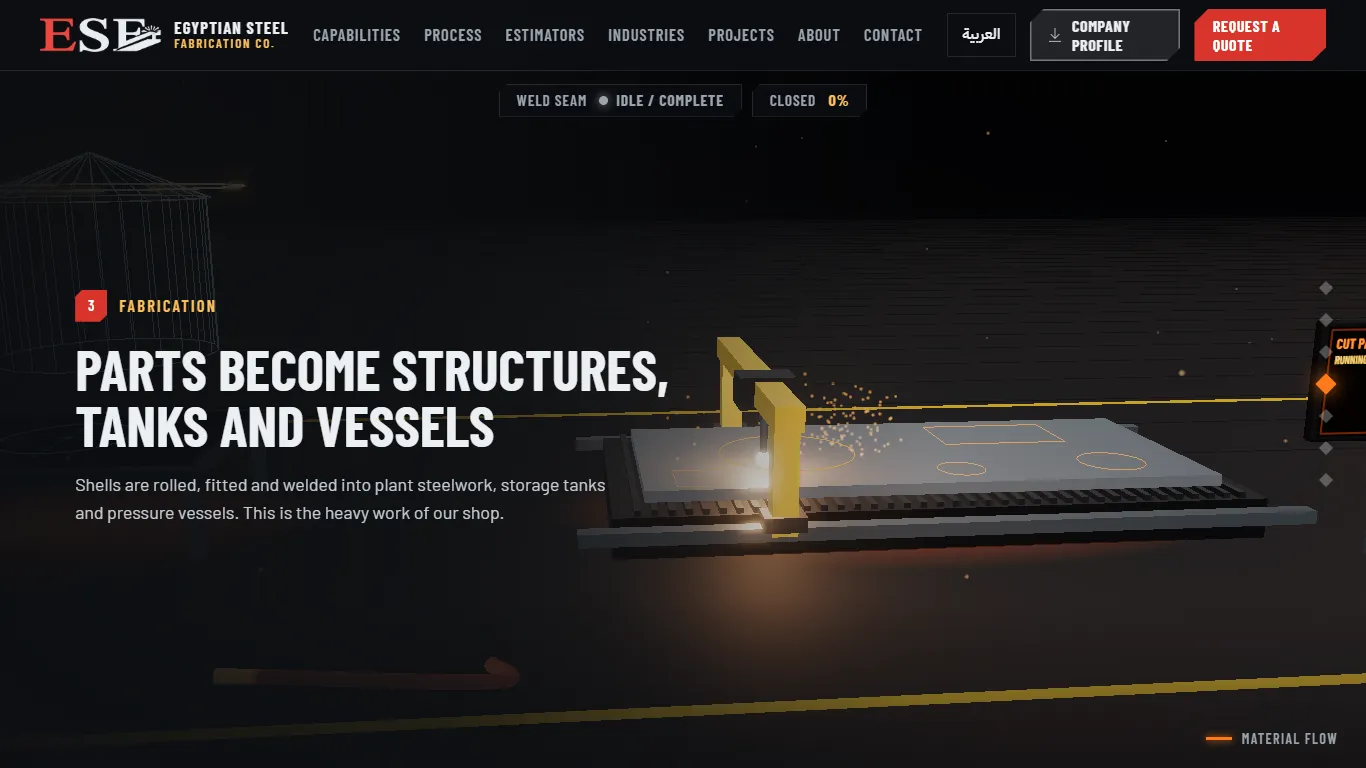
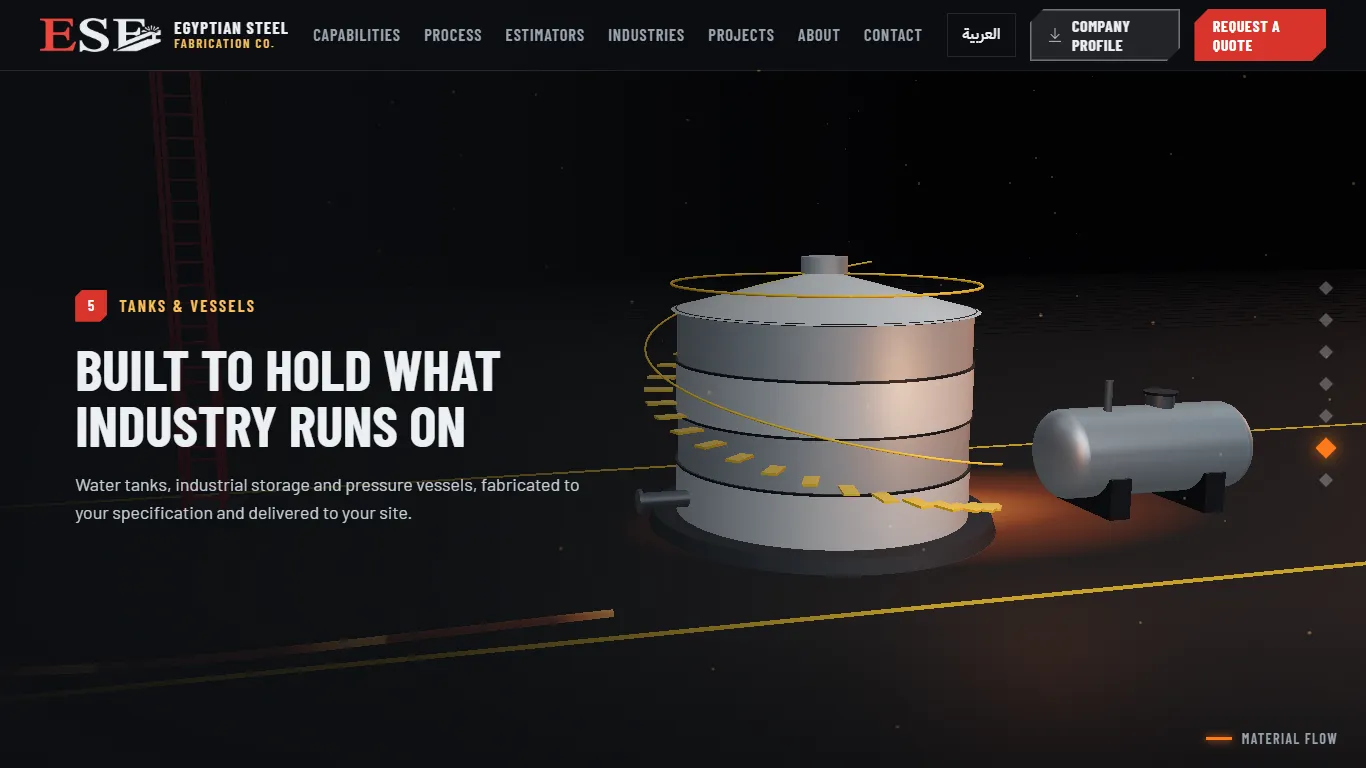
The home page is a real-time 3D shop floor that you move through by scrolling. It starts in a drawing office, with a screen showing model, shop drawings, bill of materials and cut list. The next stop is plate cutting, where a gantry throws sparks over a steel sheet. Then the rolling and welding station, where a weld seam closes as you scroll, with a small readout in the header that shows the seam as a percentage. Then structures going up under a crane, and finally a storage tank and a horizontal pressure vessel. The headline words, “Drawn. Cut. Welded. Erected.”, light up in step with the stations powering on.
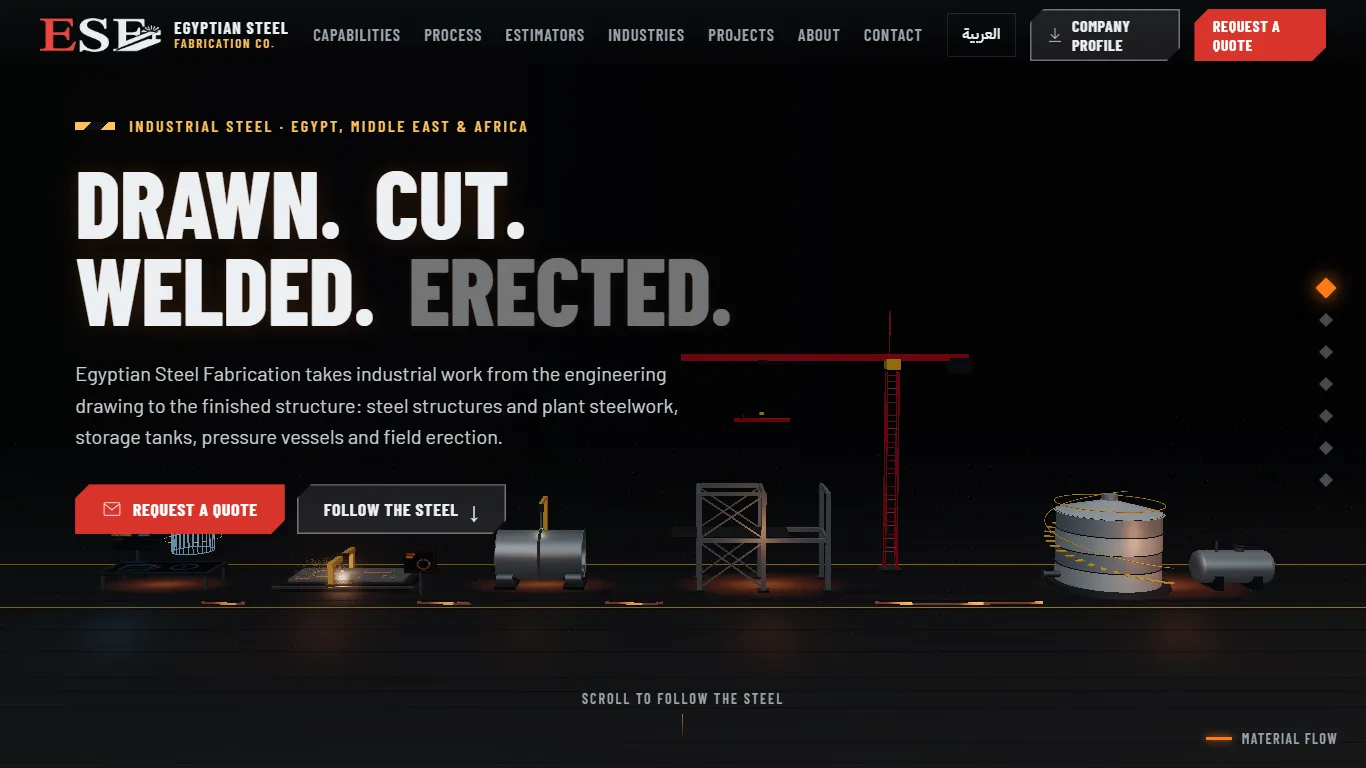
We build the scene from simple shapes in the browser, with no 3D model files, so the page loads quickly and every station is something we control. That also meant the scene could show the client’s own order of work, which turned into the most useful feedback we got.
After we showed the first version, ESF marked up the draft by hand. They renamed the process steps to match how the shop actually works: raw material cutting and forming; fit-up, welding, inspection and painting; final inspection and dispatch. They changed a heading so that commissioning replaced anchor bolts as a step. And they asked for steel structures to come before tanks everywhere. We could have changed the text only. Instead we reordered the 3D story as well, swapping the stations and moving the camera path and the rail labels, so that the visitor now meets structures first and tanks last. If a client says the order matters, the picture has to agree with the words.
A thing the owner rejected
At one point we built an automatic tour: after a few seconds the story played itself, and any touch paused it. We had good reasons, including accessibility guidance on moving content and the fact that many visitors scroll slowly on a phone. We tested it carefully. The owner watched it and said he did not like it. We removed it completely and went back to scrolling by hand. The lesson was ordinary: a clever feature is still a feature the client has to want.
The estimators: size a job before you call
Since the page could not honestly claim tonnage or codes, we gave visitors a tool instead. The first version was a tank estimator. You set a diameter, a height and an average plate thickness, and it returns gross capacity, shell plate area and an indicative steel weight, using a steel density of 7.85 tonnes per cubic metre. It states what it leaves out: stiffeners, nozzles, stairs, platforms and weld metal. One tap sends the numbers to ESF’s team.
After the client’s feedback round we added a second tab for steel hangars. You set width, length and eave height, pick a preset (workshop, warehouse, hangar, large hangar), and it shows floor area, enclosed volume, wall and roof cladding area and an indicative steel range. For a 30 by 60 metre building with 9 metre eaves, the live page returns a floor area of 1,800 square metres, an enclosed volume of 17,550 cubic metres, 3,474 square metres of cladding and an indicative steel range of 43.7 to 66.8 tonnes.
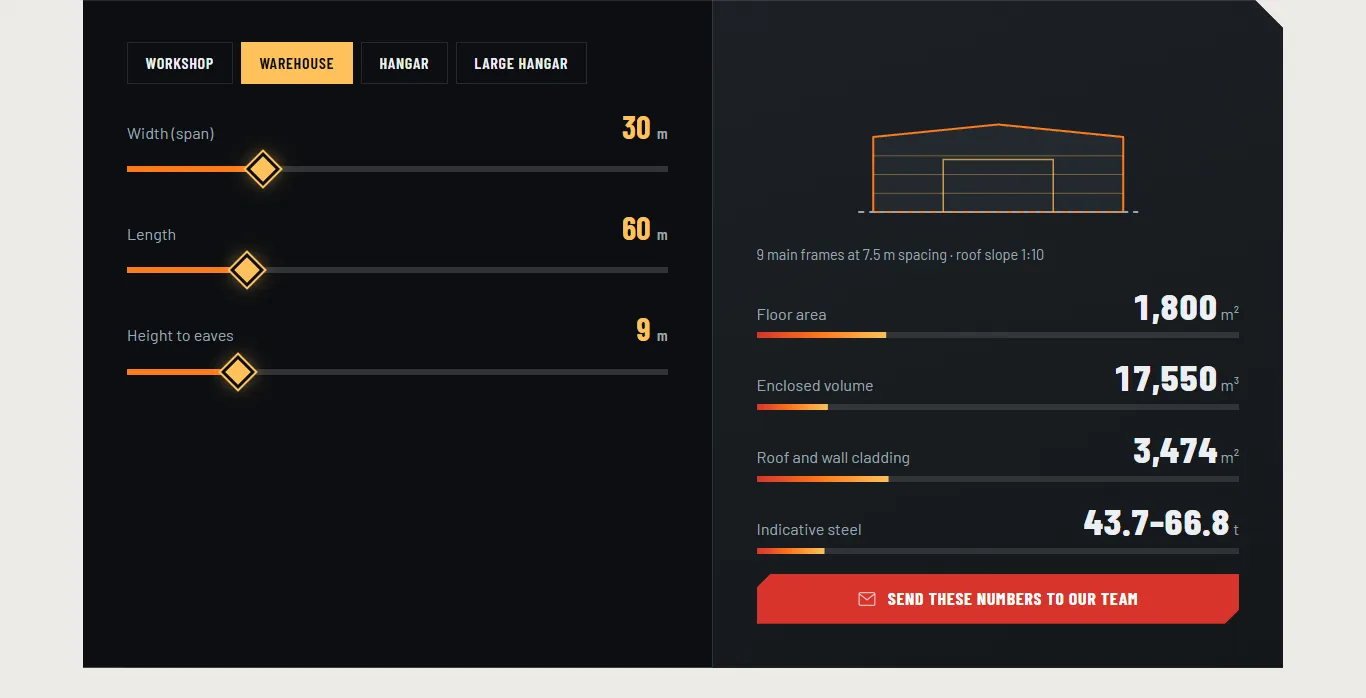
We want to be exact about where those numbers come from. The geometry (area, volume, cladding) is arithmetic. The steel range is not. It rests on a model we chose: a clear-span portal-frame building, web-tapered S355 frames at 7.5 metre spacing, a 1:10 roof, ordinary industrial loads, no cranes, with purlins, girts and bracing included. We found no published table of kilograms per square metre that we could cite, so the assumption is ours. The page prints it in full under the results and calls the figure indicative and not a design, and the range runs from roughly 0.85 to 1.3 times the central value to cover differences in load and detailing. We have asked that an ESF engineer check it, and it stays on our list until someone does. A buyer should treat it as a first conversation, not a quotation.
Why include a tool whose core number we cannot fully vouch for? Because it answers the question procurement people ask first, “roughly how much steel is this?”, and because a number labelled with its assumptions is more honest than a blank. The alternative was to say nothing and look like every other fabricator.
Photos: using the client’s Facebook page, carefully
The old site had a small gallery of four project albums, with pictures about 500 pixels wide. That was all the usable photography that existed on the site. The client’s Facebook page held far more, so we used it as a source of real photos, which was the only way to avoid stock images of anonymous steelwork.
The first pass was shallow. We read the generic Photos tab, kept 24 pictures, and noticed the problem straight away: those photos carry no project names or locations. We captioned them generically, as “tanks in the field” and “steel structure erection”, and we refused to guess what they showed. We left out the greeting graphics, an HR memo, a safety poster and one photograph where a banner in the frame made ownership unclear.
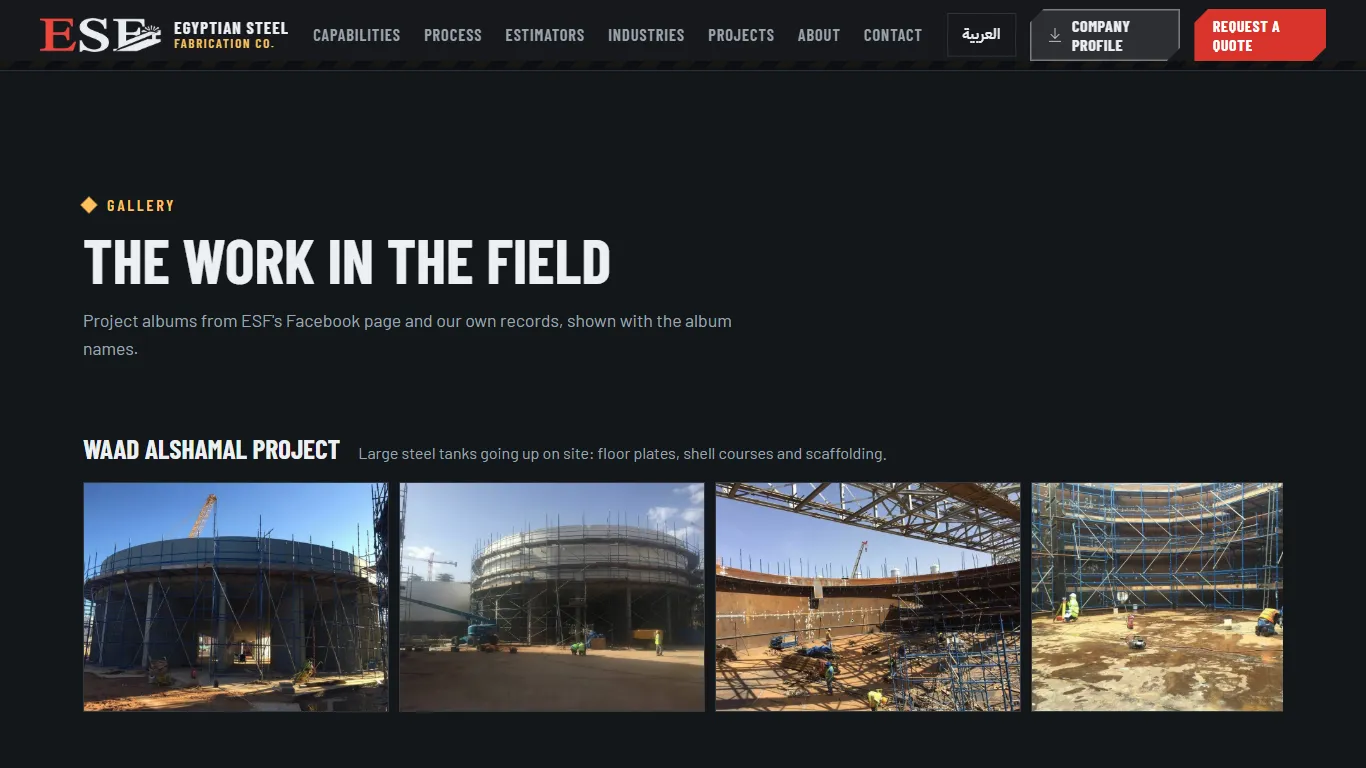
A second look showed that the page had around twenty named albums that the first pass had missed. Matching them to our generic captions was a small revelation: the “tanks in the field” photos were an album called Waad Alshamal Project, and the structure erection photos belonged to an album about maintenance hangars at Jeddah airport. We renamed the albums to the client’s own titles, and added further named albums: a gold mine, a silo erection, a school, silos for the cement and explosives industry, pressure vessels and products, a refrigerated building, and exhibition albums from 2011 and 2012. The owner then said to add everything.
The version of the site we deployed has 19 albums and more than 700 photos. The first six albums show on the page and a button reveals the rest. The Arabic page uses the exact Arabic captions the client had put on Facebook, not our own translations, including a spelling for “silos” we would not have chosen ourselves. We asked the client to confirm it, and it remains on our list.
One practical trap: logged-out Facebook shows only part of a long album, so the file count on our side may be smaller than the real album. We say “project albums from ESF’s Facebook page” on the site and make no claim to completeness.
The 28-project record and the numbers
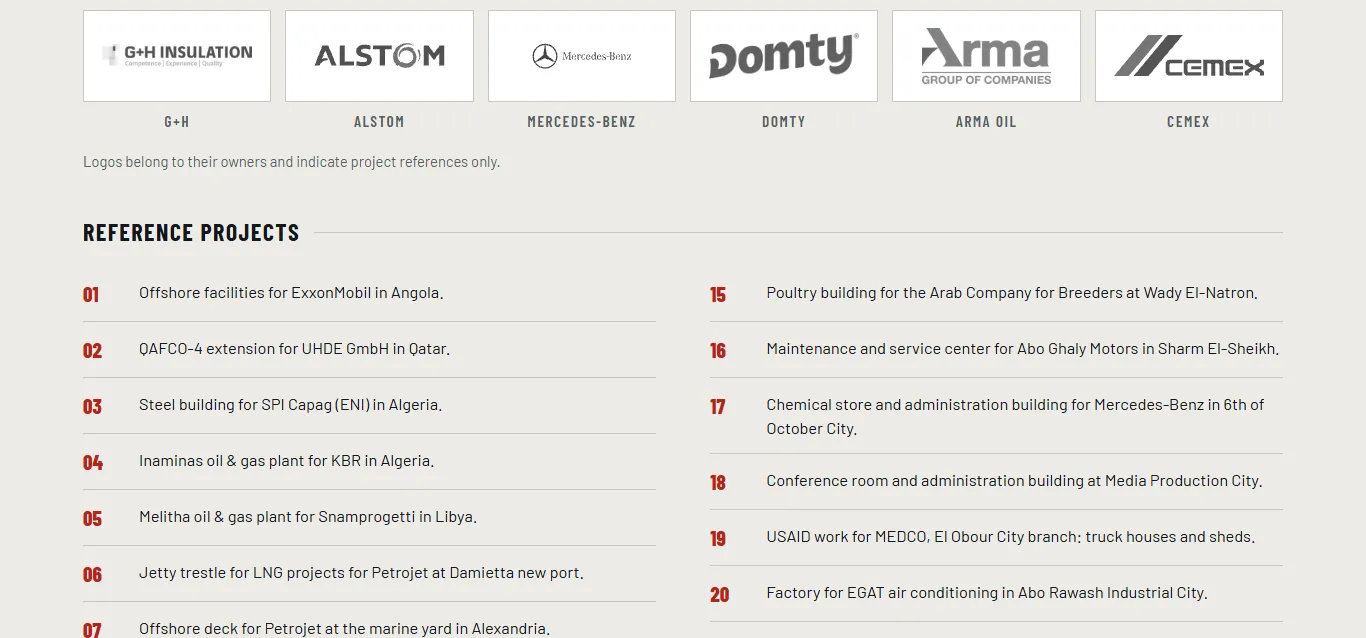
The Projects section is the 28-project list from the July 2025 original, rewritten into clean sentences and shown in two columns, with the partner names as a wall of logos above it. A line under the logos says they belong to their owners and indicate project references, nothing more. We were careful with that: a logo on a contractor’s page can read as an endorsement, and none was given to us.
The four headline figures on the page, 291 reference projects, 31 countries, 53 named client and partner companies and one team from drawing to erection, are the company’s own. They came from a page the client wrote by hand, and the owner checked the digits at double zoom before we used them. On the site they are labelled as figures on record, and in this article we attribute them to the company too. The 28 listed projects cover seven countries; the larger numbers are the client’s wider record, which is why a reader may notice the difference.
Two languages, one set of facts
English is at the root of the domain and Arabic, right-to-left, is at /ar/. We chose the company’s own Arabic name, the one on its logo. We spent time on engineering vocabulary, because Arabic readers in this field are sharp about it. We settled on one term for each concept and used it everywhere: structures, pressure vessels, shell, plates, shutdown. We reviewed the wording line by line with an independent pass, and one global find-and-replace we ran during that review broke a phrase about pipe racks and supports, which we caught and fixed. After that we stopped doing global replaces on Arabic technical text.
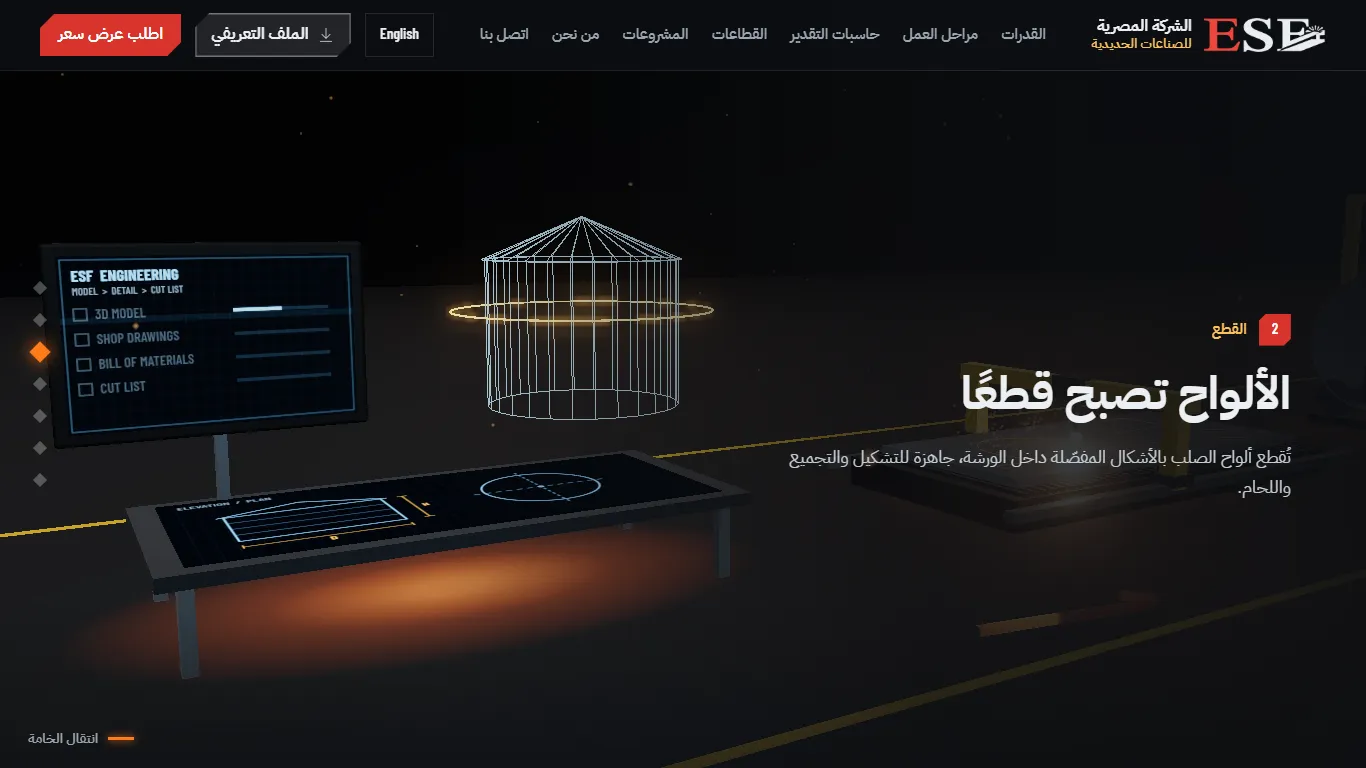
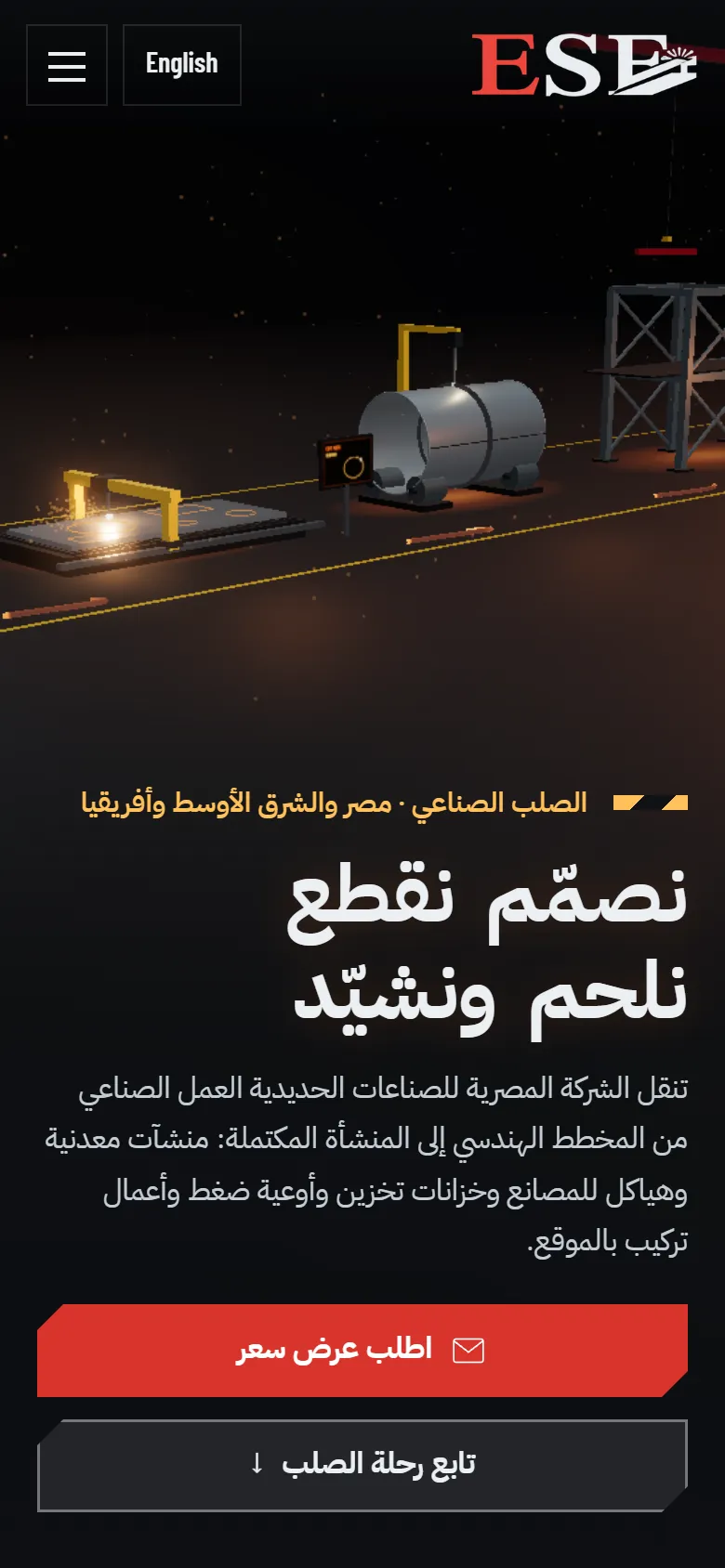
On phones, the layout puts the 3D scene above the text instead of beside it. We checked widths from 320 to 1440 pixels by scrolling through the page for real, in both languages, and the checks found two problems we then fixed: the header was cut off between 1,024 and 1,180 pixels, and several tap targets were under the 44 pixel guideline. The menu became a burger below 1,180 pixels and the targets grew.
Moving the domain: the DNS and certificate trap
The old site lived on a platform where we had no access. The owner then told us the domain had been added to our hosting and to go ahead and upload. The upload went through one archive stream, was verified by file checksums at both ends, and the site came up on 18 October.
Then we hit the trap that catches many migrations. When a domain is added to a hosting account before its DNS has moved, the server’s automatic certificate tool tries to prove control of the domain and cannot, because the web address still points at the old platform. In our case it issued a certificate at once, but only for the mail and control-panel subdomains. The apex and the www address had no valid certificate. Visitors would have seen a browser warning on the main address of a company asking them for business.
We found it by testing the live addresses over HTTPS, not by trusting that “DNS is done”. Once the name servers pointed at us, we re-ran the certificate check. It then issued one that covers the domain and its subdomains, valid until January 2027, and we confirmed that every address answers with a verified certificate. The plain http address and the address without www both redirect to the www version. The practical rule we took away: after DNS flips, re-run the certificate step and test www and the apex separately.
The mail is where it got messier. When the DNS moved, the zone on our side came with default records that route mail for the domain to the server itself. The records the client had used for its previous mail provider were gone, and since the old DNS no longer answered, we could not read the old values back. We spotted it before any mail was lost, because the mail log was empty. How the domain’s mail should work is a decision between the owner and ESF, and it is still being settled, which is why this article prints no mailbox address. If your company has mail on one provider and a website on another, treat the DNS move as a mail project too.
One more mistake belongs here. After uploading several hundred gallery images we tried to verify them by firing about 760 requests at the live site, many in parallel. The server’s security software read this as an attack and blocked our own office address, and for a while it looked as though the server had gone down. It had not. It had simply stopped talking to us. The owner removed the block with a command we were not allowed to run ourselves, and the whole episode is the reason this case study was measured with only a handful of page loads. Verify with a checksum, or a few requests one after another. Never a burst against a client’s live site.
What the page looks like to a phone, measured
On 14 November 2026 we loaded the English home page three times from a fresh browser context, with a mobile screen (390 by 844 pixels, double density) in headless Chromium, and read the timings from the browser’s own performance API. We did not use Lighthouse. The browser rendered the 3D scene in software, which is slower than a real phone’s graphics chip, and we did not throttle the network or the CPU, so treat these as a rough guide only.
| Measure | Three runs |
|---|---|
| Time to first byte | 332 to 800 ms |
| Largest contentful paint (the intro paragraph) | 1.26 to 1.90 s |
| Cumulative layout shift | 0, 0 and 0.127 |
| Data transferred on first load | about 464 KB |
| Requests | 13 |
| Console errors | 0 in all three |
The first load is light for a 3D page because the scene is built from code, not model files, and the client’s large PDF profile only downloads when someone clicks it. The one number that is not flattering is the layout shift: in one run out of three it reached 0.127, which is above the 0.1 mark that Google treats as good. We did not trace the cause, and we are not going to guess it here. It is on our list to investigate.
What changed, in verifiable terms
We have no traffic, enquiry or ranking figures for this site that we can publish, and we do not make any claims about them. What we can say is what exists now.
- The site is live at esfegypt.com in English and Arabic, on a valid certificate, with the non-www address and plain http redirecting to www.
- Every claim on it traces to the client’s own records, with the figures attributed, and the unverified tonnage and standards are not there.
- The content is real HTML text, not hidden inside a script bundle, so a search engine or a procurement engineer’s browser can read it. The site has a sitemap with the two language versions linked to each other, a robots file, and a social preview image, all of which the old one lacked.
- Two estimators, a 28-project reference list, 19 photo albums with more than 700 photos, and a company profile you can download from the header.
- One phone number for calls and WhatsApp, with the client’s struck-out old number and fax removed.
- A complete backup of three earlier versions, stored apart from the site, so that nothing the client had can be lost by a future change.
Open items remain: the steel-estimate model awaits an ESF engineer, the Arabic wording for a few terms awaits the client, the capacity and standards claims await confirmation, and, when we last checked, the Arabic page linked an English-only PDF.
Lessons for a fabricator, contractor or manufacturer
- Back up before you touch anything. Content that lives inside a script bundle is the first thing a rebuild loses. Save the files, screenshots of every page and any archive copies, and write down the checksum.
- Compare versions. The earlier versions showed us which claims were original and which had been added later. Without that comparison we would have repeated numbers nobody could support.
- Leave out what you cannot source. A thin honest page gets confirmed and completed later. A confident wrong number is much harder to take back from a buyer who has already quoted it to a client.
- Show the work. Buyers of steel work want proof of references and a way to size a job. A named list of projects and a labelled estimator do more than adjectives.
- Use your own photos, with honest captions. If you do not know what a photo shows, say “tanks in the field”. Do not write a project name you cannot support.
- Treat a domain move as three projects. The website, the certificate and the mail each break differently.
- Let the client edit your first draft by hand. Ours changed the process names and the order of the story, and the site was truer afterwards.
FAQ
Why did you back up the old site before designing the new one?
The old site’s content was inside a JavaScript bundle on a platform we did not control. A backup of the files, page screenshots and older archive copies protected the client’s project list and text, and let us compare the versions to see which claims were original.
What did you leave out of the new site, and why?
We left out a yearly tonnage figure and a list of engineering standards that appeared on the latest single-page version but not on the 2025 original, and that the client had not confirmed. They can be added once the company confirms them in writing.
How do buyers usually search for a steel tank or pressure vessel fabricator in Egypt and the Gulf?
From what we read in search results, they combine the product, the place and the code, for example storage tank manufacturer Egypt or API 650 tank manufacturer Saudi Arabia, and then compare company sites and directories. We had no search volumes, so we cannot rank these phrases by popularity.
Is the steel quantity in the estimator a quotation?
No. The page labels it as indicative. The area and volume figures are plain geometry, while the steel range rests on a portal-frame model we assumed and printed on the page. The final design and price follow the customer’s specification and code.
Where did the photos come from?
From the client’s own Facebook project albums, kept under the album names the client gave them. Photos with no project information carry generic captions. We left out greeting graphics, internal documents and one photo whose ownership was unclear.
What is the DNS and certificate problem when moving a domain?
If a domain is added to the new host before its DNS points there, the automatic certificate may be issued for the wrong set of addresses. After the DNS change, re-run the certificate step and test the www and apex addresses over HTTPS, then check mail records too.
Did the new site bring more enquiries?
We do not have enquiry or ranking data for ESF that we can publish, so we make no claim. What we can show is the live site, its structure and the measured load figures above.
Want a steel fabrication website done this way?
If your company has a site you are afraid to touch, or one that says less than your project list would, we can start with the backup and work forward. Read about our web development, web design and SEO services, or see our portfolio (English version: PRMAGLY portfolio). To talk to us directly, message us on WhatsApp.
خدمات مرتبطة
- تصميم مواقع الشركات في مصر
- إنشاء متجر إلكتروني
- برمجة مواقع وأنظمة خاصة
- ايميل رسمي للشركات
- أتمتة واتساب للشركات
- نظام شركات السياحة