
Case study: the bilingual website we built for Wall Breakers, a turnkey finishing and fit-out company in Egypt with medical and office projects since 2011.
- شركة برمجيات مصرية منذ 2010
- دعم فني على واتساب
The Arabic original of this case study is here: دراسة حالة بالعربية.
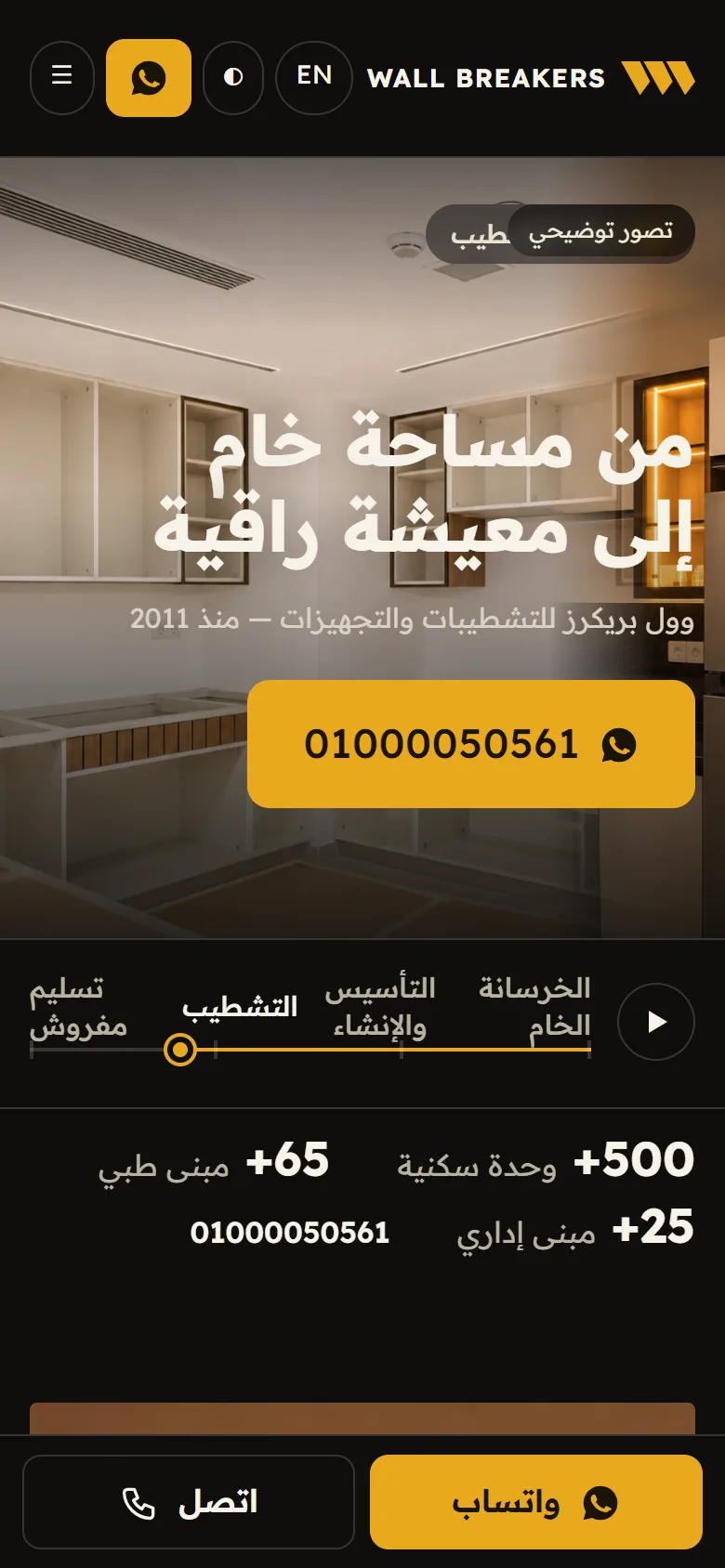
In short: PRMAGLY built a bilingual Arabic and English website for Wall Breakers, a turnkey finishing and fit-out company in Egypt working from 6th of October City since 2011. The core idea is a “project film” at the top of the page: one room changes in front of the visitor from raw concrete to a furnished handover.
- Five fields on one site: construction, interior fit-out, smart systems, medical and administrative fit-outs.
- Three contracting systems (Cost-Plus, Fixed Cost, Per-Item Supervision) explained in plain words.
- Dark and light themes, a mobile contact bar and direct WhatsApp contact.
- AI-generated images are labelled “Illustrative render”; the clips in the Projects section are the client’s own footage.
If you are looking for a turnkey finishing and fit-out company in Egypt, you will probably open a dozen websites that look the same: a polished photo, the words “years of experience” and a contact button. Our challenge with the Wall Breakers website was to show what the company actually does instead of claiming it is good. This case study covers what the client asked for, what we decided, what is real footage and what is an AI illustration, and what we cannot claim.
Who Wall Breakers is and what it needed
Wall Breakers Finishings & Fitout is a general contracting, interior fit-out, medical and administrative fit-out and smart-systems company founded in 2011 and based in 6th of October City. By its own profile it has delivered more than 500 residential units, more than 65 medical buildings and more than 25 administrative buildings. Those are the company’s figures and the only source we have for them; we did not audit them.
The client arrived with a situation common among contractors: plenty of real work and a digital presence that does not reflect it. The brief was clear:
- One site that introduces five different fields without feeling scattered or like a trade directory.
- A simple explanation of three contracting systems, because clients ask about them on almost every call.
- Real work from real sites, not stock photography.
- Arabic for local clients, English for investors, residents and buyers comparing companies.
- A short path from visit to a WhatsApp conversation, which is how most finishing clients in Egypt start.
Why a new website mattered
Choosing a finishing contractor is a trust decision before it is a price decision. An owner hands over keys and a large budget to a company they do not know, and searches for it online before calling. A site that neither shows work nor explains how contracts operate leaves the visitor to decide on impression alone.
What owners of homes, clinics and offices search for
Before designing, we researched market wording and the page titles that appear for searches in this field. The limits are important: our tools give no search volumes or difficulty scores, and the index we could query leans towards the US market. So we publish no Egyptian search numbers and claim no rankings. What we can share are repeating patterns in company headlines and reader questions.
Three patterns we saw
- Residential turnkey finishing is crowded. Results are full of apartment finishing companies, and most content is articles about price per metre. We hold no pricing from the client, so we could not compete there in good faith.
- Few contractors combine residential, medical and office work. Medical fit-out results are mostly equipment vendors and firms outside Egypt. A contractor showing apartments, clinics, offices and smart systems together is rare.
- Explanations of contract types are thin. Articles on cost-plus, lump sum and per-item contracts are few, and many are generic or promotional. The questions exist; clear answers are scarce.
Two decisions followed. First, the site should read as one company with five fields, not five mini-sites. Second, contracting systems should get their own page and a section on the homepage, because that is what separates this company and answers what clients really ask. We also decided not to enter the “price per metre” race: we do not have the company’s prices, and we will not invent a number that misleads a reader.
Our concept: a project film at the top of the page
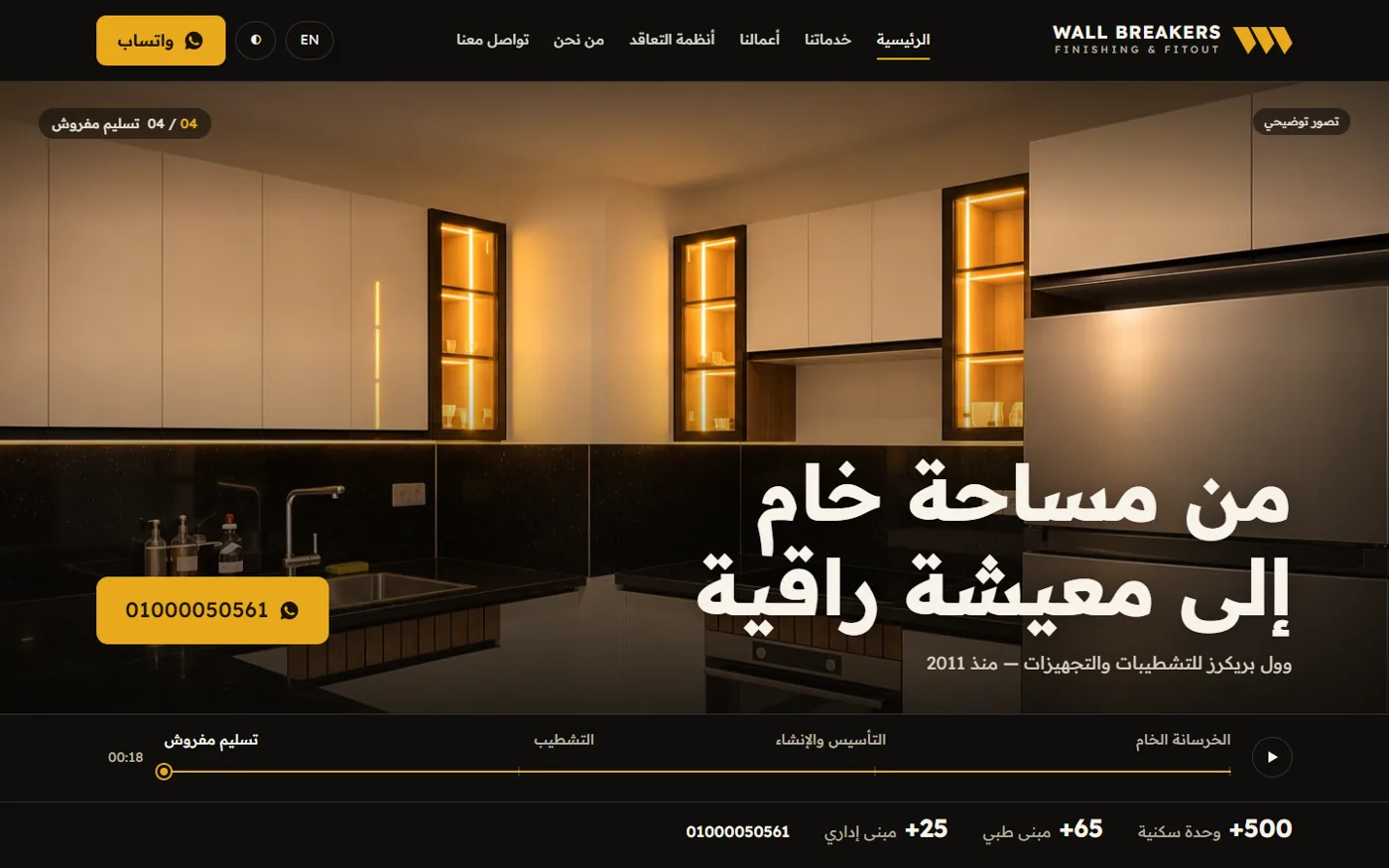
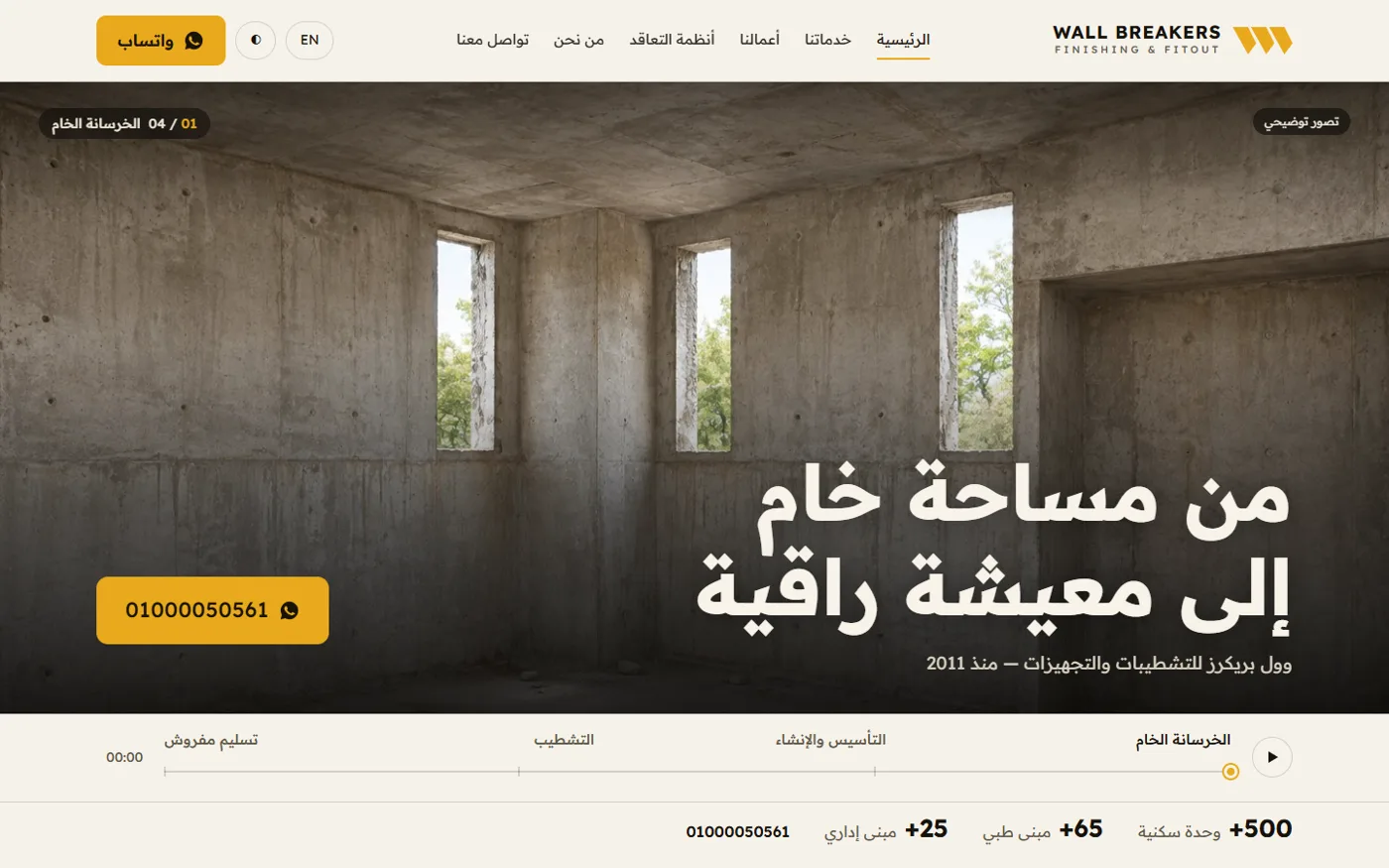
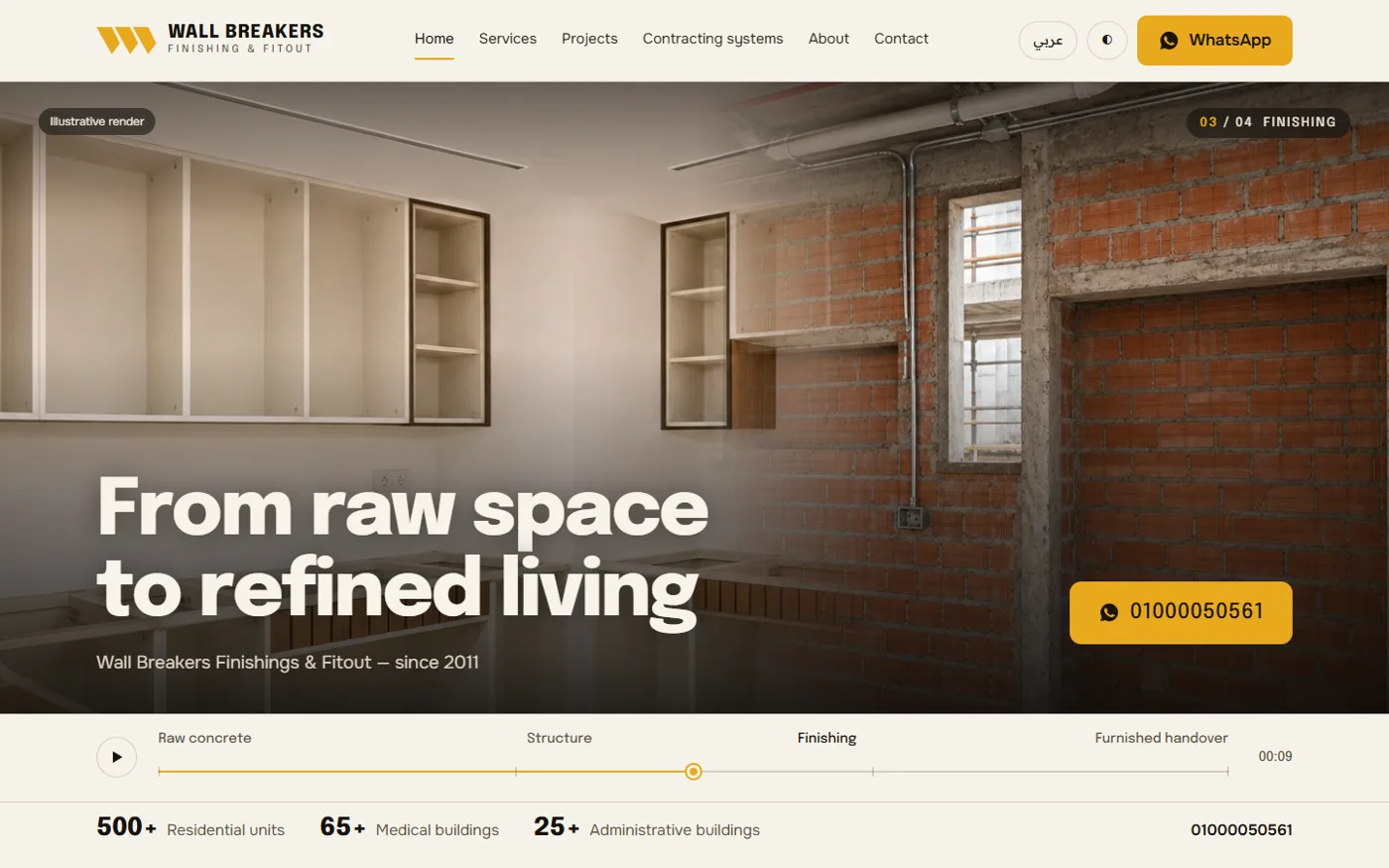
PRMAGLY has an internal rule: no two websites look alike. Finishing has a natural visual story, which is transformation: a raw room becomes a room people live in. So we built the hero as a “project film” of a single room moving through four stages: raw concrete, structure, finishing and furnished handover. The visitor scrubs or plays the timeline and the room changes stage.
Why this idea instead of a photo gallery
The client’s own line, “from raw space to refined living”, describes the service itself. A visitor understands within seconds that the company starts at concrete and ends at the keys, without reading a paragraph. The timeline also trains the eye on the order of work: concrete, first-fix, finishing, handover. The same order returns later in the stage tracker.
What is AI-generated and what is real
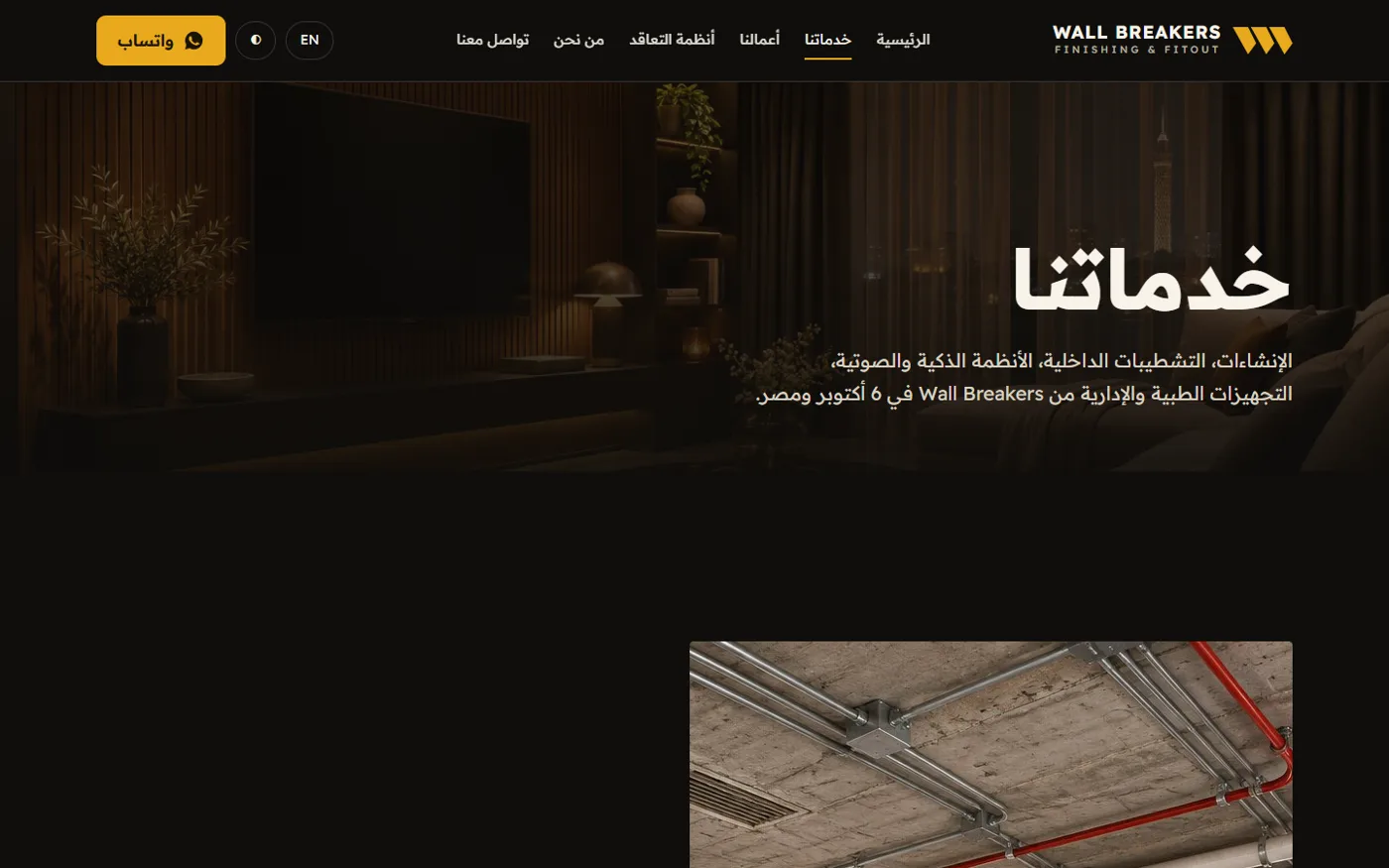
We say it plainly. The project-film room consists of AI-generated images, because the company does not hold a continuous sequence of one room from concrete to handover from a fixed angle, and we will not pretend it does. Every such image carries the label “Illustrative render” on the site, and so do the service plates. The clips and stills in the Projects section and in the stage tracker are the company’s own footage from its own sites, with its logo.
A walk through the site
Numbers and credibility at the top
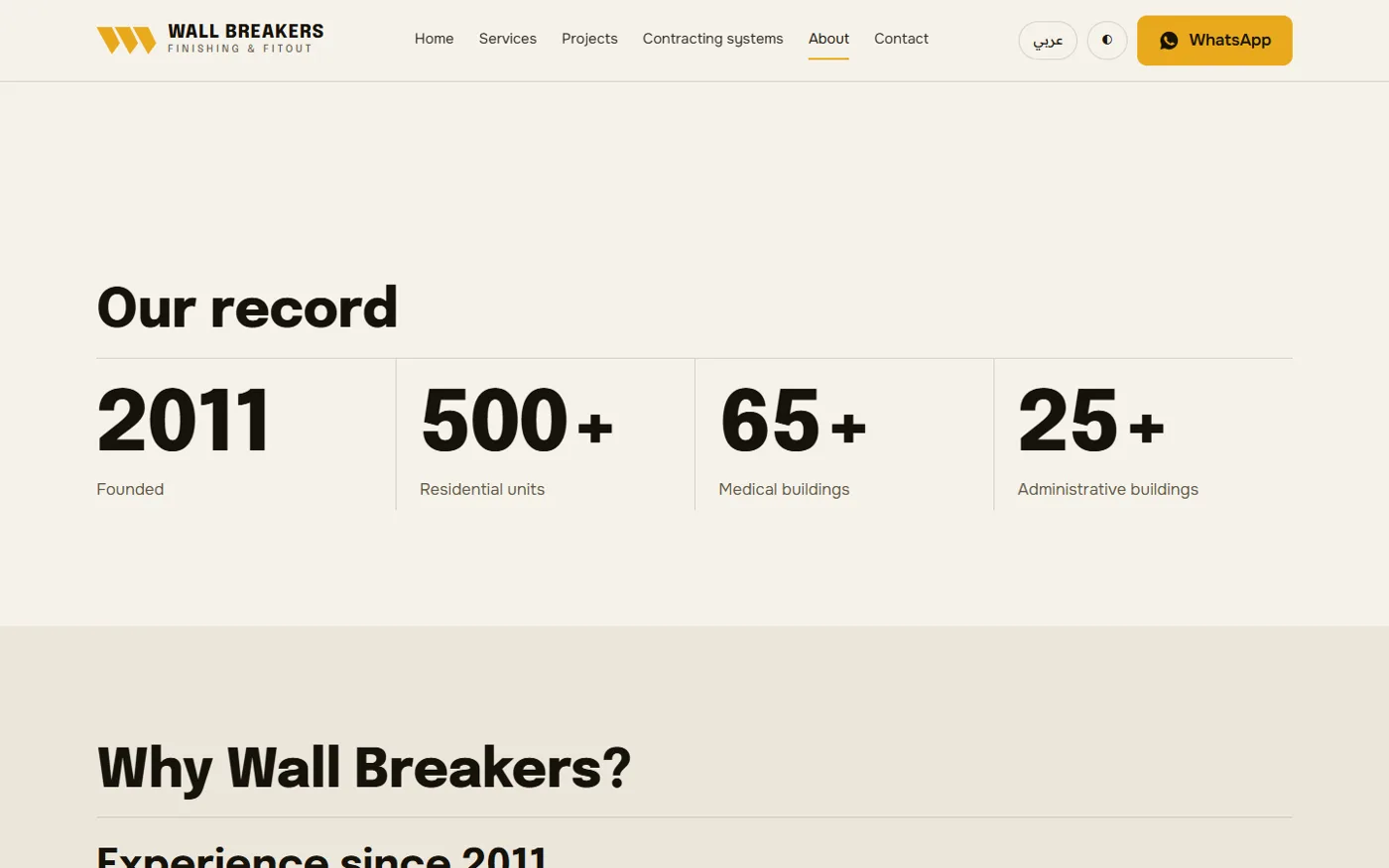
Right under the project film we placed the company’s numbers: founded 2011, more than 500 residential units, more than 65 medical buildings, more than 25 administrative buildings. They sit where a visitor cannot miss them, because the first question is always “who are these people and how much have they built?”. They are the company’s figures only, and we added no awards or certificates we were not given.
Services: five fields under one roof
Services take up the largest part of the site. Each field has a short list of what the company actually does:
- Construction and general contracting: reinforced concrete and structural works, excavation, foundations and building of residential blocks and facilities, and turnkey delivery.
- Interior fit-out and finishes: masonry and plaster, plumbing and drainage first-fix, electrical first-fix and panels, floors, ceramic and porcelain, doors, windows, cladding, wooden and metal decor, and the electrical finish with spots and lighting units.
- Smart and sound systems: smart home automation, central and distributed sound, and card and fingerprint access control.
- Medical facility fit-outs: operation theatres, X-ray rooms with protection requirements, patient rooms, medical gases, fire fighting, light-current systems, nurse-call and monitoring.
- Administrative and office fit-outs: glass partitions and office space design, fire-fighting systems, CCTV, and computer networks, telecom and structured cabling.
Medical fit-out: a section that needs careful wording
The medical field is the most sensitive one on the site. The company describes its work as “built to international codes for healthcare facilities”, and we carried that sentence over exactly, without naming any standard or certificate. The reason is simple: the client has not given us a document proving a specific standard, and naming one would be unfair to the reader and to the company. Hospitals and clinics that need to know which code applies to their project should ask the company and get the answer in the project specification.
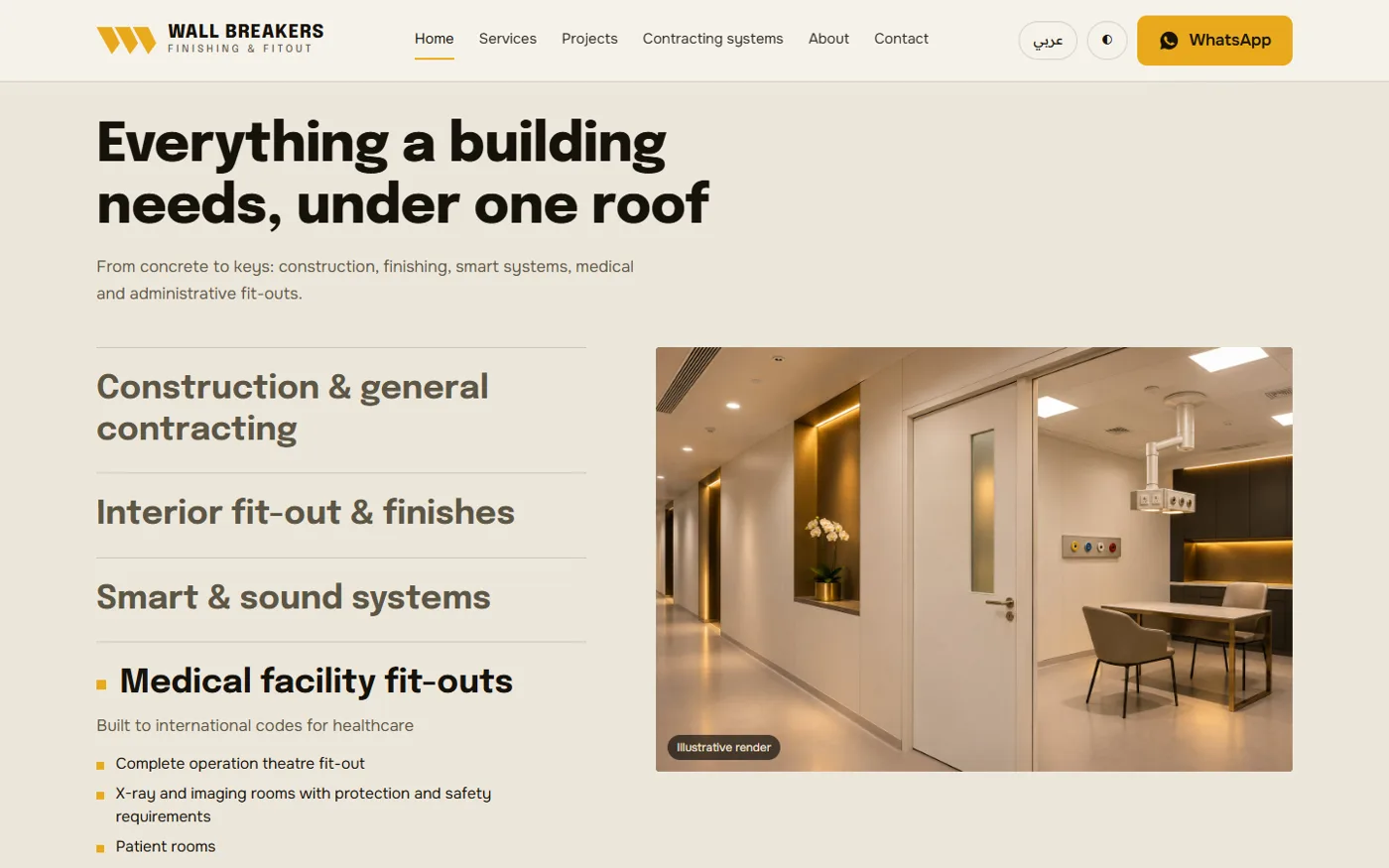
These lists help people searching for clinic and hospital fit-out or operating room fit-out and medical gas systems, because they name the components owners ask about: theatres, imaging, patient rooms, gases, fire fighting, light-current systems and nurse-call. The strapline describes an approach, not a promise.
Administrative fit-out: what an office needs after the paint
An office needs more than paint and flooring. So this section highlights glass partitions, fire fighting, cameras, and networks with structured cabling. These are the items a company manager moving premises will ask about, and seeing them listed tells him that one party coordinates the trades. For anyone searching for office fit-out in Cairo or Egypt, that is the difference between a contractor who paints walls and one who delivers a working office.
Stage tracker and real footage
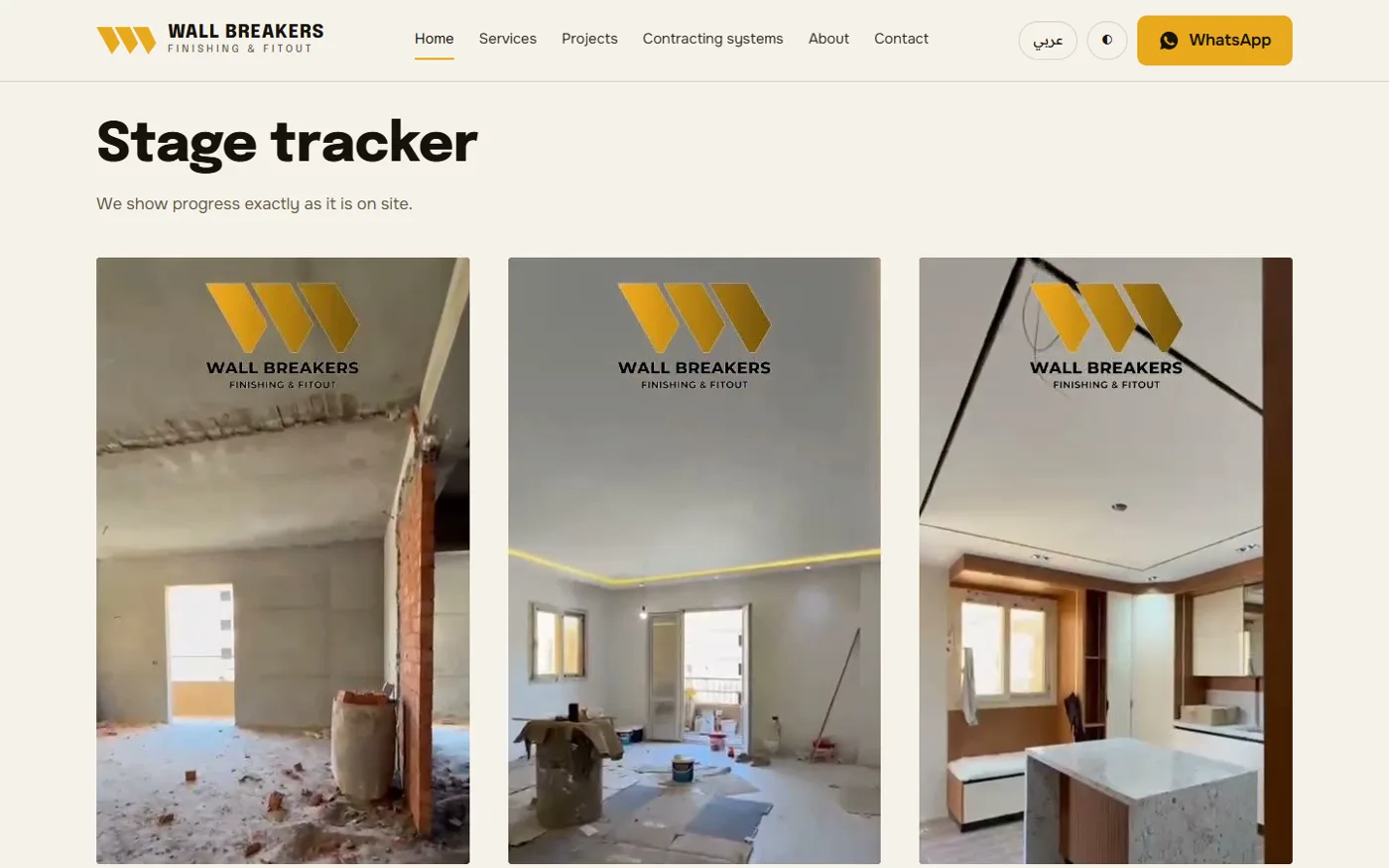
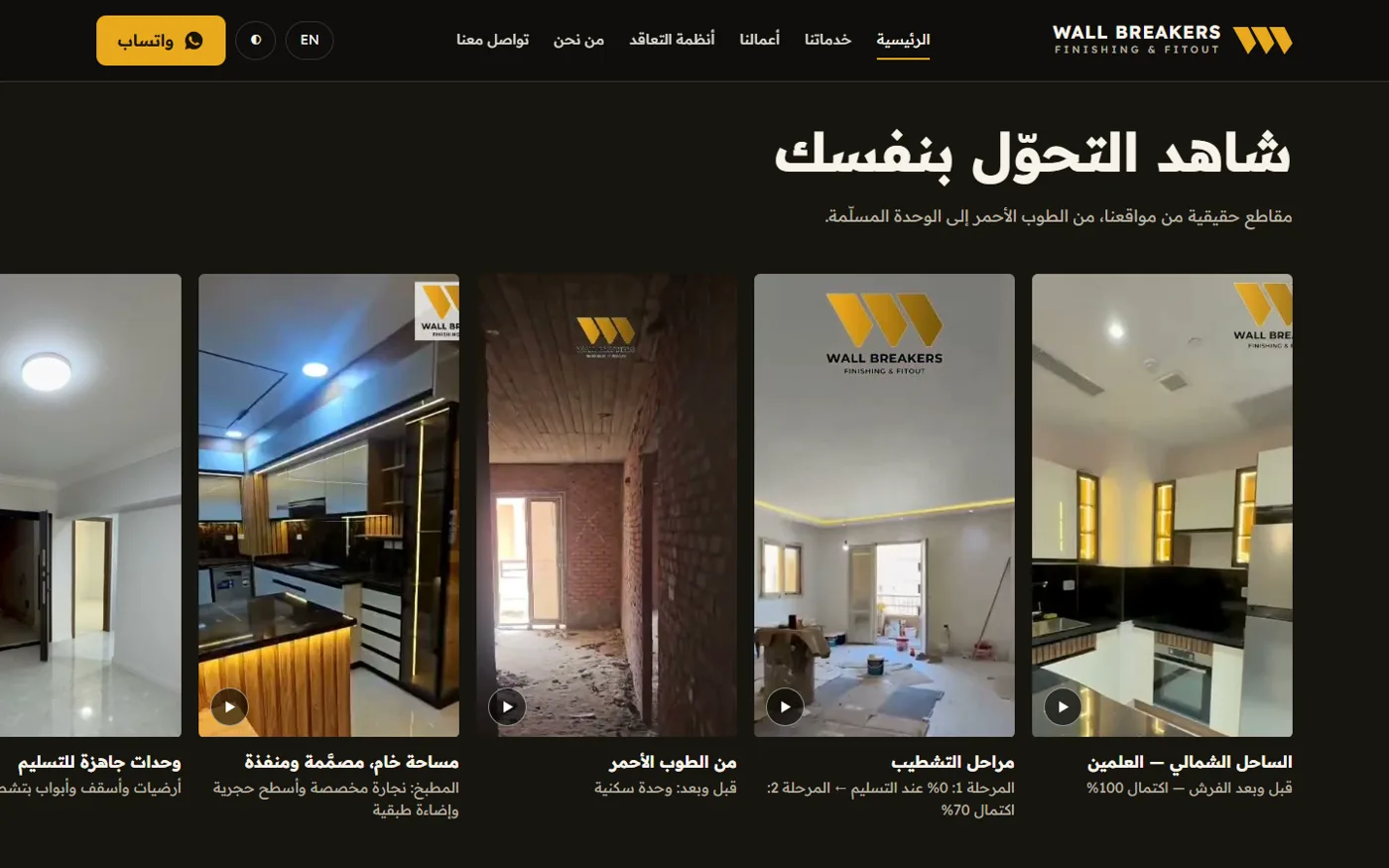
This is where the site moves from illustration to reality. The “Stage tracker” section shows three real stills of the same unit: stage one “0% finishing at handover”, stage two “70% complete”, and handover “100% complete”. They come from the company’s sites and carry its logo. The point is that the client sees progress exactly as it is, which signals confidence because the company shows the in-between, not only the finished result.
The Projects section holds five vertical clips in reel format: a unit in the North Coast and Alamein before and after furnishing, the finishing stages, a unit from red brick before and after, a kitchen with custom joinery, stone surfaces and layered lighting, and units ready for handover. We chose reels because clients who follow the company on Facebook and Instagram know the format, and because it works well on a phone.
Contracting systems in plain words
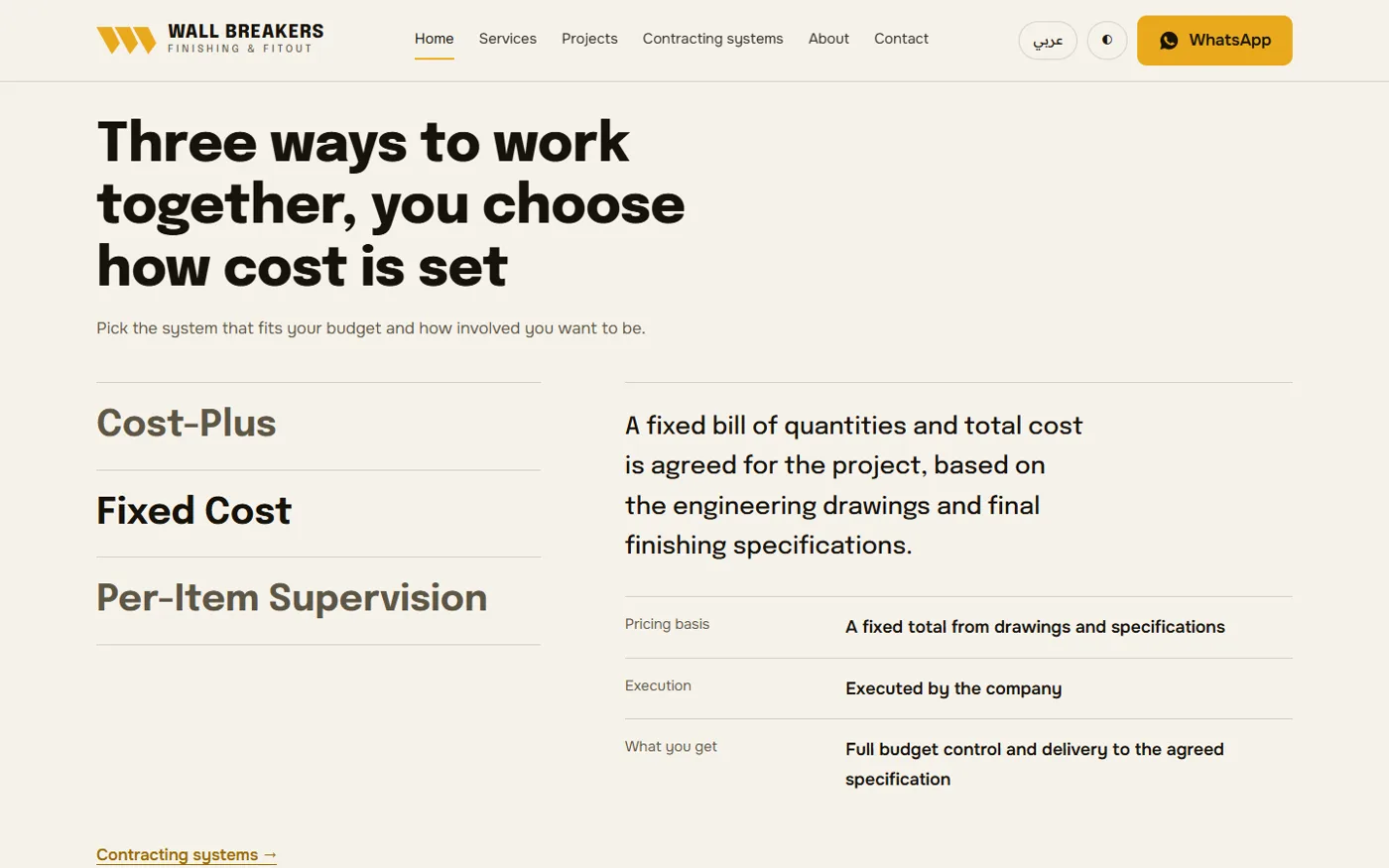
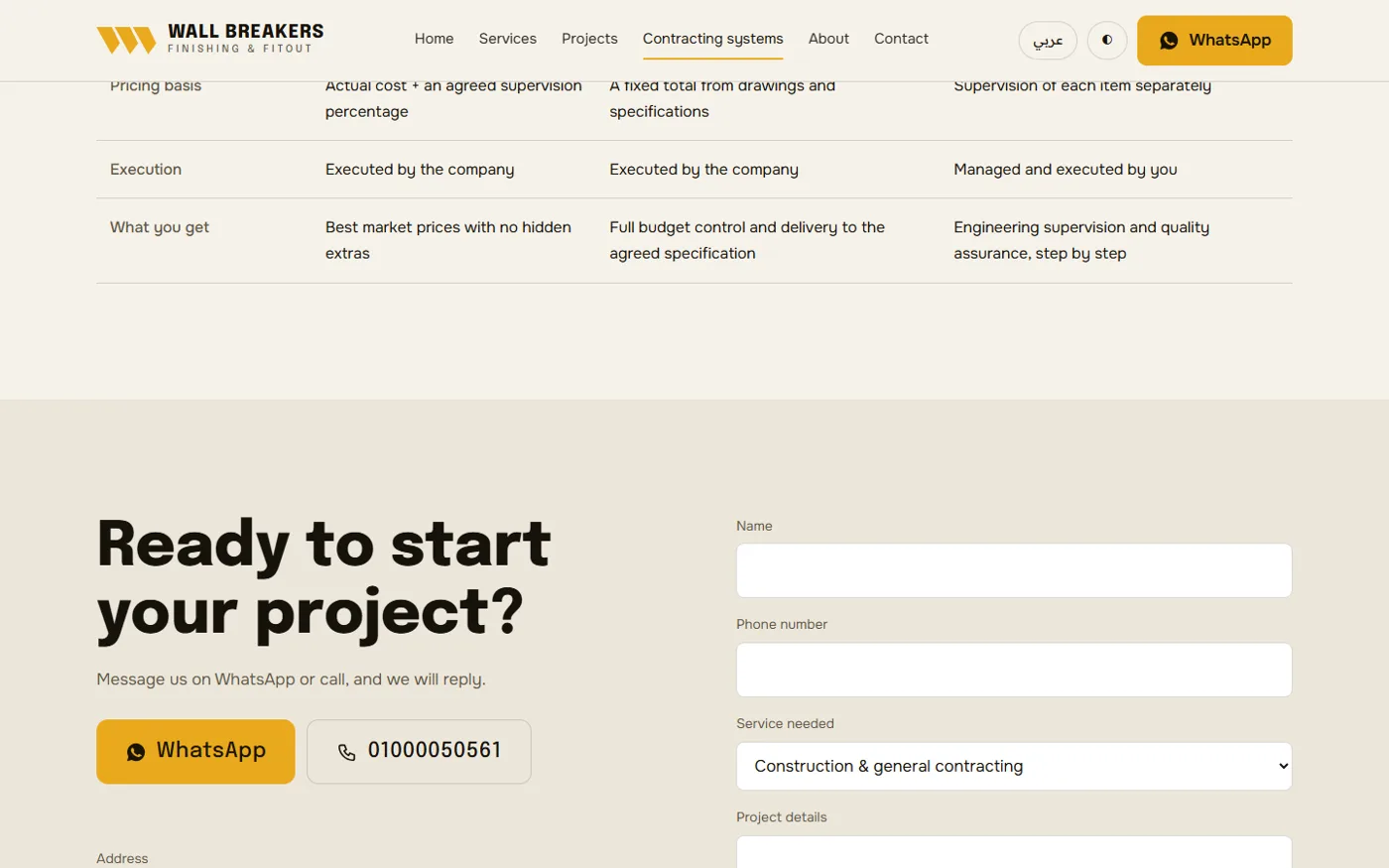
This is the section we most wanted to be clear. Many disputes between owners and contractors start with a misunderstanding about how the price is built. So we gave contracting systems a full page and a homepage section, and wrote each system in the same order: what is the pricing basis, who executes, and what do you get.
Cost-Plus
Works are executed at the actual direct cost of materials, supplies and labour, plus a supervision or management percentage agreed in advance. The company executes, and the client gets price transparency with no hidden extras. The strength is that the owner does not pay a hidden risk margin inside the price. The weakness is that the final total is not known on day one, so it needs a rough estimate and regular review of invoices.
Fixed Cost
A fixed bill of quantities and total cost is agreed from the engineering drawings and final finishing specifications. The company executes, and the client gets full budget control and delivery to the agreed specification. The Egyptian market usually calls this muqatua (lump sum). Its strength is clarity; its condition is that drawings and specifications are settled, and later changes are priced separately.
Per-Item Supervision
For clients who want to manage and execute their own works while benefiting from the company’s engineering and supervision expertise. The owner manages and executes, and the company supervises each item and assures quality step by step. In the local market this is sometimes called bel-band (by item). It suits someone with time and experience who wants technical oversight without handing over the whole project.
Why a comparison table
Because readers compare by instinct. Three rows and three columns are clearer than three paragraphs. We used the company’s own names first (Cost-Plus, Fixed Cost, Per-Item Supervision) and mentioned the market term once so people searching with it still find the answer. We did not state a supervision percentage: it is agreed with each client and it is not ours to invent.
Two languages, two themes, mobile, technical build
Arabic and English written separately
The site has an Arabic version laid out right to left and an English version laid out left to right, with a switch in the header. Each version was written separately, and they are linked with hreflang tags so search engines show each language to the people searching in it. For more on why this matters, see our guide to Arabic website design and RTL localisation (Arabic).
Dark and light themes
A button in the header switches the theme and the site remembers the choice. We tried all four combinations: Arabic dark, Arabic light, English dark and English light, because large images and headlines can look strong in one mode and weak in the other.
Mobile first for contact
Most finishing clients browse on a phone and then tap WhatsApp. So we added a sticky bar at the bottom of the screen with call and WhatsApp, and tested on several common phone widths instead of one.
Technical build and SEO
We promise no first-page rankings; nobody can guarantee them. What we did was remove technical obstacles:
- Static pages that load fast.
- A unique title and description per page, and a clean H1 then H2 heading order.
- Structured data (schema) describing the company as a general contractor with its address.
- hreflang between the Arabic and English versions, and an XML sitemap.
These are basics done once, a necessary condition and not a sufficient one. Real SEO follows launch: regular content, proof of work and client reviews.
The WhatsApp-ready contact form
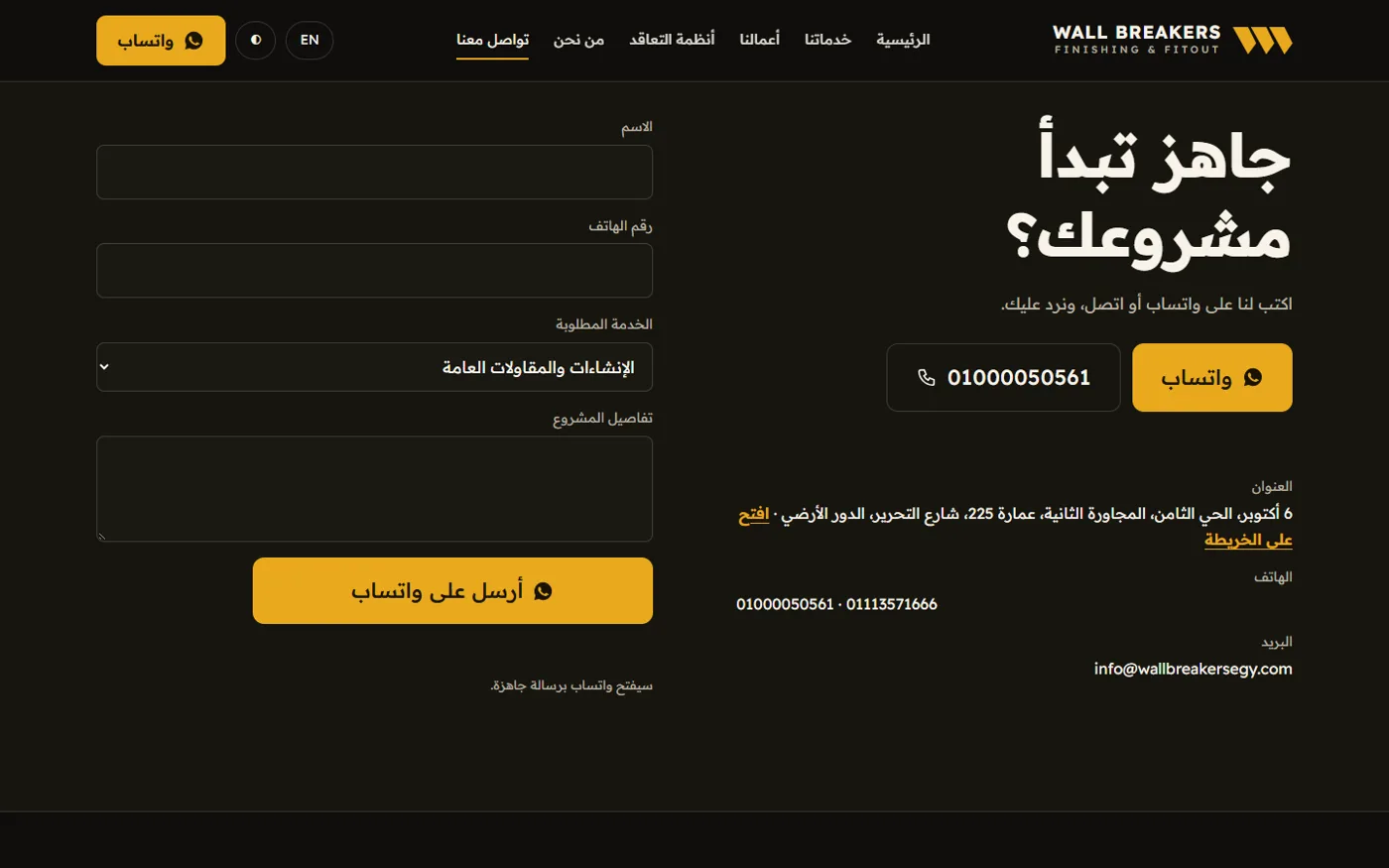
The form asks for name, project type and details (location, area, rough budget), then opens a WhatsApp conversation with the details already written. It saves the team asking “what kind of project and where?” every time, and the client starts the conversation knowing what they want.
What the client got
Here is what the client got, with no invented numbers. The site is newly launched and we have no visit, enquiry or Google ranking data to publish yet; any figure we gave now would be a claim. What we can say is what the company received:
- A website in two languages and two themes that works on phone and desktop.
- A page that explains contracting systems, which sales staff can send to a client instead of explaining on every call.
- Real work shown through a stage tracker and reels.
- A short path from visit to WhatsApp.
- A technical base for appearing in search in Arabic and English.
We will review visit and WhatsApp data after enough time has passed and add the results to this article if they are fit to publish.
Lessons for contractors
If you run a contracting or finishing company and are planning a website, here is the checklist we took from this project:
- Show the transformation, not a logo. Visitors want to see how a raw space becomes a delivered one.
- Explain how you contract. A company that explains cost-plus, lump sum and per-item clearly earns trust before the client calls.
- Separate real from illustrative. If you use generated images, label them. That trust cannot be bought.
- Do not copy certificates and standards. State only what you can document, and never name a standard to decorate a page, especially in medical work.
- Make mobile the base. A fixed contact bar and a visible WhatsApp button.
- Write in your client’s language. Clear Arabic for those who book, English for those who compare.
- Do not publish a price per metre you cannot stand behind. Prices move with materials; an itemised quote after a site visit is better.
- Document work on video. A before-and-after clip from your own site beats any stock image.
- Keep the site alive. Add a new project regularly; fresh content keeps a site useful.
For more on these points read our guides to small business website cost, our Advanced HVAC contracting website case study and our MIS Group case study, where an engineering consultancy got a live BIM model instead of a project film. See more of our work in the PRMAGLY portfolio.
Why we chose this approach at PRMAGLY
We do not reuse templates. In our web design work we start from the client’s real work and ask: what one thing, if the visitor saw it, would convince them? For Wall Breakers the answer was the transformation and the three contracting systems. For another company it would be something entirely different.
There were trade-offs. A project film is heavier visually than a plain gallery, so we put extra effort into keeping it fast on a phone. Illustrative renders do not depict a specific project, so we labelled them clearly. The numbers belong to the company, so we attributed them to it. These choices cost a little “shine” and keep the credibility.
FAQ: turnkey finishing and fit-out in Egypt
What is the difference between cost-plus, fixed cost and per-item supervision contracts?
With cost-plus you pay the actual cost of materials and labour plus a supervision percentage agreed in advance. With fixed cost (often called a lump sum in the Egyptian market, muqatua) you agree one total from the drawings and final specifications. With per-item supervision you manage and execute the works yourself while the contractor supervises each item. The real difference is who carries the risk of price changes and who does the work.
What does turnkey finishing include in Egypt?
Turnkey means the contractor delivers the project ready to live in or operate, so you do not coordinate separate trades. In Wall Breakers’ case the package runs from masonry and plaster, plumbing and electrical first-fix, through floors, doors, cladding, decor and lighting, and can add smart systems and medical or office fit-out depending on the project. Whatever the contractor, get the list of what is in and out of handover written into the contract.
Which contract type is best for finishing an apartment or villa?
If drawings and specifications are final and you want a firm number, fixed cost fits. If specifications may change during works and you want to pay real cost, cost-plus fits. If you have the time and experience to run the trades yourself, per-item supervision fits. No type wins in every case; it depends on how settled the specification is and how involved you want to be.
How much does turnkey apartment finishing cost per square metre in Egypt?
We do not quote a figure. Published per-metre prices vary widely between sources, they change with materials and market conditions, and we do not hold the client’s pricing, so any number from us would be invented. Ask for an itemised bill of quantities after a site visit, and compare two or more quotes on the same specification.
How long does a clinic fit-out take in Egypt?
It depends on floor area, how many rooms need special services, the state of the shell and the approvals involved. We have no schedule from the client to quote, and anyone giving a number before a site visit is guessing. Ask for a phased programme with milestones tied to payments.
What systems go into a medical facility fit-out?
Wall Breakers’ site lists complete operation theatres, X-ray rooms with protection and safety requirements, patient rooms, medical gases, fire fighting, light-current systems, and nurse-call and monitoring. The company describes this work as built to international codes for healthcare facilities. Which specific code applies to your project is a question for the contractor and should be written into the project specification; we do not present any standard as the client’s certification.
What is the difference between Cat A and Cat B fit-out?
In office projects, Cat A usually means the base fit-out of a shell (ceilings, lighting, basic services), while Cat B is the tenant-specific layer (partitions, furniture, branding, IT). Definitions vary between landlords and contractors, so confirm exactly what a given quote means by either term.
Can a space be fitted out while the building stays open?
Sometimes, with phased work, noise and dust control and out-of-hours schedules. It must be agreed before the contract because it affects both programme and cost. Ask the contractor how they would phase it for your building.
Do I need a specialist contractor for medical or office fit-out?
Usually yes when the scope goes beyond paint and flooring: fire-fighting systems, structured cabling, cameras, access control, glass partitions or medical services. These need coordination between several trades, and one responsible party reduces clashes and delays. Ask for similar projects they have completed.
Can smart home systems be installed in an existing home?
It depends on the system. Some devices are wireless and need no wall chasing; others need new cabling. A site visit settles it, so ask the contractor to state what can be done without breaking walls and what cannot, before signing.
Does the per-metre price include furniture?
Not necessarily. Per-metre prices often cover finishing works only, while furniture and loose items are separate. Ask which items are in the rate and put that list in writing.
What should a detailed quotation (bill of quantities) include?
Item-by-item quantities and units, material specifications, the contract type, a programme with milestones, a payment schedule tied to those milestones, how variations are priced and approved, and examples of completed work shown with real photos or video from the contractor’s own sites.
Run a contracting or fit-out company and need a site that shows your work?
Tell us your line of work on WhatsApp and we will tell you where we would start and show similar sites. You can also visit the client’s site to see the result yourself: wallbreakersegy.com.
WhatsApp PRMAGLY: +20 100 693 7070PRMAGLY web designSee our portfolio
خدمات مرتبطة
- تصميم مواقع الشركات في مصر
- إنشاء متجر إلكتروني
- برمجة مواقع وأنظمة خاصة
- ايميل رسمي للشركات
- أتمتة واتساب للشركات
- نظام شركات السياحة