
A custom ERP for small business is a set of connected modules. See which to build first, what drives the cost and where projects go wrong.
- شركة برمجيات مصرية منذ 2010
- دعم فني على واتساب
Custom ERP for Small Business: Cost, Modules, Risks
Which modules to build first, what drives the cost, and where ERP projects go wrong, from a team that builds modular systems for working businesses.
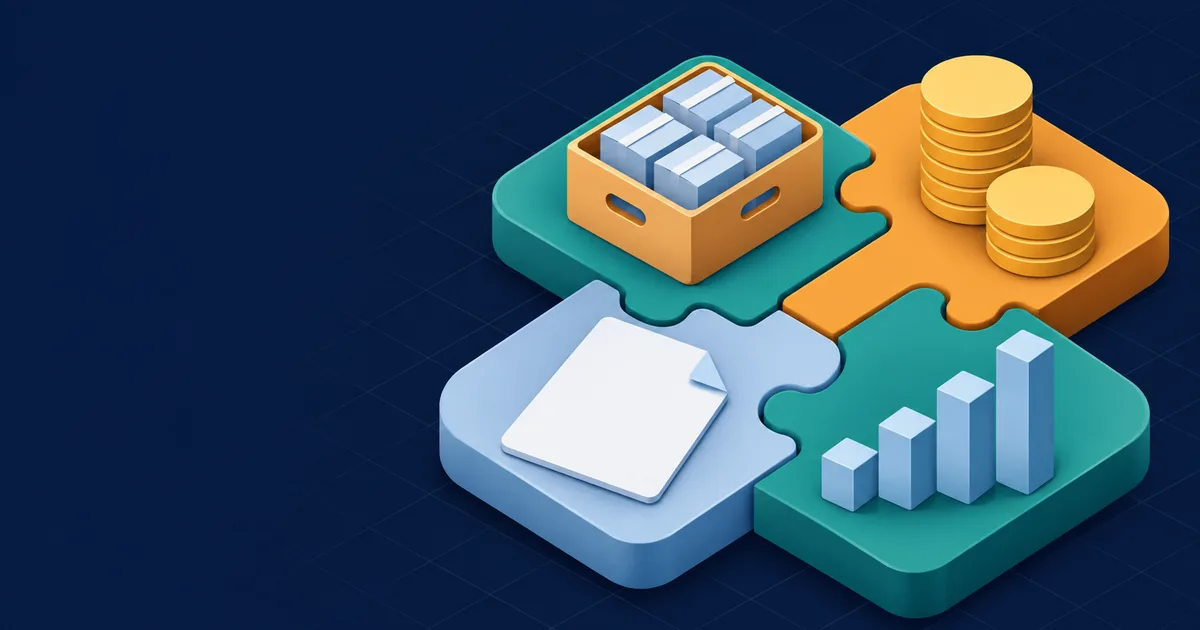
In short: a custom ERP for small business is a set of connected modules, such as stock, sales, cash, suppliers and reports, built around how you work, instead of a large package with every department. Start with the two or three modules that fix your costliest problems and add more later. We do not publish one price, because it depends on modules, roles, reports and connections; we start with a free requirements session and give you a written scope with price and timeline before you commit.
Custom ERP for small business: what it really is
ERP stands for enterprise resource planning. In practice it means one system where stock, sales, purchasing, cash and reports share the same data, instead of living in separate notebooks and spreadsheets. Big packaged ERP suites cover every department. Most small businesses do not need every department on day one, and paying for all of it is where budgets and patience run out.
That is the case for a custom ERP for small business: you build the parts you need now, in the order that hurts most, and connect them so they share one set of records. Each part is a module. When you need another one, you add it.
We want to be precise about what we offer. We build ERP-type modules to order. We do not sell a ready-made ERP package with every department included, and we say so on our own case-study pages.
Which modules to start with
Start from the problem that costs you money today, not from a feature list. This table maps common problems to a first module:
| What goes wrong today | First module | What it records |
|---|---|---|
| Stock counts never match reality | Inventory | Items, quantities, locations, movements; serial numbers where each unit matters. |
| The same item is sold twice, or sold without being paid for | Sales and cash | Invoices, payments, cash drawer, close-of-day reconciliation. |
| You do not know what you owe suppliers | Supplier accounts | Purchases, payments, balances per supplier. |
| Customers buy on installments or credit | Customer accounts | Contracts, down payments, due dates, reminders. |
| Several branches, one owner | Branches and permissions | Separate books per branch, one login per person, a log of changes. |
| The owner asks the same five questions every week | Reports | The five reports, on demand, from the same data. |
Notice that none of these is called “ERP”. The word covers a connected set of small modules, and you can start with two or three.
How much does a custom ERP system cost?
We do not publish one price for a custom ERP, because the price depends on the modules, not on the word. These are the things that move it:
- Number of modules and how many record types each one holds.
- Roles and permissions: one owner login is simple; ten staff roles across branches is not.
- Reports: ten standard reports cost less than ten reports that each need their own logic.
- Connections: payment gateways, WhatsApp, printers, barcode scanners and your accountant’s software.
- Mobile and offline use: a counter that must keep selling when the internet drops is more work than a screen that always has a connection.
- Data migration: moving years of spreadsheets means cleaning them first.
What we do publish is how we start. Our written requirements analysis for a management system starts from 50 USD. The first requirements session is free, and you receive a written outline with screens, price and timeline before you commit. The service is described on our custom systems page.
A rule that keeps the budget safe: agree on three modules, ship them, then decide on the fourth. A plan to build everything in one go ties your money to guesses about next year.
Can I create my own ERP?
You can get a long way with an accounting package plus well-organised spreadsheets, and for a very small business that is a sensible start. The signs that you are outgrowing it:
- Two people edit the same file and one set of changes is lost.
- You keep a second spreadsheet only to check the first.
- Month-end takes days because numbers must be collected from several places.
- You cannot give an employee access to one part without exposing the rest.
When two of these are true every month, a connected system starts to pay for itself in time saved and mistakes avoided.
Why ERP projects struggle, and how to lower the risk
A thread on Reddit asks why so many ERP projects struggle after implementation. We have not tried to measure that, and we do not quote figures. These are the failure points we guard against, because they come up in any systems project:
- Scope too big at the start. The fix is modules, in order of pain.
- No owner on your side. Someone must answer questions within a day and approve screens.
- Dirty data. Duplicates and missing codes in your old files become duplicates and missing codes in the new system. Plan time to clean.
- Staff not involved. The person who uses a screen eight hours a day should see it before it is finished.
- No budget for changes. The first weeks of real use always bring a list of small corrections.
- Connections left to the end. If payments, printers or WhatsApp matter, decide how they connect in the scope, not after.
What we have built in modules
Two systems running today show the module approach. Neither is a complete ERP, and we describe them as what they are.
- A shop system. It combines a cashier that keeps selling offline, an inventory that records each device by its serial number and status, customers and installments with a down payment and a guarantor, separate cash drawers and wallets with reconciliation at shift close, a repair centre that deducts spare parts from stock, several branches under one account, staff permissions and financial reports. Read the business modules case study.
- A freight system for a land shipping company. It numbers waybills automatically with a QR receipt, manages trips and drivers including each driver’s fare, tracks several warehouses and branches, records collection on delivery against each waybill, gives the customer a tracking link, and produces reports with Excel export, with staff permissions and a log of every edit. The company name is not published. See the shipping case study.
The same building blocks (inventory, customer accounts, cash, supplier accounts, permissions, reports) appear in both, arranged for different businesses. That is the practical meaning of modules.
Custom or packaged ERP: a decision table
| Your situation | Lean towards |
|---|---|
| Standard accounting, standard stock, no unusual rules | A packaged tool. It will be cheaper and faster. |
| Your process is unusual (serial-number stock, installments with guarantors, trip and driver accounting) | Custom modules built around it. |
| You need WhatsApp, a local payment method or a specific printer connected | Custom, or a packaged tool plus a custom connection. Ask how each option handles it. |
| You want to be live quickly with few changes | Packaged. |
| You want the system to change as your business changes | Custom. |
If a packaged ERP fits, we will say so in the first session. For the wider question, read our guide on build vs buy software.
Questions we hear
Is this a full ERP?
No. We build the modules your business needs, such as inventory, customers, cash, suppliers and reports, and connect them. We do not offer a packaged ERP with every department.
Can we start with one module?
Yes, and we recommend it. Pick the module for the problem that costs you most, run it for a few weeks, then add the next.
Can it work with our existing Excel files?
Yes. We review your current data, move what is worth keeping and produce Excel exports when you need them.
Tell us which problem costs you most
Send us three lines: what you sell, where the numbers go wrong today and how many branches or staff you have. We reply on WhatsApp with a suggested first module, and the first requirements session is free.
خدمات مرتبطة
- تصميم مواقع الشركات في مصر
- إنشاء متجر إلكتروني
- برمجة مواقع وأنظمة خاصة
- ايميل رسمي للشركات
- أتمتة واتساب للشركات
- نظام شركات السياحة